
Table of Contents
ChatGPT vs Claude for Proposal Writing: Which Is Better
Both ChatGPT and Claude can draft a usable proposal from a good prompt, and both fall short of a finished, client ready document on their own. The differences that actually matter for proposal writing show up in how each one handles a long, detailed brief, how closely it follows a specific structure, and how it behaves when you ask it to hold a consistent tone across several sections. This comparison focuses on those differences rather than a generic feature list.
How We Are Comparing These Two
Four things matter most for proposal writing specifically: how closely the model follows a detailed structural brief, how consistent the tone stays across a long document, how it handles being fed a lot of background context at once, and how often it needs a second pass to fix generic phrasing.
| What to judge | Why it matters for a proposal |
|---|---|
| Instruction following | A proposal brief usually has several specific requirements at once, sections, tone, pricing format, and a model that drops one of them creates rework. |
| Tone consistency | A proposal that starts formal and drifts casual by the final section reads as unedited, and that is a fast way to lose a client’s confidence. |
| Handling long context | Feeding in a full client brief, a past proposal, and pricing details at once tests how well a model keeps track of everything without losing the thread. |
| Editing effort afterwards | The real time saved is measured by how much rewriting the draft needs, not how fast the first version appears. |
For a wider view of the category beyond model choice, the guide to AI proposal generators covers tools built specifically around this workflow rather than a general chat window.
Where ChatGPT Tends to Do Well
ChatGPT is generally strong at producing a fast, well organised first draft from a short prompt, and it tends to default to a confident, sales friendly tone without much extra instruction, which suits a straightforward proposal well.
For a fairly standard proposal, brief scope, clear pricing, a familiar structure, ChatGPT usually gets close to a usable draft on the first attempt with a moderate amount of prompting. It responds well to being told to shorten, lengthen, or adjust formality, which makes iterating on tone reasonably quick once the first draft is on the table.
Where Claude Tends to Do Well
Claude tends to hold a longer, more detailed brief together more reliably, and it is generally more consistent at sticking to a specific structure across a long document rather than drifting from the instructions partway through.
If your proposal brief is long, with a lot of background detail, a past proposal to match tone against, and several specific sections that all need to appear in a particular order, Claude tends to keep track of all of it more reliably across a longer output. It also tends to be more consistent about maintaining a specified tone from the first section to the last, rather than the tone gradually shifting as the document goes on.
Head to Head on the Things That Matter for Proposals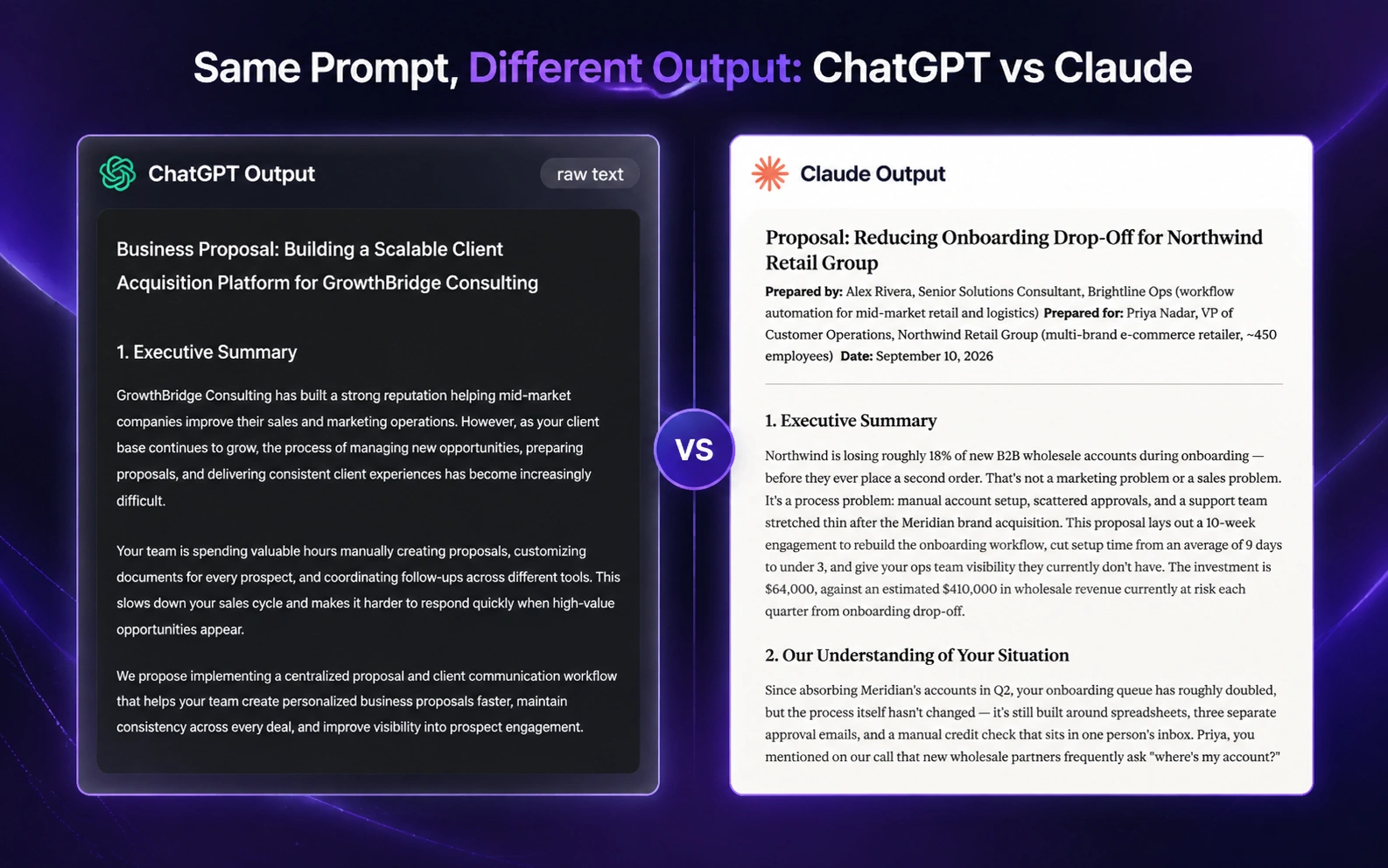
Neither model is categorically better across every dimension. ChatGPT tends to edge ahead on quick, simple drafts. Claude tends to edge ahead on longer, more detailed briefs where structure has to hold across many sections.
| Dimension | ChatGPT | Claude |
|---|---|---|
| Short, simple proposal from a brief prompt | Generally fast and usable with light editing | Also solid, though the speed advantage is less noticeable |
| Long brief with detailed background | Can lose track of smaller requirements in a very long prompt | Tends to hold onto detail more reliably across a long input |
| Consistent tone across many sections | Can drift toward generic phrasing in later sections | Tends to stay closer to the specified tone throughout |
| Following a strict section by section structure | Generally good, occasional reordering on complex briefs | Generally very consistent about following the structure given |
| Speed of a first usable draft | Typically faster to a first pass | Comparable, sometimes slightly more deliberate |
Which One Should You Use for Proposal Writing
For a short, standard proposal, either model works well and the choice matters less. For a long, detailed brief with several specific requirements to track, Claude has a practical edge. The bigger factor either way is how specific your prompt is, not which model you pick.
| Your situation | Better starting point |
|---|---|
| A short, standard proposal with a clear scope | Either model, the choice matters less here |
| A long brief with a lot of background detail to track | Claude |
| You need the fastest possible first pass | ChatGPT |
| Several past proposals to match tone against | Claude |
| A one off proposal with no real complexity | Either model, the choice matters less here |
If you already have a workflow with one of these tools, the case for switching purely for proposal writing is weak, the gap between them is smaller than the gap between a specific prompt and a vague one. Ready made prompt structures exist for both: ChatGPT prompts for proposal writing walks through one set of templates worth adapting.
Claude prompts for proposal writing covers a second set, since the two models respond a little differently to the same brief and are worth testing before you judge either one on a genuinely difficult proposal.
Whichever model you land on, you still need somewhere to create and send proposals once the draft is done, that step does not go away regardless of prompt quality.
Where Neither Model Gets You the Whole Way
Neither ChatGPT nor Claude applies your branding, sends the document, tracks whether a client opened it, or collects a signature. Both stop at the writing step, and everything after that is still manual unless you are using a tool built to handle it.
This is true regardless of which model wins the comparison above. The writing takes a minute either way, formatting, branding, sending, tracking, and signing take the rest of the evening. This breakdown of what a dedicated proposal tool handles that a chat window does not covers that gap in full.
That includes what changes when the draft is generated inside a document platform that already knows your brand rather than a general chat window.
Final Word
Neither model is the clear winner across every scenario. ChatGPT tends to suit fast, simple drafts, Claude tends to suit long and detailed ones, and for most proposals the quality of your prompt matters more than which one you picked. What both leave unsolved is everything after the writing: branding the draft, sending it as something trackable, and getting it signed without a separate tool. That gap is worth planning for regardless of which model you settle on.
Frequently Asked Questions
Is ChatGPT or Claude better for writing proposals?
Neither is categorically better. ChatGPT tends to produce a fast, usable draft for short, standard proposals. Claude tends to hold together more reliably on long, detailed briefs with several specific requirements. The gap between them is smaller than the gap between a specific prompt and a vague one.
Does Claude handle long client briefs better than ChatGPT?
Generally yes, Claude tends to keep track of detail more reliably across a long, information dense prompt, which matters most when you are feeding in a full brief, a past proposal for tone, and detailed pricing all at once.
Which model is faster for a first draft?
ChatGPT is typically a little faster to a usable first pass on straightforward proposals. The difference narrows on longer, more complex briefs.
Can either ChatGPT or Claude send or track a proposal after writing it?
No. Both stop at the writing step. Sending, tracking whether a client opened the document, and collecting a signature all require a separate step or a dedicated document platform.
Do I need to switch models if I am already using one of them for proposals?
Not necessarily. If your current model is producing usable drafts with a specific prompt, the practical gain from switching is smaller than the gain from tightening the prompt itself.

Ronak Surti

 Ronak Surti