
Table of Contents
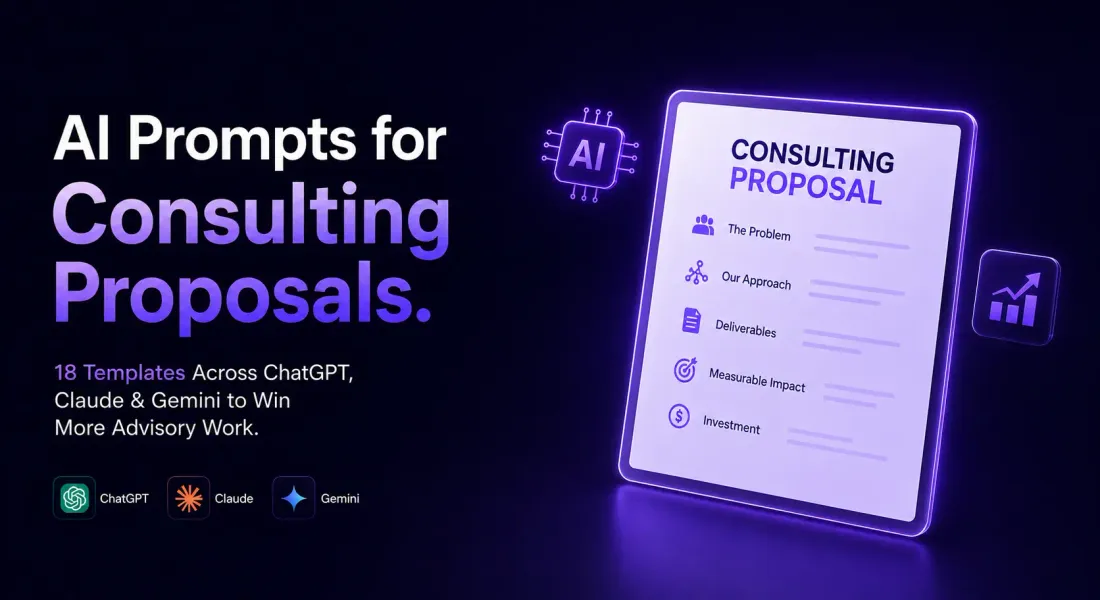
AI prompts for Consulting Proposal: 18 Templates Across ChatGPT, Claude And Gemini
A consulting proposal sells something the client cannot pick up and hold. There is no product to point at, only a promise that your thinking will move their numbers. That makes it the hardest document in professional services to get right. Price it too vaguely and the buyer cannot tell what they are paying for. Scope it too loosely and you are doing unbilled work by the second month. Lean too hard on your logos and credentials and you read like every other firm on the shortlist. The proposals that actually win describe the client’s problem more precisely than the client managed to, then draw a straight line from that problem to a result someone can measure.
The 18 templates below are split six each across ChatGPT, Claude and Gemini, and every one is built for a real moment in a consulting sale. The ChatGPT set drafts full proposals, paid diagnostics and value-based fee structures. The Claude set works through long discovery notes, methodology sections and the assumptions that keep a fixed fee from quietly becoming a loss. The Gemini set researches the client’s market, benchmarks comparable engagements and grounds your recommendations in evidence the buyer will already recognise.
Why AI Works Well For Consulting Proposals
A consulting proposal follows a recognisable shape even when every engagement is one of a kind: the problem, your read on it, the approach, the team, the fee, and the outcome you are willing to be held to. Models hold that shape reliably when the brief is sharp. Hand one a precise problem statement and it keeps the structure steady while you supply the judgement that no model can.
Each Model Has A Different Edge
ChatGPT is the quickest at turning a rough brief into a polished draft. Claude stays coherent across long discovery notes and detailed methodology without losing the thread. Gemini is the one to reach for when you need to understand the client’s industry before you write a single line.
Name The Problem Better Than The Client Did
A buyer hires the firm that describes their situation most accurately. Every template here asks the model to sharpen the problem statement before anything else, because that precision is what separates a proposal from a brochure.
Tie The Fee To A Result, Not An Activity
Clients resist paying for hours and pay willingly for outcomes. These templates push the model to connect each phase to something the client can measure, so the price reads as an investment rather than a meter ticking over.
Show The Method, Not Just The Promise
Anyone can promise insight. The proposals that close explain how the insight gets made. The prompts ask for a visible method so the buyer trusts the thinking behind the number on the last page.
ChatGPT prompts For Consulting Proposals
ChatGPT is the flexible drafter of the three. It is happiest taking a half-formed brief and returning a structured, readable proposal you can refine. The six templates below cover the situations independent consultants and advisory firms meet most often, from a full proposal to a single executive summary, so you can start from the closest match rather than a blank page.
1. Full Consulting Proposal From Scratch
Act as a senior consultant writing a proposal to win a new
advisory engagement.

Context:
- My practice: [name and the problem you solve]
- Client: [name, industry, size]
- Their core problem: [what is actually going wrong]
- The outcome they want: [what success looks like to them]
- Engagement length: [target timeframe]
- Fee range I have in mind: [figure or band]
- My relevant proof: [a comparable result]

Write a complete consulting proposal with these sections:
1. The problem, restated more precisely than they did
2. Why it matters now (cost of inaction)
3. My approach, in clear phases
4. Deliverables per phase, each with a measurable output
5. The result I will be accountable for
6. Team and who does what
7. Assumptions and what I need from them
8. Fee and what it includes
9. Next step

Rules:
- Lead with their problem, not my credentials.
- Make every deliverable something a stranger could verify.
- Plain language. No consulting jargon.
- Around 900 words.
Where it works best: ChatGPT returns a complete, well-ordered first draft that already frames the problem before the pitch. It is the fastest route from a verbal agreement to a document you can edit.
Best for: A first full proposal when the scope is broadly agreed and you need it written down today.
2. Paid Diagnostic That Leads To A Larger Engagement
Act as a consultant pitching a short, paid diagnostic that is
designed to scope and de-risk a bigger piece of work.

Context:
- Diagnostic scope: [what you will assess]
- Duration: [usually 2-4 weeks]
- What the client gets at the end: [findings, a plan]
- The larger engagement this could open: [scope and value]
- Diagnostic fee: [figure]

Write a diagnostic proposal that:
1. Names the question the diagnostic will answer
2. Lists exactly what you will examine (and what you will not)
3. Describes the deliverable and its format
4. States the decision the client can make once they have it
5. Explains how the diagnostic credits towards the full project
6. Gives a clean way to stop after the diagnostic, no pressure

Rules:
- Make the diagnostic valuable on its own, not a sales call.
- Be explicit that the client is free to walk after it.
- Around 500 words.
Where it works best: ChatGPT keeps the diagnostic feeling like genuine value rather than a thinly veiled sales step, which is what makes buyers say yes to it.
Best for: Cautious clients who will not commit to a large engagement before they trust you.
3. Value-Based Fee Proposal
Act as a consultant who prices on outcomes, not on hours.

Context:
- The result the client wants: [specific outcome]
- What that result is worth to them: [revenue, cost, risk]
- My three options idea: [good / better / best]
- The constraint that usually drives their decision: [time,
  budget, certainty]

Write the fee section of a consulting proposal that:
1. Anchors the price to the value of the outcome, not effort
2. Presents three options at different scopes and prices
3. Makes the middle option the obvious recommendation
4. Explains plainly what changes between the tiers
5. Avoids any reference to hourly or day rates

Rules:
- Each tier must map to a different level of outcome.
- No padding. Every line of a tier should earn its place.
- Keep it to one page.
Where it works best: ChatGPT structures tiered, outcome-anchored pricing cleanly and resists drifting back into a timesheet mindset once you tell it not to.
Best for: Engagements where the value to the client is far larger than the hours involved.
4. Proposal For A Client Burned By A Previous Consultant
Act as a consultant writing for a buyer who hired an advisor
before and felt they got slides, not change.

Context:
- The engagement: [what you are proposing]
- Why they were disappointed last time: [no follow-through,
  generic advice, no measurable result]
- What you do differently: [specific operational choices]
- The proof you actually deliver: [evidence]

Write a proposal that rebuilds trust:
1. Acknowledge the gap between advice and change, neutrally
2. Spell out how your engagement ends in implementation,
   not a report
3. Name the checkpoints where they can judge progress early
4. Standard sections: problem, approach, fee, outcome
5. A short list of what would make you wrong (your assumptions)

Rules:
- Never criticise the previous consultant.
- Replace vague reassurance with specific commitments.
- Confident, grounded tone.
Where it works best: ChatGPT writes credible trust-rebuilding language without tipping into defensiveness or overselling.
Best for: Buyers who open the conversation by telling you consulting has let them down before.
5. Approach And Methodology Section On Its Own
Act as a consultant writing the methodology section that
shows the buyer how the result actually gets made.

Context:
- The problem: [what you are solving]
- Your phases: [list them, even roughly]
- The single hardest part of the work: [where it usually
  goes wrong]

Write a methodology section that:
- Describes each phase, its purpose and its output
- Shows how each phase feeds the next
- Names what the client does at each stage, not just you
- Makes the hardest part visible and explains how you handle it

Rules:
- Concrete steps, not a generic four-box framework.
- Every phase ends in something the client can see.
Where it works best: ChatGPT turns a list of phases into a method that reads as deliberate, which is what justifies the fee.
Best for: Proposals where the buyer is weighing your thinking against a cheaper, vaguer competitor.
6. Executive Summary That Earns The Next Page
Act as a consultant writing the opening summary of a proposal
for an executive who will decide whether to keep reading.

Context:
- Client problem: [one sentence]
- Your recommended approach: [one sentence]
- The outcome and rough value: [one sentence]
- The fee: [figure]

Write an executive summary, no more than 150 words, that:
- Opens on their problem, not your firm
- States the result before the method
- Makes the fee feel small next to the outcome
- Ends on a single clear next step

Rule: a busy reader should grasp the whole offer from this
alone.
Where it works best: ChatGPT is reliably good at compressing an offer into a tight, lead-with-the-outcome opener.
Best for: Long proposals that need a front page strong enough to survive a skim from the decision-maker.
Claude prompts For Consulting Proposals
Claude earns its place on the long, careful work. It holds attention across pages of discovery notes, keeps a detailed scope internally consistent, and is the model least likely to drop an assumption halfway through. Use these six when the input is messy or the stakes sit in the fine print.
7. Turn Discovery Call Notes Into A Proposal
Act as a consultant turning raw discovery notes into a
structured proposal.

Below are my unedited notes from the discovery call. Read all
of them before writing.

[paste full notes here]

From these notes:
1. State the client's real problem in two sentences
2. List what they said they want, separated from what you
   inferred they need
3. Draft a proposal: problem, approach, phases, deliverables,
   outcome, fee, next step
4. Flag anything in the notes that is ambiguous and needs
   confirming before you send

Rules:
- Do not invent facts the notes do not support.
- Mark every assumption clearly as an assumption.
Where it works best: Claude reads long, messy notes faithfully and keeps the distinction between what the client said and what you are assuming, which matters when scope is on the line.
Best for: The morning after a long discovery call, when the notes are dense and you want a draft before the detail fades.
8. Detailed Scope With In And Out Boundaries
Act as a consultant writing the scope section so tightly that
no reasonable reader could disagree about what is included.

Context:
- The engagement: [what you are delivering]
- Phases: [list]
- The grey areas clients usually push on: [list them]

Write a scope section with three parts:
1. In scope: every deliverable, specific enough to verify
2. Out of scope: the adjacent work people assume is included
   but is not
3. Assumptions: what must be true for the fee and timeline to
   hold

Then write one paragraph on how out-of-scope requests are
handled (a simple change process), with no mention of legal
enforceability.

Rule: the out-of-scope list is as important as the in-scope
list. Do not leave it thin.
Where it works best: Claude is the most disciplined at holding a long in and out list consistent, so the boundaries do not contradict each other three pages apart.
Best for: Fixed-fee engagements where unmanaged scope is the difference between profit and loss.
9. Methodology Deep-Dive With Phase-By-Phase Logic
Act as a consultant explaining your method in enough depth
that a sceptical technical buyer would trust it.

Context:
- Problem: [what you are solving]
- Phases and their order: [list]
- Why this order and not another: [your reasoning]

For each phase, write:
- What you do and why it comes where it does
- The input it needs and the output it produces
- How you would know the phase succeeded before moving on

Close with a short note on what you would change if the work
revealed your initial read was wrong.

Rules:
- Show cause and effect between phases.
- No generic frameworks. This must read as your method.
Where it works best: Claude sustains the reasoning across every phase without the logic thinning out towards the end, which cheaper drafts tend to do.
Best for: Technically literate buyers who judge consultants on how they think, not how they present.
10. Risk, Dependency And Assumption Register
Act as a consultant adding the section most proposals leave
out: an honest read on what could go wrong.

Context:
- The engagement: [summary]
- What you depend on from the client: [access, data, decisions]
- The thing most likely to derail this: [be honest]

Produce three short lists:
1. Risks, each with likelihood, impact and your mitigation
2. Dependencies, each with who owns it and by when
3. Assumptions, each phrased as a condition for success

Rule: surfacing risk should build confidence, not undermine
it. Keep the tone steady and practical.
Where it works best: Claude produces a measured risk section that reads as competence rather than hedging, and keeps the three lists from blurring into one.
Best for: Larger or politically sensitive engagements where the buyer needs to see you have thought past the sales pitch.
11. Restructure A Bloated Draft Into A Tight Proposal
Act as an editor cutting a long, repetitive consulting
proposal down to its strongest version.

Here is the current draft:

[paste the draft]

Do the following:
1. Cut repetition and filler without losing substance
2. Move the outcome and problem to the front
3. Demote credentials to a short, supporting position
4. Flag any claim that is vague or unmeasurable
5. Return the tightened proposal, then a two-line note on
   what you removed and why

Rule: keep my voice. Make it shorter and sharper, not
blander.
Where it works best: Claude edits long documents without flattening the author’s voice, and explains its cuts so you can overrule them.
Best for: A proposal that grew through too many revisions and now buries its own argument.
12. One Proposal, Three Stakeholder Versions
Act as a consultant adapting a single proposal for three
people who will read it differently.

Here is the core proposal:

[paste it]

Produce three tailored summary pages:
- For the chief executive: outcome, strategic fit, risk
- For the finance lead: fee, value, payment, certainty
- For the operational owner: scope, time commitment, what
  their team has to do

Rules:
- Same facts, three lenses. Do not contradict yourself.
- Each version is half a page at most.
Where it works best: Claude keeps the underlying facts consistent across all three versions while genuinely reframing each for its reader.
Best for: Complex sales where several people with different priorities have to agree before you are hired.
Gemini prompts For Consulting Proposals
Gemini is the research engine. When a proposal needs to prove you understand the client’s market before you ever mention your fee, these six templates pull the context, benchmarks and evidence that make your recommendations land as informed rather than generic.
13. Research The Client’s Industry Before You Scope
Act as a research analyst briefing a consultant before they
write a proposal.

Client: [name and industry]
Their likely problem: [your hypothesis]

Research and summarise:
1. The three pressures shaping this industry right now
2. How a company like this typically makes the kind of
   decision I am proposing to help with
3. The language and priorities decision-makers in this sector
   use
4. One thing an outsider often gets wrong about this industry

Rules:
- Cite where each point comes from.
- Flag anything you are unsure of rather than guessing.
Where it works best: Gemini pulls current industry context and surfaces the vocabulary the buyer uses, so your proposal sounds like an insider rather than a tourist.
Best for: Pitching into a sector you know less well than you would like to admit.
14. Benchmark Fees And Engagement Length
Act as a research analyst helping me sanity-check pricing.

Engagement: [type of consulting work]
Region: [where the client is]
Client size: [revenue or headcount band]

Research and report:
1. The typical fee range for this kind of engagement
2. The usual duration and how work like this is normally
   structured (fixed, phased, retained)
3. What buyers at this size expect to be included as standard
4. Where my proposed fee would sit: low, mid or premium

Rules:
- Give ranges, not false precision.
- Note where sources disagree.
Where it works best: Gemini gathers comparable pricing signals and gives you a defensible sense of where your number sits before you commit it to the page.
Best for: Setting or defending a fee when you are not sure whether you are under-pricing the work.
15. Build The Evidence Base For Your Recommendations
Act as a research analyst assembling support for the advice
in my proposal.

My recommendation: [what you are advising the client to do]
Their context: [industry and situation]

Find and summarise:
1. Evidence that this kind of approach tends to work in this
   context
2. The conditions under which it works and where it does not
3. Two or three credible references I could cite

Rules:
- Do not invent statistics. If a figure is not well sourced,
  leave it out and say so.
- Prefer primary or reputable neutral sources.
Where it works best: Gemini finds and organises supporting evidence while flagging weak sources, which keeps your proposal credible rather than confidently wrong.
Best for: Recommendations a buyer will want to defend to a board or a sceptical colleague.
16. Map Competitive Pressure Into The Problem Statement
Act as a research analyst sharpening my problem statement
with outside context.

Client: [name and what they do]
My draft problem statement: [paste it]

Research the client's competitive landscape, then:
1. Identify the pressure their competitors are putting on them
2. Rewrite my problem statement so it reflects that pressure
3. Note the cost to the client of not acting now

Rules:
- Keep the rewrite to three sentences.
- Ground every claim in something you can point to.
Where it works best: Gemini connects external competitive context to your framing, so the problem feels urgent and specific rather than abstract.
Best for: Proposals where the client already knows they have a problem but has not felt the urgency yet.
17. Surface Regulatory Or Market Context
Act as a research analyst checking for context that should
shape my proposal.

Client: [industry and region]
Engagement: [what you are proposing]

Research and summarise:
1. Any regulatory, compliance or market shift that affects
   this work in the next 12 months
2. How it changes what the client should prioritise
3. How I should reference it in the proposal without
   overstating it

Rules:
- Distinguish confirmed changes from speculation.
- Cite sources and dates.
Where it works best: Gemini catches the market or regulatory shifts that make a proposal feel current, and tells you how confident to be about each.
Best for: Sectors where timing and external change are part of why the client needs help now.
18. Find The Business Case The Buyer Needs Internally
Act as a research analyst helping me arm my buyer to sell
this engagement inside their own organisation.

Client: [name and industry]
Engagement and expected outcome: [summary]
Who my buyer has to convince internally: [role]

Research and draft:
1. The argument my buyer would make to that internal audience
2. The two or three numbers or references that strengthen it
3. The objection that audience is most likely to raise, and
   the answer to it

Rules:
- Make it something my buyer could paste into an email.
- No unverified figures.
Where it works best: Gemini builds the internal case your champion needs, grounded in researched context, so the deal does not stall once it leaves the room you are in.
Best for: Engagements that need sign-off from someone you will never get to pitch directly.
How To Get More From Each Prompt
A template, even a polished executive consulting pitch deck, is a starting point, not the finished proposal. A few habits pull far more value out of every prompt above, whichever model you are using, and they apply equally to any AI prompt to write a consulting proposal you save for yourself later.
Argue With The First Draft
The first reply is raw material. Tell the model where it is vague, push back on a soft fee section, ask it to make a deliverable measurable. Each round of pushback tightens the document.
Stack The Prompts In Sequence
Feed one output into the next. A research prompt grounds the problem statement, the problem statement feeds the full draft, the draft feeds a stakeholder version. The proposal compounds.
Bank The Versions That Win Work
When a proposal converts, keep it with a short note on why it landed. Over a year you build a personal library of openings, scope language and fee structures that beat writing from scratch.
From Prompt To Branded Consulting Proposal
A model gives you words. It does not give you a branded consulting proposal your client opens, or any way to know whether they read past the fee. That last stretch, putting your brand on the document, sending it and following up at the right moment, is usually where the days disappear.
This is where Proposal.biz fits in.
Pull Your Brand From Your Website
Paste your website address and your logo, colours, services and case studies populate a Smart Content Library, so every proposal looks like yours without manual formatting.
Generate The Branded Proposal From A Prompt
Describe the engagement and it produces a fully branded consulting proposal, ready to refine in the editor rather than rebuilt slide by slide.
Send A Link You Can Track
Instead of a flat attachment, you send a shareable link and see views and time spent, so you know when the buyer is actually looking and when to follow up.
The simplest workflow is to draft with whichever prompt above fits the situation, then move the copy into Proposal.biz to brand, send and track it. You keep the writing speed of the model and add the document layer that closes the loop with the client.
Prefer to stay in your AI chat?
Proposal.biz connects to Claude and ChatGPT, and to any MCP-compatible AI tool. Connect your account once, ask for the consulting proposal, and a link to the finished, branded document comes back in your chat. See how to connect Proposal.biz to your AI assistant.
Final Word
A consulting proposal is the document a client returns to whenever the engagement gets uncomfortable, alongside the consulting agreement that formalises it. Make it specific enough to answer their questions without a phone call. The discipline lives in the parts most drafts rush: a problem stated more precisely than the client could, a fee tied to a result, and a method that shows your thinking. Get those right and the rest of the sale gets easier.
A prompt hands you the words. Proposal.biz hands you a branded, sent and trackable consulting proposal in about 60 seconds, then tells you when the client opened it. If that is the part that slows you down, start your free trial and see the difference on your next pitch.
Frequently Asked Questions
What is the best AI prompt for consulting proposal writing?
There is no single best one. The strongest result depends on where you are in the sale and which model you reach for. For a first full draft after a verbal agreement, the from-scratch ChatGPT template works well. For a tightly scoped, dispute-proof document, the Claude scope and methodology templates hold up best. For a pitch into an industry you are still learning, the Gemini research templates are the right place to begin. Treat any AI prompt to write a consulting proposal as a frame you adapt, not a button you press.
Which AI tool is best for writing a consulting proposal?
Each has a clear strength. ChatGPT is the most flexible for turning a brief into a polished draft quickly. Claude is the most reliable across long discovery notes, detailed scope and assumptions that need to stay consistent. Gemini is the strongest when you need to research the client’s market and benchmark your fee before you write. Most experienced consultants use all three, one to research, one to draft, one to tighten.
How do I stop a fixed-fee consulting proposal from turning into unpaid work?
Write the out-of-scope list as carefully as the in-scope list, and name the assumptions the fee depends on. The dedicated scope template in this guide does exactly that, separating what is included from the adjacent work clients tend to assume is free, then adding a simple paragraph on how new requests are handled. The boundary you write before signing is what protects your margin once the work is underway.
Can I reuse these prompts across different industries and engagement sizes?
Yes. The structure of a consulting proposal holds whether you are advising a startup or a large enterprise. The variables that change, the problem, the fee band, the client’s vocabulary, all live in the bracketed inputs, so you swap those and keep the frame. For an unfamiliar sector, run the Gemini industry research template first so the language and priorities match the buyer.
How do I turn the AI output into a branded consulting proposal?
A model gives you the words, not a branded document or a way to know whether the client read it. Tools like Proposal.biz close that gap: paste your website address to pull your brand into a Smart Content Library, generate a fully branded consulting proposal from a prompt, then send a shareable link and track views and time spent. When the client signs, you see the signed status and date and both parties get a confirmation email.

Ronak Surti
 Ronak Surti