
Table of Contents
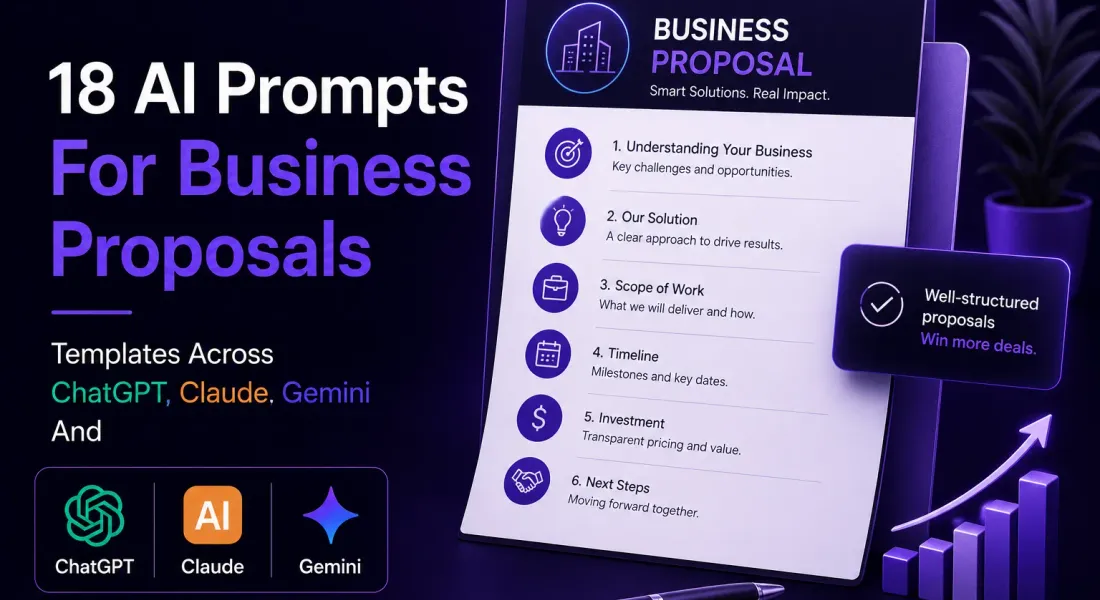
AI Prompts for Business Proposal: 18 Templates Across ChatGPT, Claude And Gemini
Most business proposals are too long, structured the same way, and too cautious. The buyer reads the first page, scans the pricing, and decides whether to read the rest. Everything between those two moments either earns the meeting or wastes the buyer’s time. The proposals that get signed are the ones where every section answers a real question the buyer is already asking.
A useful AI prompt for business proposal writing has to feed the model enough context to ask those questions on the buyer’s behalf, then answer them cleanly. The 18 templates below, six each for ChatGPT, Claude and Gemini, do exactly that. ChatGPT handles fast first drafts and tone iteration. Claude turns long discovery notes and formal RFPs into precise documents. Gemini grounds the pitch in current market data and competitor research.
For additional ChatGPT templates covering executive summaries, risk assessments, and budget breakdowns, our ChatGPT prompts for proposal writing guide covers ten more use cases.
Why AI Works Well For Business Proposals
A business proposal follows a clear structure: situation, solution, scope, timeline, investment, next step. AI handles structured business writing well when you give it the right brief. A strong, structured prompt delivers a usable draft in one pass.
If the deal requires a detailed scope and delivery plan rather than a general pitch, our AI prompts for project proposal writing guide covers 18 templates built for phased, milestone-driven engagements.
Each Model Plays A Different Role
ChatGPT is the most flexible for general drafting and quick rewrites. Claude is best when the input is long, like a transcript or RFP. Gemini wins when you need live research about the prospect.
Context Beats Cleverness
Give the model the client’s industry, role, problem, the cost of staying as they are, and what they have tried. Every template below is built around that structure because that is what produces specific, credible proposals.
Pricing Needs Framing, Not Just Numbers
Frame pricing as an investment against the value delivered. The prompts here ask the model to attach a value statement to each tier rather than dropping in a bare table.
Always Plan For Iteration
The first reply is a draft. Iterate on the executive summary, push back on weak sections, and ask for tone variations until the proposal sounds like you.
ChatGPT Prompts For Business Proposals
ChatGPT is the flexible workhorse for business proposal drafting. It handles complete proposals, tone iteration and quick section rewrites. These six ChatGPT prompts for business proposal writing cover the situations sales teams, consultants and founders face every week. Each ChatGPT prompt for business proposal below is built around a specific scenario, so you can pick the right ChatGPT prompt for business proposal for the job rather than starting from a blank page.
1. Full Business Proposal From Scratch
Act as an experienced B2B proposal writer with 15 years of
experience closing deals in [your industry].

Context:
- Our company: [name and one-line description]
- What we sell: [product or service]
- Prospect: [client name, industry, company size]
- Their main problem: [the pain point they want solved]
- Why they are looking now: [trigger event, if known]
- What success looks like for them: [their desired outcome]
- Our edge over alternatives: [one or two genuine differentiators]

Write a complete business proposal with:
1. Executive summary
2. Our understanding of their situation
3. Proposed solution, in plain terms
4. Scope of work in clear phases
5. Timeline with rough milestones
6. Investment, framed against the value delivered
7. Why us
8. Clear next step

Rules: lead with their problem, not our company. Keep every claim
realistic and specific. Plain language. Around 900 words.
Where it works best: ChatGPT produces a complete, well-ordered first draft and is easy to iterate with on individual sections. This is the ChatGPT prompt for business proposal most teams reach for first.
Best for: A first full draft when you have the basics but no template to start from.
2. Short-Form Proposal For Small Deals
Act as a sales lead writing a tight, one-page proposal for a
small deal where a full document would be overkill.

Context:
- Client: [name]
- The deal: [what you are proposing in one line]
- Total value: [under £25k or equivalent]
- Their pain point: [one sentence]
- The proof you have: [one customer outcome]

Write a one-page proposal.

Structure:
1. The situation in two sentences
2. What we will do (3-5 bullets)
3. What you get at the end (the deliverable, clearly defined)
4. Timeline in one line
5. Investment in one line
6. How to say yes in one line

Rules:
- Under 300 words total.
- Plain language. No buzzwords.
- The whole thing should be readable in under 90 seconds.
Where it works best: ChatGPT is excellent at compression and produces tight, focused short-form proposals quickly.
Best for: Small deals or fast turnarounds where a full document would slow things down.
3. Tiered Pricing Section
You are a pricing specialist who presents options so buyers
choose confidently.

Context:
- Service: [what you offer]
- Rough price range: [your range]
- The tier you most want them to choose: [name it]
- What differentiates the tiers: [scope, speed, support, seniority]
- Their budget signal: [what you know]

Create a clear pricing section with three tiers.

For each tier provide:
- A short, descriptive name
- What is included
- Who it suits best
- The price (or "from" price)
- The value attached (what they get back for the spend)

Then add one sentence beneath the table that guides the reader
towards the preferred tier by reason, not pressure.

Rules: plain language. No artificial urgency. No false scarcity.
Where it works best: ChatGPT formats clean comparison tiers and writes neutral, reason-led guidance.
Best for: Proposals where you want the buyer to self-select a tier and lean towards your preferred one.
4. Cover Email For The Proposal
You are an account executive writing the email that goes
with the proposal.

Context:
- Client: [name and role]
- Attachment: [proposal title]
- What stage we are at: [first proposal / revision / final]
- The single most important thing in the document: [one line]
- The next step you want them to take: [meeting, call, review]

Write a cover email.

Rules:
- Under 100 words.
- Open with one sentence that references the conversation, not
  the document.
- Name the one most important section of the proposal explicitly.
- End with one clear next step.
- Do not list everything in the proposal. The point of the
  email is to make them open it.

Format: subject line, body, signature placeholder.
Where it works best: ChatGPT writes short cover emails that actually drive opens, instead of restating the proposal.
Best for: Every proposal needs a strong covering email. Most are weak.
5. Executive Summary Variations
You are an editor who specialises in tight, high-impact
proposal openings.

Context:
- The deal in one sentence: [what you are proposing]
- The single most compelling outcome: [the one result that matters]
- Why you over the alternatives: [one genuine reason]
- Their main hesitation: [the doubt they will likely have]

Write three distinct executive summary variations, each under
130 words.

1. Confident and quiet (we have done this before)
2. Outcome-led (opens with the result, then the path)
3. Empathy-led (opens with their situation, then the answer)

For each, return the full text. Then tell me which one you would
recommend for a [first-time / repeat / senior] buyer and why.

Rules: every word earns its place. Open with the client, not
our company. No throat-clearing.
Where it works best: ChatGPT generates strong tone variations quickly, which helps you find the opener that matches your style.
Best for: Sharpening the most-read part of any proposal when the rest is solid.
6. Follow-Up Sequence After Sending
You are an account executive writing follow-ups that get
replies without ever sounding desperate.

Context:
- Client: [name]
- What we proposed: [one line]
- Sent: [number] days ago, no reply
- What you suspect is happening: [budget, approval, holiday,
  cold feet]
- One new piece of value you can offer: [an idea, an audit,
  a case study]

Write a three-message follow-up sequence spaced a few days apart.

Rules:
- Message 1: light nudge, three sentences, end with one easy
  yes or no question.
- Message 2: deliver the new value, no pressure. Three to four
  sentences.
- Message 3: clean, respectful close that leaves the door open
  without guilt-tripping. Three sentences.
- No "just circling back". No fake urgency.
- Each under 80 words.

Format: Message 1, Message 2, Message 3.
Where it works best: ChatGPT writes light, varied follow-ups across multiple touches without slipping into pushy or robotic language.
Best for: Reviving a quiet proposal thread across multiple messages.
Claude Prompts For Business Proposals
Claude is the right model when you have a long brief, an RFP, or detailed discovery notes to work from. These six Claude prompts for business proposal writing handle the situations where structure and faithfulness to source material matter most. Each Claude prompt for business proposal below is built around a specific scenario, so you can pick the right Claude prompt for business proposal for the job rather than starting from a blank page.
1. Proposal Built From Discovery Call Notes
You are a proposal writer who is brilliant at making clients
feel genuinely listened to.

Notes:
[paste your raw discovery call notes or transcript, however messy]

Context:
What we sell: [product or service]
Our relevant proof: [one comparable result]

Task:
Turn these notes into a business proposal that proves we were
paying attention.

Instructions:
- Quote their priorities back to them in their own language.
- Map each priority to a specific part of our solution.
- Surface any risk, concern or constraint they raised and
  address it directly.
- Note one thing they did not mention but should consider,
  framed as a helpful observation rather than a sales push.
- Stay grounded in what they actually said. Do not invent
  priorities.

Format:
Clear sections, warm and credible tone, around 850 words.
Where it works best: Claude reads long, messy notes faithfully and pulls a clear structure out of them. This is the Claude prompt for business proposal most teams reach for first.
Best for: Fast follow-up after a sales call while the detail is still fresh.
2. Response To A Long RFP Or Brief
You are a proposal specialist who answers exactly what was
asked, in the order it was asked.

Brief:
[paste the full RFP, brief or enquiry, however long]

Task:
Write a business proposal that responds to every point.

Instructions:
- Open with a short summary of their requirements in bullet form,
  so they know you read carefully.
- Address every requirement in the order they listed them.
- For each requirement, include: our approach, what we deliver,
  who is involved, and how we will measure success.
- Where a requirement is vague, make an assumption and label it
  clearly as an assumption to confirm.
- End with a "Questions before we proceed" section.
- Do not invent budget figures. Give a structured range and
  explain what moves the number.

Format:
Clear headings, confident tone, no filler.
Where it works best: Claude handles long input well and reflects requirements back accurately without quietly inflating scope.
Best for: Responding to formal RFPs or detailed inbound briefs.
3. Proposal With Risk And Assumption Sections
You are a proposal writer who builds trust by surfacing risk
upfront rather than hiding it.

Context:
Deal: [what you are proposing]
Client: [name and industry]
The riskiest aspects of delivering this in your honest view:
[list them]
Standard assumptions for this kind of work: [list them]

Task:
Write a business proposal that includes substantive risk and
assumption sections, not boilerplate.

Sections:
1. Executive summary
2. Situation
3. Proposed solution
4. Scope
5. Timeline
6. Investment
7. Risks: each as a risk + likelihood + impact + mitigation
8. Assumptions: each one specific enough to confirm or push back
9. Next step

Rules:
- Honest, not defensive. Specific, not vague.
- "Delays may occur" is not a risk. Name what could delay it
  and what would trigger the mitigation.
- Buyers trust this kind of writing more than the alternative.
Where it works best: Claude is measured and credible on risk language without slipping into defensive boilerplate.
Best for: Larger or higher-stakes deals where the buyer’s hesitation is about delivery risk.
4. Competitive Displacement Proposal
You are a senior proposal writer pitching to a client who is
already working with a competitor.

Context:
Client: [name]
Incumbent: [competitor]
Why they are evaluating: [the trigger]
Our genuine advantages over the incumbent: [list 2-3]
Our weaknesses they will hear about: [be honest]
Switching cost they will worry about: [time, training, data]

Task:
Write a proposal designed to displace the incumbent without
trashing them.

Rules:
- Never insult the competitor.
- Address the switching cost directly with a realistic mitigation
  plan.
- Include a "what we are not" section that is honest about our
  weaknesses.
- End with a low-risk path (pilot, parallel run, phased migration),
  not a hard ask.

Structure:
Standard proposal sections, but include:
- A "moving from current state" section
- An honest weaknesses section
- A phased migration plan
Where it works best: Claude is measured and credible on competitive positioning. The proposals it writes do not feel like takedowns.
Best for: Deals where the buyer already has a vendor and you need to make switching feel safe.
5. Executive Summary Rewrite
You are an editor who specialises in tight, high-impact
proposal openings.

Draft:
[paste your current executive summary]

Context:
The deal in one sentence: [what you are proposing and to whom]
The single most compelling outcome: [the one result that matters]
Why you over the alternatives: [one genuine reason]

Task:
Rewrite this executive summary so it works even if it is the
only thing the client reads.

Rules:
- Under 150 words.
- Open with the client, not our company.
- Cover: their problem, our solution in one line, the headline
  outcome, the reason to choose us.
- No throat-clearing. The first sentence does real work.
- Keep all facts from the original. Change only structure,
  phrasing and emphasis.

Then give me one alternative version with a slightly bolder
opening line, so I can choose.
Where it works best: Claude is excellent at compression and edits with restraint, keeping facts intact while sharpening the opening.
Best for: When the body of your proposal is solid but the executive summary falls flat.
6. Two-Option Proposal With Clear Trade-Offs
You are a senior proposal writer producing two genuine
alternatives so the client can choose the path that fits.

Context:
Client: [name and industry]
Their goal: [one sentence]
Two defensible paths to that goal:
Path A: [the proven or conservative approach]
Path B: [the ambitious or faster approach]

Task:
Write a proposal that presents both paths fairly, so the client
can pick.

Structure:
For each path:
- Strategic frame in one paragraph
- Scope of work
- Timeline
- Investment
- The risk profile (be honest)
- Who this path suits best

Then a closing paragraph helping the client compare them,
without subtly favouring one over the other.

Rules:
- Both paths must be genuinely defensible. No straw man.
- Trade-offs must be honest.
- Length: balanced across the two paths.
Where it works best: Claude handles parallel structures cleanly and avoids the trap of subtly weighting one option.
Best for: Clients who want to feel like they are choosing, not being sold.
Gemini Prompts For Business Proposals
Gemini’s live web grounding is the right tool whenever the proposal needs current information about the prospect, their industry or their competitors. These six Gemini prompts for business proposal writing turn generic templates into research-led pitches. Each Gemini prompt for business proposal below is built around a specific scenario, so you can pick the right Gemini prompt for business proposal for the job rather than starting from a blank page.
1. Research-Backed Business Proposal
You are a proposal writer who researches before writing.

Step 1: Research [prospect company] and their industry using
current web information. Look for:
- Their stated priorities for this year
- Recent funding, expansion or leadership changes
- Public pain points (in earnings calls, press, job ads)
- Their main competitors

Step 2: Write a business proposal pitching [your solution] to
them, using what you find.

The proposal should:
- Reference their specific priorities and recent developments
- Frame our solution as the bridge from current state to stated
  goal
- Use comparable data points from their industry to anchor claims
- Cite any specific fact, with the source
- If you cannot verify something, say so

Structure: executive summary, situation read, proposed solution,
scope, timeline, investment, next step. Around 1000 words.
Where it works best: Gemini’s live web grounding turns a generic AI prompt for business proposal writing into a document that reads like you have done your homework on the buyer. This is the Gemini prompt for business proposal most teams reach for first.
Best for: Account-based outbound where personalisation is the whole point of the pitch.
2. Industry Benchmark Section
You are an analyst building the benchmark section that
contextualises the client's current performance.

Step 1: Research current benchmarks for [the metric the client
cares about] in [client industry]. Find:
- Median performance for similar-sized companies
- Top quartile performance
- The trend over 2-3 years
- 2-3 named companies often cited as best-in-class
- The drivers behind the gap

Step 2: Write a benchmark section for the proposal.

Output:
- A short opening paragraph framing the benchmark
- A description of a clean comparison chart
- The client's likely position, framed neutrally
- Three implications for what they should do next

Rules: cite every figure with its source. Use ranges where
single agreed figures do not exist.
Where it works best: Gemini’s web grounding makes benchmark sections credible rather than estimated.
Best for: Proposals where the buyer needs to see how they compare before believing they should act.
3. Competitor Move Analysis
You are a strategist building a "what your competitors are
doing" section that increases urgency without fear-selling.

Step 1: Research [client industry / category] for the last 12
months. Identify:
- The 2-3 main competitors of the client
- Notable moves each has made (product launches, hires, M&A,
  geographic expansion)
- Visible investments (job posts, press releases, ad campaigns)
- Any public signals about their strategic direction

Step 2: Write a competitor activity section for the proposal.

Output:
- A short framing paragraph
- A bullet per competitor with their notable recent moves
- The implication for the client in two paragraphs
- One paragraph proposing how our work changes the client's
  position in this picture

Rules: cite every claim with the source. Do not exaggerate
moves. Recent (12 months) only.
Where it works best: Gemini’s recency catches competitor activity that older models would miss entirely.
Best for: Buyers who need a reason to act now rather than next quarter.
4. Regulatory Or Compliance Context Section
You are a research lead building the regulatory context
section of a proposal.

Step 1: Research [client industry] for regulatory changes in the
last 12 months. Find:
- New laws, regulations or guidance affecting their business
- Enforcement actions against peers
- Industry-body advisories
- Anticipated changes in the next 12 months

Step 2: Write a regulatory context section for the proposal.

Output:
- Opening paragraph framing the regulatory shift
- Bullet list of the specific changes with citations
- A paragraph translating the changes into business impact
- A paragraph showing how our solution helps the client respond

Rules: cite every regulation by name and source. Use the actual
regulatory language where possible. Do not exaggerate impact.
Where it works best: Gemini’s web grounding is essential for regulatory writing. Older models miss recent rule changes that the buyer will notice immediately.
Best for: Regulated industries (finance, healthcare, data) where compliance shapes the buying decision.
5. Comparable Customer Wins Section
You are a research lead sourcing the strongest comparable
customer story for this prospect.

Step 1: Using web research, find:
- Published case studies, press releases, or LinkedIn posts about
  similar buyers
- Their reported results
- The named buyer who championed the project
- Any quotes in their own words

Step 2: Write a "comparable wins" section for the proposal.

Output:
- A short opening paragraph framing why these are relevant
- 2-3 customer stories, each with: starting position, what they
  did, result with a number, attributed quote
- A paragraph connecting these to the prospect's situation

Rules: cite the source for every number and quote. Use publicly
verifiable examples. Do not paraphrase quotes into language the
customer did not use.
Where it works best: Gemini can pull comparable wins from public sources beyond your own case study library.
Best for: Outbound to buyers who need to see comparable proof before believing the pitch.
6. Investor And Owner Context Section
You are a strategist researching the investor or ownership
context of a prospect, so the proposal speaks to the full
decision logic.

Step 1: Research [prospect company] and its ownership using
current web information. Find:
- The PE firm, VC, or owner of record
- Their published investment thesis or stated priorities
- Portfolio-wide trends (margin, growth, expansion)
- Hold period and likely exit window
- The board members who are likely to weigh in

Step 2: Write an investor-aware section for the proposal.

Output:
- A short framing paragraph
- A clear summary of what the owner is optimising for
- Bullet list of how our solution moves the dials the owner
  cares about
- A paragraph showing how this strengthens the buyer's internal
  case

Rules: cite specific claims about the owner. Do not name the
investor in the final proposal unless natural. Frame the section
as helping the buyer, not bypassing them.
Where it works best: Gemini can surface investor-thesis context that turns a generic AI prompt to write a business proposal into one that addresses the buyer’s full decision logic.
Best for: Selling into PE-backed or investor-driven companies where the owner’s clock and thesis quietly shape decisions.
How To Get More From Each Prompt
A prompt is a starting point, not the finished article. A few habits get a lot more value out of every template above when you are working on a business proposal. Whether you use a ChatGPT, Claude or Gemini prompt, or any other AI prompt to write a business proposal you have saved, these habits apply.
Treat The First Reply As A Draft
Ask for a tighter version, push back on a weak section, or request more depth. Each pass sharpens the document.
Chain Your Prompts
Use the output of one prompt as the input to the next. A research prompt can feed a full-draft prompt, which can feed a follow-up prompt.
Before investing time in a full business proposal, make sure the buyer is ready. Our guide on how to qualify serious prospects before writing covers the frameworks that separate real opportunities from dead ends.
Save What Works
When a prompt produces a strong result, keep it with a note on why. Over time you build a personal library that beats writing from scratch.
From Prompt To Branded Document
AI gives you the words. It does not give you a branded business proposal your client actually sees, or tell you when they open it. That last stretch, branding the document, sending it, and following up at the right moment, is usually where the time stacks up.
This is where Proposal.biz fits in.
Paste Your Website URL - Proposal.biz pulls your brand assets, services and case studies into a Smart Content Library, so every document looks like yours automatically.
Generate From A Prompt - Describe what you need and it uses the AI-powered document generation engine to produce a fully branded business proposal, ready to refine in the Proposal Builder.
Send A Shareable, Trackable Link - Instead of a flat PDF, you send a live link and see views, time spent and section-level engagement, so you know exactly when to follow up.
Business proposals are just one document type. See how teams create and send proposals, quotes, SOWs, and contracts from the same platform.
The simplest workflow: draft your proposal using whichever AI prompt for business proposal writing fits the scenario, then drop the copy into Proposal.biz to brand, send and track. You keep the AI tool’s writing speed and add the document layer that closes the loop with your client, then use any AI prompt to write a business proposal you have saved alongside it.
Final Word
The strongest business proposals share three things. They open with the buyer’s problem in the buyer’s words. They show the path to the outcome rather than a catalogue of services. They close with a next step that is genuinely easy to say yes to. Use these templates for the structure. The specifics, the ones that actually close, still come from you.
Proposal.biz is built for the handover from words to signed documents. Paste your website URL and the platform extracts your brand, services and proof points into a Smart Content Library you reuse on every proposal. Generate from a prompt, refine in the Proposal Builder, then send a shareable link instead of a PDF and see what the buyer actually engages with. When they are ready to commit, the e-signature is built in. One window, from prompt to signed.
Consultants and agencies sending proposals weekly will find that proposal software built for consulting firms cuts the gap between draft and signed document to minutes.
Try Proposal.biz for free →
Frequently Asked Questions
What is the best AI prompt for business proposal writing?
There is no single best prompt. The strongest output comes from matching the prompt to the deal stage and the model. For a first full draft, the ChatGPT prompt for business proposal building at the top of this guide is a good starting point. For a researched, account-based pitch, the Gemini template is a better fit. For long input like a transcript or RFP, the Claude templates handle structure most faithfully.
Which AI tool is best for writing business proposals?
Each model has a different strength. ChatGPT is the most flexible for drafting and tone changes. Claude is best when you have long source material to turn into a structured document. Gemini wins when you need to research the prospect live before writing.
How long should a business proposal generated by AI be?
Most B2B business proposals land between 800 and 1,500 words, with the executive summary doing most of the heavy lifting. The prompts in this guide target around 900 to 1,000 words. If your output is longer, ask the model to tighten by removing filler and merging overlapping sections rather than cutting content.
Can I use the same AI prompt to write a business proposal for any industry?
The structure carries across industries, but the language, examples and risk concerns do not. Use the templates here as a base and feed the model real industry context, benchmarks and the specific concerns your buyers raise. The output goes from generic to specialist with one or two extra context lines in the prompt.
How do I turn the AI output into a branded business proposal?
AI gives you the copy, not a branded document tied to your visual identity, and no way to know if the client opened it. Tools like Proposal.biz close that gap: paste your website URL to pull your brand into a Smart Content Library, generate a fully branded proposal from a prompt, then send a shareable link and track views, time spent and section-level engagement.
You've read the blog. Get your personalized prompt pack now.
Tailored to your exact document type, sent straight to your inbox.
No Credit Card.
Get a personalized prompt pack for your exact use case.
Pick your document type and we'll send it straight to you.
No Credit Card.

Ronak Surti
 Ronak Surti