
Table of Contents
Digital Marketing Proposal: A Practical Guide With Template Structure
A digital marketing proposal is the moment a prospect stops listening to you and starts comparing you. Everything you said on the discovery call gets compressed into a document that will be skimmed in four minutes, forwarded to a finance lead you have never met, and read side by side with two competitors who promise roughly the same things you do.
Most agencies lose at exactly that point. Not because the strategy is weak, but because the document is generic, undated, unpriced, and indistinguishable from the one the other agency sent on Tuesday.
This guide covers what a digital marketing proposal contains, the full template structure section by section, how to handle social media scope, how to price it, and how to follow up without becoming annoying. If the thinking is done and only the writing is slow, AI-powered document generation turns discovery notes into a branded draft in minutes.
What A Digital Marketing Proposal Is
A digital marketing proposal is a document sent to a prospective client that sets out their current position, the growth opportunity you have identified, the channels you will work across, the deliverables you will produce, the timeline, the price, and the terms. It asks for a decision, and the decision is a signature.
It is not a capabilities deck. A capabilities deck is about you. A proposal is about them. If a stranger read your document and could not name the client, the industry, or the specific problem within the first page, you have written a brochure.
The distinction matters more in marketing than in most categories, because your prospect has almost certainly been burned before. They have paid a retainer, received a monthly report full of impressions, and cancelled after seven months. Your proposal is competing with that memory as much as with the other agency. The same principle drives every strong marketing proposal that stands out: specificity beats polish.
Why Most Digital Marketing Proposals Get Ignored
The failure pattern is consistent. Look for these in your last three sent proposals.
- It opens with agency history, awards, and team headshots.
- It promises channels rather than outcomes. Six channels, no numbers.
- It has no forecast, so the client cannot build a business case internally.
- Deliverables are unquantified. “Social media management” is not a deliverable.
- Pricing sits behind another call, which stalls the internal approval.
- It arrives as a static attachment that renders badly on a phone.
- It ends with “let us know your thoughts.”
Fixing all seven is a single afternoon of restructuring. The template below is that restructure.
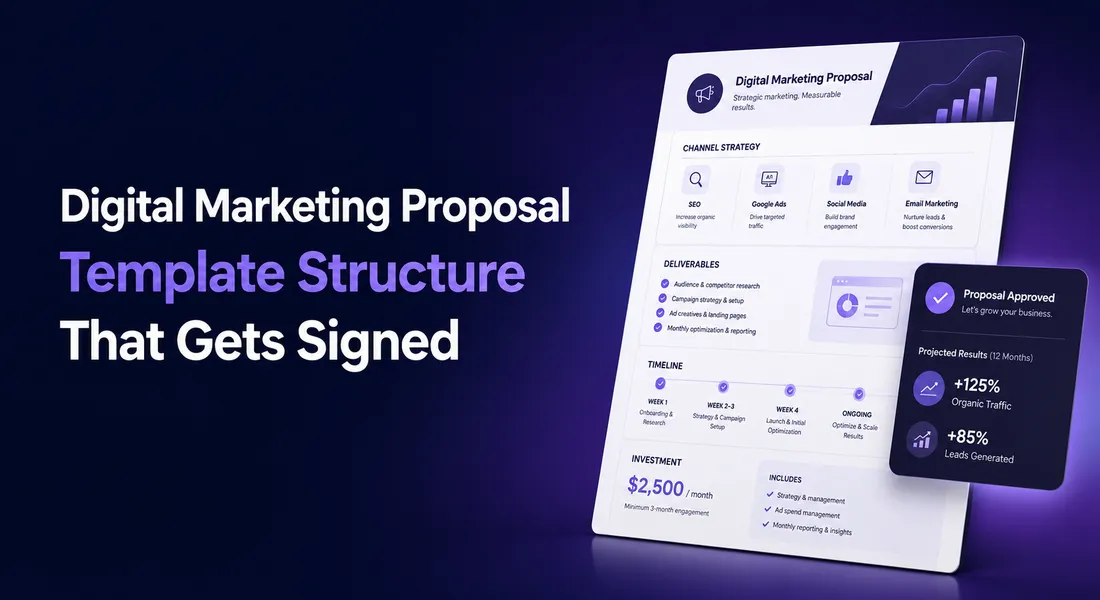
The Digital Marketing Proposal Template, Section By Section
Use this as the skeleton for every proposal. Reuse the structure. Never reuse the findings.
1. Cover And Positioning Line
Client name, your name, the date, and one sentence stating the outcome. Not “Digital Marketing Proposal” but “A nine month plan to cut your cost per lead from £94 to under £60.” The reader should know the stake before they scroll.
2. Executive Summary
One page. Problem, opportunity, approach, investment, next step. Write it last, because it summarises decisions you have not made yet when you start. For the person approving budget this is frequently the only page that gets read properly, so treat this breakdown of how to write an executive summary as required reading before you draft it.
3. Where The Client Is Now
A short, evidenced snapshot of their current position. Traffic sources, current spend, conversion rate, top performing pages, obvious leaks. Three to five findings, each with a business consequence attached. “Your paid search is bidding on your own brand terms at 34% of total spend” is a finding. “Your PPC needs optimisation” is filler.
4. The Opportunity, With Numbers
This is the section that gets your proposal circulated internally, because it is the only part a finance lead can act on. Model the gap between where they are and where the channel benchmark sits. LocaliQ’s 2026 search advertising benchmarks put the cross-industry average conversion rate at 8.18% and average cost per lead at $66.69. If your prospect is converting at 3% in a category that averages 8%, the arithmetic writes the case for you. Show the assumptions in the open so the client can challenge them.
5. Channel Strategy
Explain which channels you will work and, more importantly, which you will not. Deliberate exclusion signals judgement. An agency that proposes six channels for a £4,000 monthly retainer is telling the client it will do all six badly.
| Channel | What To Promise | What To Report |
|---|---|---|
| Paid search | Lower cost per qualified lead | CPL, conversion rate, spend efficiency |
| SEO | Position gains on commercial terms | Rankings, organic sessions, assisted revenue |
| Paid social | Cheaper top of funnel volume | CPM, click quality, downstream conversion |
| Organic social | Audience and share of voice | Engagement rate, follower quality, referral traffic |
| Revenue from existing contacts | Open and click rates, revenue per send | |
| Content | Pipeline from non-branded search | Pages published, rankings, assisted conversions |
6. Scope And Deliverables
Countable units with a monthly cadence. Four blog articles. Twelve social posts. Two landing pages. One monthly review call. Then state exclusions explicitly, because unstated exclusions are how a profitable retainer turns into a loss by month four.
7. Timeline
Phases with milestones, plus the client dependencies each phase relies on. If month one is audit and setup with no performance change, say that plainly. A client who expects results in week two will churn in month three regardless of what you deliver.
8. Reporting And Measurement
Name the metrics, the frequency, and the format. Agree the definition of success now, not in month six. If the metric is qualified leads, state who decides a lead is qualified. Ambiguity here is the single most common cause of a renewal falling apart.
9. Pricing
Three tiers, not one price. A lean tier, a core retainer, and a growth tier. A single price forces a yes or no. Three options move the conversation to which one, which is where you want it. Mark the recommended tier and show the annual figure alongside the monthly one.
10. Proof
One or two results from the same sector, with the actual numbers and the timeframe. Relevance beats volume every time. A single case study from their industry outperforms six from elsewhere, and vague claims about “significant growth” actively cost you credibility.
11. Terms And The Next Step
Payment schedule, notice period, validity window, and one action. Not four. Put the signature field in the document itself so approval does not require a separate email thread. Built-in e-signatures remove the print, sign, scan, return loop that adds days to a deal the client has already mentally approved.
How To Write A Social Media Marketing Proposal
A social media marketing proposal follows the same skeleton but fails in its own particular way: it promises reach and delivers reporting nobody values. Followers and impressions are not outcomes. They are inputs that a client cannot take to a board meeting.
The audience case is easy to make. DataReportal figures put global social media use at 5.79 billion user identities, equivalent to 94.7% of the world’s internet users. Your prospect does not need convincing that their customers are on social platforms. They need convincing that your version of social produces revenue rather than activity.
So structure the social section around three commitments. First, a defined content volume per platform per month, with formats named. Second, a stated position on paid amplification, including whether budget sits inside or outside your fee. Third, a conversion path, meaning what happens after someone engages. Without the third, you are selling a content calendar.
Community management deserves its own line item and its own price, because response time commitments are an operational cost, not a bonus. State the hours covered and the expected response window. The same discipline applies whether you are scoping social, a website design proposal, or a content retainer: name the unit, name the quantity, name the month.
Who Actually Reads Your Proposal
Rarely the person you have been speaking to, and rarely alone. Gartner research finds the typical buying group for a complex B2B purchase involves six to ten decision makers, with buyers spending only 17% of the purchase journey meeting suppliers. Your document does most of the selling in rooms you are not in.
Build for that. The marketing manager wants the channel detail. The finance lead wants the forecast and the notice period. The founder reads page one and the pricing table. Each section needs to survive being read out of order, because it will be. Write section openers that state the conclusion rather than introduce the topic.
Pricing A Digital Marketing Retainer
Price against outcome value, not hours. If your work is worth an extra 40 qualified leads a month at a £3,000 average deal value, a £5,000 retainer is not expensive. Get the client to state their close rate and deal value during discovery so this arithmetic is theirs rather than yours.
Structural choices worth offering: a phased retainer that starts smaller and scales as results land, a base fee with a performance component tied to an agreed metric, or a flat tiered retainer. Avoid pure performance pricing unless you control the entire funnel, which you almost never do. Underpricing to win is the most expensive mistake in this category, and the hidden cost of bad business proposals is usually paid in margin rather than in lost deals.
Using A Digital Marketing Proposal Template Without Sounding Templated
Templates are not the problem. Recycled thinking is. The structure, terms, pricing tiers, and proof library should all be standardised, because rebuilding them each time is wasted hours. The audit findings, the opportunity model, and the channel rationale must be written fresh every time.
A practical split: roughly 70% of your proposal should be reusable and 30% should be client-specific, with the client-specific 30% concentrated in the first four pages where attention is highest. Keeping the reusable portion in a Smart Content Library means service descriptions, case studies, and terms drop in already branded, and the only writing left is the part that actually differentiates you.
If you want a faster first draft, structured prompting helps more than a blank page. These AI prompts for marketing proposals cover the sections most people get stuck on.
Sending, Tracking, And Following Up
Stop attaching PDFs as the primary format. You cannot update them, they render badly on mobile, and the moment you adjust pricing there are two versions in circulation. Send a link and keep a PDF export for procurement teams who need one to file. A link lets you create and send proposals that stay current, open on any device, and carry the signature step in the same page.
The link also ends the guessing. Document analytics and engagement tracking show whether it was opened, which sections held attention, and where the reader stopped. A prospect who read the scope three times but never reached pricing needs a different follow up from one who never opened it.
Agree the decision date before you send. Then run a cadence: a short note the day after sending, a value-adding message around day four, and a direct close-or-park question at day ten. Each touch should carry something new, whether that is a competitor movement or a clarified assumption. This guide to following up on a sales proposal has the full sequence.
Mistakes That Cost Agencies The Deal
- Promising a specific revenue figure by a specific date without stating the assumptions behind it.
- Proposing six channels on a budget that supports two.
- Reporting on impressions and follower growth as headline metrics.
- Quoting a retainer with no deliverable count attached.
- Copying a previous client’s proposal and missing a find-and-replace.
- Leaving out exclusions, then arguing about scope in month three.
- Naming your own tool stack instead of the client outcome it produces.
- Closing with four possible next steps instead of one.
Frequently Asked Questions
How long should a digital marketing proposal be?
Eight to fifteen pages for a standard retainer. Long enough to show the thinking, short enough that the decision maker does not delegate it to someone junior. If it runs past twenty pages, move the detail into an appendix.
Should I include pricing in the proposal?
Yes, always. Withholding price to force another call stalls the internal approval, because nobody can build a business case around a number they do not have. Present tiers rather than a single figure.
What is the difference between a digital marketing proposal and a social media marketing proposal?
Scope. A digital marketing proposal covers multiple channels such as search, paid, email, and content. A social media marketing proposal covers organic and paid social only, and usually carries more detail on content volume, platform mix, and community management.
How fast should I send it after the discovery call?
Within 48 hours. Speed signals that you have systems, and it closes the window in which a competitor lands theirs first.
Should I use a digital marketing proposal template?
For the structure, terms, and pricing tiers, yes. For the audit findings and the opportunity model, no. A prospect can spot a fully templated proposal within thirty seconds, and it reads as effort-free work.
How long should a proposal stay valid?
Thirty days is standard. A validity window creates a natural deadline and protects your pricing if media costs move.
What if the client asks for a discount?
Reduce scope rather than price. Dropping the fee without dropping deliverables teaches the client that your original number was invented, and it sets the anchor for every renewal that follows.
Final Word
A digital marketing proposal is not admin at the end of the sales process. It is the sales process, compressed into the one artefact that circulates in rooms you will never enter. Lead with their situation, attach numbers to the opportunity, count every deliverable, price in options, and close with a single action and a date.
Agencies sending several of these a week should stop rebuilding the document from scratch. Proposal software for marketing agencies pulls your brand, service descriptions, case studies, and pricing blocks from one library, so the only thing left to write is the part that is genuinely about the client.

Ronak Surti
 Ronak Surti