
Table of Contents
PPC Proposal: A Practical Guide To Writing One That Closes
A PPC proposal has a harder job than most. Search and social clients have usually been burned before, by an agency that promised leads and delivered impressions, or by pausing a campaign the moment the invoice went unpaid. Your proposal is not just selling a service. It is undoing the last agency’s mess before it can sell anything at all.
That means the standard proposal template, the one built for consulting or design work, does not quite fit. A PPC proposal has to show account access, budget ownership, and platform fees in plain terms, because a client who does not understand where their money goes will not sign, and if they do sign, they will not renew.
This guide covers what goes into a PPC proposal, how to structure the audit and the budget breakdown, how to price management fees, and what to do differently when the buyer has already run ads themselves. If the strategy is set and the writing is the bottleneck, AI-powered document generation turns account audit notes into a branded document in minutes.
What A PPC Proposal Is
A PPC proposal is a client-facing document that sets out the paid search or paid social opportunity you have found, the campaigns you will build and manage, the monthly ad spend and management fee, the timeline, and the terms. It sits between the account audit and the contract. The audit proves you understand their account history. The contract governs the relationship. The proposal is the bridge, and for a category with this much buyer scepticism, it has to do more convincing than usual.
The reach argument is not the hard part. Google’s own Display Network documentation states that its sites reach over 90% of internet users worldwide. Your prospect already knows paid search and paid social can put them in front of nearly everyone. What they do not know is whether your account structure will spend their budget better than the last agency did, or better than their internal marketing hire is doing right now.
Why PPC Proposals Get Rejected
Most rejected PPC proposals share a small set of habits. Check your last three against this list.
- They quote a management fee with no account structure to justify it.
- They promise clicks or impressions instead of cost per lead or return on ad spend.
- They hide the ad spend split from the management fee, so the client cannot see what they are actually paying you for.
- They skip account ownership. Nobody says who owns the Google Ads account after the contract ends.
- They arrive with no audit findings, just a generic capabilities pitch.
- They close with a vague “let’s chat” instead of a signature field.
Every one of these is fixable in an afternoon with the right structure, the same one behind any well-built business proposal: findings first, numbers second, scope third, price last.
The Structure Of A PPC Proposal
1. Cover And Positioning Line
One page. Client name, your name, the date, and a single sentence stating the outcome. Not “PPC Management Proposal” but “A six month plan to cut cost per lead from £94 to under £55 across Google and Meta.” The buyer should know the stake before they open the second page.
2. Executive Summary
One page, written last. Problem, opportunity, approach, investment, next step. Treat it as the only page a budget holder reads properly, because it usually is, and often it is read by someone who was never on your call. Gartner research on B2B buying finds that a typical purchase involves six to ten decision makers, each arriving with their own independently gathered information, so write this page assuming the reader has no context beyond what is on it. The same principles that govern how to write an executive summary apply directly here.
3. Account Audit Findings
Three to five findings from the existing account, or from competitor research if there is no existing account to review. “Your account is bidding on branded terms at 40% of total spend” is a finding a client can act on. “Your PPC strategy needs work” is filler. Screenshots of wasted spend, overlapping ad groups, or missed negative keywords land harder than paragraphs.
4. The Opportunity, Benchmarked
Attach numbers to the gap. LocaliQ’s 2026 search advertising benchmarks put the average cost per click across industries at $5.42 and the average conversion rate at 8.18%. If the client’s account is converting at 3% in a category that averages 8%, or paying £9 a click where the benchmark is £5, the arithmetic makes the case for you far better than an adjective would.
5. Platform And Campaign Scope
Name every platform in scope, not “paid media” as a single line. Google Search, Google Shopping, Meta, LinkedIn, whichever apply. For each, state the campaign types, the audience approach, and what you will and will not touch. A client should never discover mid-engagement that Performance Max was never part of the deal.
6. Budget Split
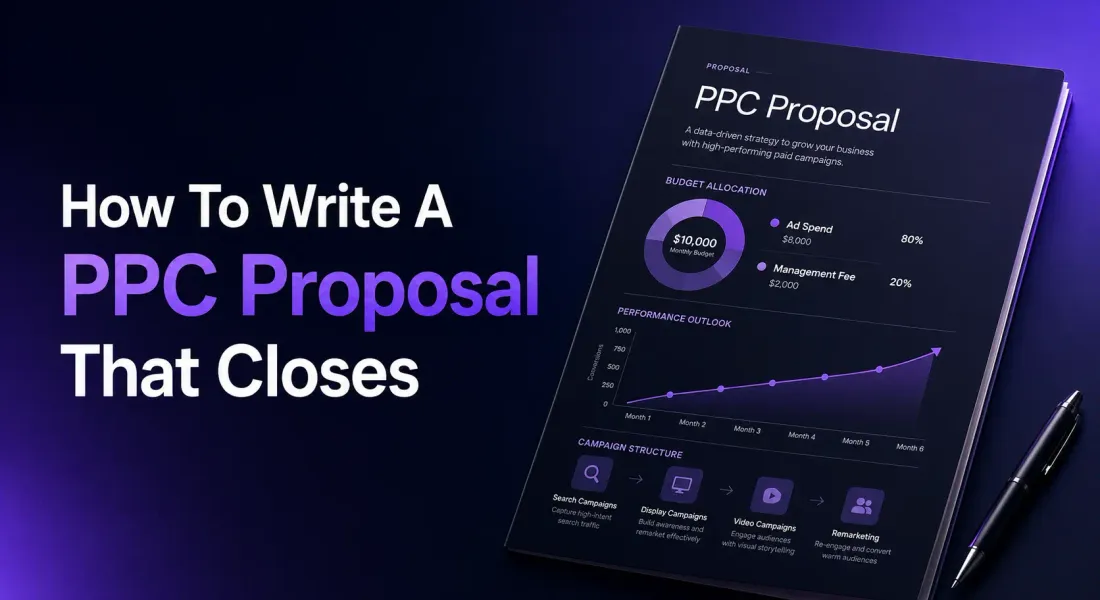
This is the section that avoids the most disputes in the category. Show ad spend and management fee as two separate lines, every time. A client paying £4,000 a month needs to see, in the document, how much goes to the platforms and how much comes to you. Bury this and the relationship starts on the wrong foot.
| Line Item | Monthly Amount | Notes |
|---|---|---|
| Ad spend (client budget) | Client sets, agency recommends | Paid directly to ad platforms, billed separately |
| Management fee | Flat or percentage of spend | Covers strategy, build, optimisation, reporting |
| One-off setup | First month only | Account structure, tracking, conversion setup |
7. Timeline And Milestones
Break the engagement into phases with something visible in each. Month one is typically setup, tracking, and account restructure with limited performance change. Say that plainly. A client expecting week-two results from a rebuilt account will panic before the data has had time to settle.
8. Reporting And Measurement
State the metrics, the cadence, and the attribution model in the document itself. If cost per lead is the headline number, define what counts as a lead. If return on ad spend is the number, define the revenue source it is measured against. Agree this now, not after the first disappointing report.
9. Pricing
Three tiers, not one number. A lean tier covering one platform, a core tier covering two, and a growth tier with creative testing and landing page work included. A single price forces a yes or no decision. Three tiers move the conversation to which one, and that is a far better conversation to be having with a sceptical buyer.
10. Account Ownership And Terms
State explicitly who owns the Google Ads and Meta accounts, both during the engagement and after it ends. This single clause prevents more disputes than anything else in a PPC contract. Cover notice period, minimum term if any, and what happens to historical campaign data on exit.
11. Next Step
One action. A signature field inside the document beats a follow-up email asking for one. Built-in e-signatures remove the export, sign, scan, return loop that adds days to a deal the client has already decided on.
Pricing A PPC Retainer
Flat management fees are easier for a client to budget around and easier for you to defend, since a percentage-of-spend model can look like you are incentivised to spend more of their money rather than spend it well. If you do use a percentage model, cap it, and say so in the proposal. A client who does the maths and realises your fee scales with their risk will hesitate, and a hesitant client is a lost one.
Whichever model you choose, keep the commercial terms in the same place as the pitch. Teams that create and send contracts from the same library used for the proposal are not rebuilding the account ownership and notice period clauses from scratch on every deal.
When The Client Has Already Run Ads Themselves
A growing share of PPC proposals now compete against an in-house attempt, not another agency. This changes the pitch. The client already understands the platforms, so lead with the gap between “running ads” and “running an account that compounds,” not with reach statistics they already know. Show them what a properly segmented account and a tested creative rotation adds that a single generalist marketer running one campaign cannot replicate on top of everything else on their plate.
How To Follow Up Without Nagging
Agree the decision date on the discovery call, before anything is sent. Then run a short cadence: a note the day after sending, a value-adding message around day four, a direct close-or-park question at day ten. Every touch should add something, whether that is a competitor’s ad creative you noticed or a clarified assumption in the budget split. The full sequence is covered in this guide to following up on a sales proposal.
Once the proposal is sent, stop guessing about engagement. Document analytics and engagement tracking show whether the client opened it, which sections held attention, and whether they reached the pricing table at all. A prospect who reread the budget split three times needs a different follow up from one who never opened the document.
Mistakes That Cost Agencies The Deal
- Quoting a single all-in number with ad spend and fee mixed together.
- Promising a specific ROAS or CPL by a specific date. It is unenforceable and it reads as inexperience to a buyer who has seen it before.
- Sending the audit instead of the proposal. Findings are not a plan.
- Naming every platform under the sun to look comprehensive, then under-resourcing all of them.
- No answer to who owns the ad accounts after the contract ends.
- Fifteen pages of agency history before a single client-specific insight.
Most of these come down to protecting the agency’s comfort over the client’s clarity. The hidden cost of bad business proposals is not just the deal you lose today, it is the price pressure applied to every deal after it once a prospect starts comparing you on rate alone.
Frequently Asked Questions
How long should a PPC proposal be?
Eight to twelve pages for a standard retainer. Long enough to show the account thinking, short enough that a budget holder does not delegate it unread.
Should ad spend be included in the price I quote?
Show it, but keep it a separate line from your management fee. Conflating the two makes it impossible for the client to judge your actual price against another agency’s.
What is a reasonable PPC management fee?
It varies by market and account complexity, which is exactly why tiered pricing works better than a single number. A flat fee tends to build more trust than a percentage of spend, particularly with a client who has been burned before.
Do I need a separate PPC contract?
A combined proposal and agreement works for most small and mid-sized accounts. Larger clients with procurement processes will usually want a standalone agreement with the proposal attached as a schedule, and account ownership terms should appear in both.
How fast should I send the proposal after the audit call?
Within 48 hours, while the account specifics are still fresh in the client’s mind and before a competing agency lands theirs first.
Should I guarantee results in a PPC proposal?
No. Guaranteeing a specific ranking, ROAS, or cost per lead by a fixed date is unenforceable and makes experienced buyers suspicious rather than confident. State a benchmarked range instead, drawn from the audit and industry data.
Final Word
A PPC proposal wins or loses on transparency more than on strategy. Show the budget split honestly, name the account ownership terms upfront, and attach real numbers to the opportunity instead of adjectives. A client who has been burned before is not looking for the most impressive deck. They are looking for the first agency that did not hide anything.
Agencies sending several of these a week should not be rebuilding the account structure tables and terms every time. Proposal software for marketing agencies pulls your brand, service descriptions, and pricing tiers from one library, so the only part you write fresh is the part that is genuinely about the client’s account.

Ronak Surti
 Ronak Surti