
Table of Contents
Signatory Authority: A Practical Guide
A contract signed by the wrong person is not a contract. It is a piece of paper that one side can walk away from the moment it becomes inconvenient. Signatory authority is the question of who is actually allowed to put a binding signature on your organisation’s behalf, and it is one of the most commonly skipped checks in business, right up until a deal falls apart because the person who signed never had the authority to do it.
This guide covers what signatory authority means, who typically holds it, how it differs across business structures, and how to manage it properly when documents move through multiple signers.
What Is Signatory Authority?
Signatory authority is the legal capacity to sign a document on behalf of an organisation in a way that commits that organisation to its terms. Holding the authority to sign is different from simply having a job title that sounds senior. A marketing manager can be highly senior within their function and still have zero authority to sign a supplier contract, because that authority was never delegated to them.
Authority to sign generally comes from one of three places: it is written into the company’s founding documents (articles of incorporation, an operating agreement, corporate bylaws), it is granted through a formal resolution by the board or members, or it is delegated through a power of attorney or a specific written authorisation for a defined purpose. Without one of those three, a signature carries less weight than it appears to.
Who Typically Has Signatory Authority?
The exact answer depends on the entity type and its governing documents, but some patterns hold across most organisations.
- Corporations: usually the CEO, President, or other officers named in the bylaws or authorised by board resolution.
- LLCs: managing members in a member managed structure, or appointed managers in a manager managed structure.
- Partnerships: general partners typically hold binding authority, unless the partnership agreement restricts it.
- Sole proprietorships: the owner, since there is no separate legal entity to delegate authority from.
- Nonprofits: the executive director or board chair, depending on what the bylaws specify.
Authority can also be delegated downward for a specific purpose without changing anyone’s formal title. A CFO might issue a written authorisation letting a procurement manager sign purchase orders up to a set value, without that manager holding any broader signing power. That kind of scoped delegation is common and perfectly valid, as long as it is documented.
Why Signatory Authority Gets Overlooked
Most teams only discover a signatory authority problem after a deal has already gone wrong, which is exactly why it is worth checking before that happens.
- A deal moves fast and whoever is available signs, regardless of whether they hold the authority to.
- Delegated authority is granted verbally and never written down, so there is nothing to point to if it is later disputed.
- Authority limits, such as a spending cap on what a manager can approve, exist in an internal policy nobody checks against the document being signed.
- A company changes its authorised signers after an internal restructure, but external partners are never told, so old contacts keep signing documents they no longer have the authority to sign.
None of these are exotic failure modes. They are the ordinary result of speed being prioritised over a five minute verification step.
How To Verify Signatory Authority Before A Deal Closes
For anything beyond a routine, low value transaction, a short verification step protects both sides.
- Ask directly who has been authorised to sign this specific agreement, and on what basis.
- For larger deals, request a copy of the board resolution or the delegation letter that grants that authority.
- Check the signature block itself. A signature under a title with no supporting authorisation is worth a follow up question, not an assumption.
- For high value or high risk agreements, have counsel confirm authority as part of the review, rather than relying on the other side’s word.
This is not about distrust. It is about making sure that if the deal is ever challenged, there is a clear paper trail showing the signature was valid from the moment it was made.
Managing Signatory Authority When Multiple People Need To Sign
Most B2B agreements today involve more than one signer: a vendor contract might need sign off from procurement and finance, an NDA might need both a business lead and legal counsel, an SOW might need a project sponsor and a budget owner. Managing that on paper, with a document circulating by email between four people, is where authority gets muddled and versions get lost.
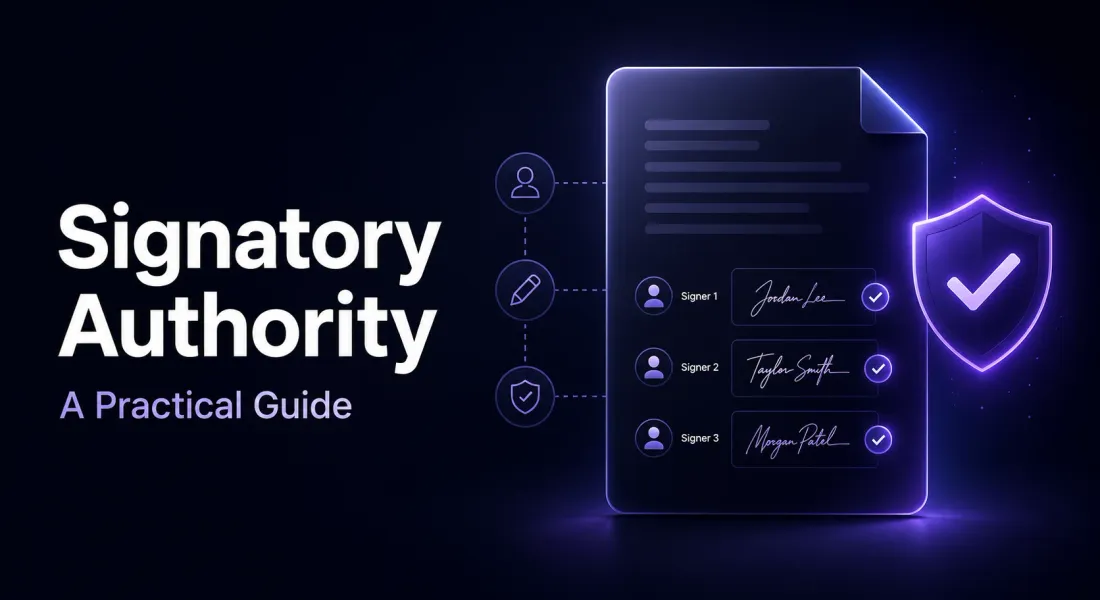
Online document signing that supports parallel and sequential signing keeps this contained. Each signer gets their own designated field in the same document, so a deal with three authorised signers does not turn into three separate email threads with three different versions in circulation. Every signature is recorded with a signed status and a signing date, and a confirmation email goes to everyone involved the moment the last signature lands, which gives you a clean, contemporaneous record of who signed and when, alongside whatever internal authorisation record you keep for that signer. This matters most in deals with several stakeholders, a pattern covered in more depth in this look at the enterprise sales cycle and how many people typically touch a single deal before it closes.
A Note On Legal Advice
This guide covers the general business practice of managing signatory authority. It is not legal advice, and authority rules vary by entity type, jurisdiction, and the specific governing documents of your organisation. For a high value contract, a dispute, or any situation where you are unsure whether a signature will hold up, get a qualified lawyer to confirm authority before signing, not after.
Common Mistakes
- Letting whoever is in the room sign, regardless of whether they hold the authority to.
- Granting delegated authority verbally with nothing written down to point to later.
- Never updating external partners when authorised signers change internally.
- Treating a job title as proof of authority instead of checking the actual delegation.
- Skipping verification on high value deals because the other side seems trustworthy.
Final Word
Signatory authority is not a formality to rush past. It is the difference between a document that holds up and one that does not. Know who is authorised to sign on your side, verify it on the other side for anything that matters, and keep a clear record of both the authorisation and the signature itself.
When multiple people need to sign the same agreement, create and send proposals and contracts that keep every signer’s field, status, and confirmation in one document instead of a scattered email trail. The same discipline that protects a signature also protects the document behind it, covered in this piece on why e-signatures matter in proposals specifically.
Frequently Asked Questions
What happens if someone signs without proper authority?
The agreement can potentially be voided or challenged by the organisation the unauthorised person claimed to represent. In practice this often gets resolved through ratification, where the organisation later approves the deal anyway, but that is a choice the organisation makes, not a guarantee.
Does a job title prove signatory authority?
Not on its own. A title suggests seniority, not a specific grant of authority. Authority comes from governing documents, board resolutions, or a written delegation, and it is worth confirming rather than assuming from a title alone.
Can signatory authority be limited to certain deal sizes?
Yes. It is common for a company to authorise someone to sign contracts up to a specific value while requiring higher approval for anything above it. That limit should be documented internally and, ideally, referenced in the authorisation itself.
Who has signatory authority in a small business?
In a sole proprietorship, the owner. In a small LLC or corporation, usually whoever is named in the founding documents or granted authority by the other owners, which for a very small business is often just the founder or founders themselves.
Do electronic signatures require the same authority checks as physical signatures?
Yes. The method of signing does not change who is allowed to sign. An electronic signature from an unauthorised person carries the same risk as a physical one, which is why the verification step matters regardless of format.

Ronak Surti

 Dimple Maru
 Ronak Surti