
Table of Contents
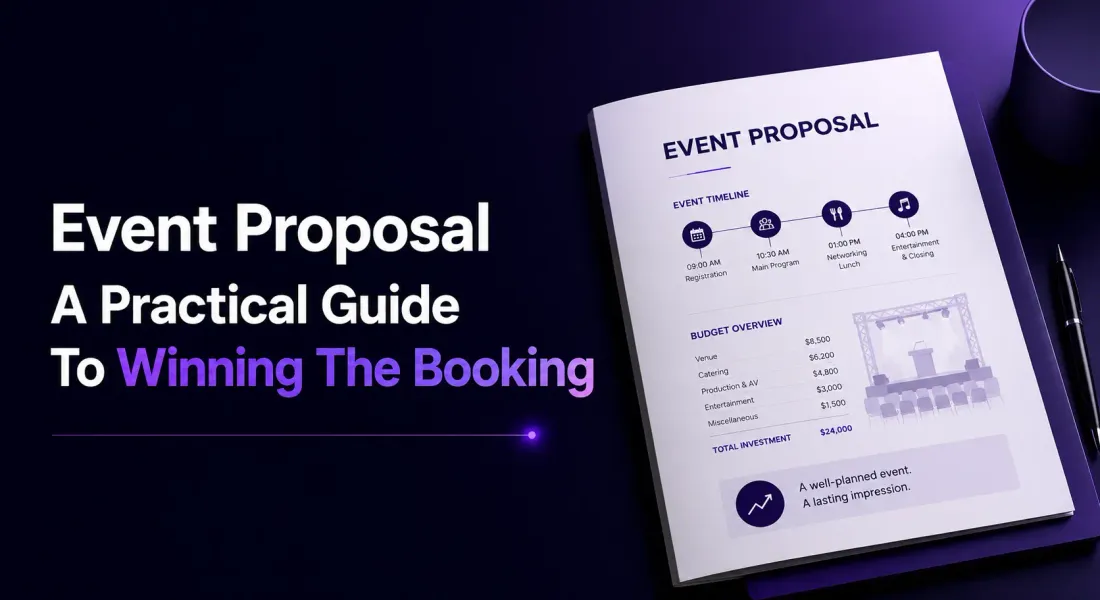
Event Proposal: A Practical Guide To Winning The Booking
An event proposal has to do something most business documents do not: sell an experience nobody can see yet. A software proposal can point to a working product. An event proposal is asking a client to commit a budget, a date, and their own reputation to something that exists only as a plan until the day it actually happens.
That gap between promise and proof is why so many event proposals get rejected on price when the real problem was trust. This guide covers what an event proposal needs to contain, how to structure the budget so it survives scrutiny, what a strong event proposal example actually looks like, and how to price and follow up without losing the booking to an agency that answered faster.
If the concept is set and the writing is the bottleneck, AI-powered document generation turns planning notes into a branded, client-ready document in minutes.
The stakes are only getting higher. Industry research aggregated from Amex GBT’s meetings and events forecast found that 88% of corporate event professionals expect their budgets to rise, which means more competing proposals landing on the same desks and less patience for a vague one.
What An Event Proposal Is
An event proposal is a document sent to a prospective client, sponsor, or internal budget holder that sets out the concept for an event, the logistics, the budget, the timeline, and the terms. It asks for a decision, and the decision is usually a signature and a deposit.
It sits between the discovery conversation and the contract. The conversation uncovers what the client actually needs the event to achieve, whether that is closing a sales quarter, launching a product, or building internal culture. The proposal turns that into a concrete, priced plan. The contract that follows locks in the commercial terms once the concept is approved.
The core structure is the same one behind how to write a business proposal in any category, with two things added that most business proposals do not need: a detailed line-item budget the client can defend to their own finance team, and enough sensory detail that a reader can picture the room before they have seen it.
Why Event Proposals Get Rejected
The rejection pattern is consistent across corporate events, weddings, conferences, and sponsorship pitches. Check your last three proposals against this list.
- The concept is described in adjectives rather than specifics. “An unforgettable evening” tells a client nothing they can approve.
- The budget is a single total with no breakdown, so the client cannot see where their money goes.
- There is no measurement plan, so a marketing or events lead cannot justify the spend afterwards.
- Vendor and contingency costs are missing, so the real number surfaces after the client has already mentally committed to a lower one.
- It arrives as a static PDF that renders badly on a phone and cannot be updated after a scope change.
- It ends with no single next step, just an invitation to “discuss further.”
Every one of these is fixable in an afternoon. Bizzabo’s 2026 benchmark research found that 40% of event teams still struggle to prove event ROI, down from 70% the year before. A proposal that builds the measurement plan in from the start is solving a problem your client already knows they have.
The Structure Of An Event Proposal
1. Cover And Positioning Line
Client name, your name, the date, and a single sentence naming the outcome, not the event type. Not “Corporate Event Proposal” but “A product launch for 200 guests designed to generate 40 qualified sales conversations in one evening.” The reader should know the stake before the second page.
2. Executive Summary
One page. The objective, the concept in brief, the headline investment, and the next step. Write it last, because it summarises decisions you have not made yet when you start. Corporate events rarely get approved by one person alone, so this page needs to work for a reader who has no other context. The discipline behind how to write an executive summary applies directly here.
3. The Concept
Describe the experience specifically enough that a stranger could picture it. Theme, flow of the evening or day, the moment you want people talking about afterwards. This is the section that turns “event” into something the client can defend internally, and it is the one most proposals skip in favour of a logistics list.
4. Objectives And Success Measures
State what the event needs to achieve, in the client’s terms, and how you will measure it. Attendance target, leads generated, media coverage, employee satisfaction score, whatever applies. Agreeing this now avoids a disappointing post-event conversation about whether the spend was worth it.
5. Logistics
Venue, capacity, date and time, catering approach, AV and production, staffing. Enough detail that the client can picture the operational shape of the day without needing to ask.
6. The Budget, Broken Down
This is the section that decides whether the proposal survives a finance review. A single total invites negotiation on the whole number. A line-item breakdown lets the client see exactly what they are paying for and where, if anything, they might trim.
| Line Item | Estimated Cost | Notes |
|---|---|---|
| Venue hire | Varies by date and capacity | Includes hire fee, insurance, security deposit |
| Catering and beverage | Per-head estimate | Based on confirmed guest count, subject to final numbers |
| Production and AV | Fixed quote | Staging, sound, lighting, screens |
| Staffing | Day rate x headcount | Event management, registration, floor staff |
| Contingency | 10-15% of subtotal | Covers weather, last-minute changes, overruns |
7. Timeline
Break the planning window into phases with milestones: contract signed, deposit due, venue confirmed, final headcount, run-of-show finalised. If any phase depends on the client, such as final guest numbers or sign-off on branding, say so plainly, because a late client deliverable is the most common cause of an event proposal timeline slipping.
8. Sponsorship Or Vendor Angle, If Relevant
If the proposal includes sponsorship packages or vendor partnerships, give each tier its own clearly priced block with the specific benefits attached, not a vague “brand visibility” line. A sponsor evaluating three events at once will pick the one that made it easiest to see what they are actually buying.
9. Investment
Present the total clearly, ideally with two or three package options rather than a single number. A lean package, a core package, and a premium package let the client choose their ambition level instead of forcing a yes or no on one figure.
10. Terms And The Next Step
Deposit amount and due date, cancellation and postponement terms, payment schedule, and one clear action. A signature field inside the document beats a follow-up email asking for one. Built-in e-signatures remove the print, sign, scan, return loop that adds days to a booking the client has already decided on.
What A Strong Event Proposal Example Actually Looks Like
Searches for an event proposal example or a proposal event sample usually lead to generic templates with placeholder text that still needs a full rewrite. The examples that actually help share three traits, regardless of event type.
- The concept section reads like it was written for this specific client, not adapted from the last one with the name swapped.
- The budget is broken into named line items, not a single total.
- There is a stated objective and a way to measure whether the event met it.
A generic sample can show you the shape of the document. It cannot write the concept section, the part that actually wins the booking, because that section has to be specific to the client sitting in front of you. Treat any template as a starting skeleton and spend your real effort on the pages a template cannot write for you.
Pricing An Event
Package pricing works better than a single quote for most event categories, because it lets a client with a flexible budget choose ambition rather than being forced into a binary decision. Show the per-package total and, where relevant, the per-head cost, so a client scaling the guest list up or down can see the impact immediately rather than asking you to re-quote.
Whichever structure you use, keep the commercial terms in the same place as the pitch. Teams that create and send proposals from the same library used for the quote are not rebuilding the deposit schedule and cancellation clauses from scratch on every booking.
Who Actually Approves An Event Budget
Rarely just the person you have been emailing. Corporate event budgets typically pass through a marketing lead, a finance approver, and often an executive sponsor before a deposit gets paid. Gartner’s research on B2B buying groups more broadly finds that complex purchases now involve six to ten decision makers, and event budgets above a certain size follow the same pattern inside most organisations. Build the executive summary and the budget breakdown to survive being forwarded to someone who was never on your call.
How To Follow Up Without Losing The Date
Event proposals are unusually time-sensitive, because venue availability does not wait for a client’s internal approval process. Agree the decision date on the discovery call, and be explicit about what happens to the venue hold if that date passes. Then run a short cadence: a note the day after sending, a value-adding message a few days later, and a direct question about the hold deadline as it approaches. The general sequence is covered in this guide to following up on a sales proposal, with the added urgency that a missed date can mean starting the venue search over.
Once the proposal is sent, stop guessing about where it stands. Document analytics and engagement tracking show whether it has been opened, which sections held attention, and whether the budget page was reached at all. A client who reread the sponsorship tiers three times needs a different follow up from one who never opened the document.
Common Mistakes
- Quoting a single all-in number with no breakdown, then explaining every add-on cost after the client has already anchored on the headline figure.
- Describing the concept in mood words instead of specifics a client can picture.
- No contingency line, so any overrun becomes an awkward conversation instead of a pre-agreed buffer.
- Skipping the objective and measurement section entirely, leaving the client with no way to judge success afterwards.
- Sending a locked PDF that cannot be updated when the guest count or scope changes mid-negotiation.
- No stated deadline tied to the venue hold, so the client treats the date as more flexible than it actually is.
The underlying discipline is the same one covered in this breakdown of the anatomy of a winning proposal: remove risk from the reader’s decision rather than trying to impress them with scale.
Frequently Asked Questions
How long should an event proposal be?
Six to twelve pages for most corporate events. Long enough to cover concept, logistics, and budget properly, short enough that a decision maker does not delegate it unread. Larger conferences or multi-day events can run longer to accommodate a fuller logistics section.
What should be included in an event proposal budget?
Venue, catering, production and AV, staffing, and a contingency line of roughly 10 to 15% of the subtotal. Breaking these out separately, rather than presenting one total, is what lets a client’s finance team approve it without a follow-up meeting.
Is there a standard event proposal template I can just fill in?
A template can give you the section order and the budget table structure. It cannot write the concept section, which has to be specific to the client and the objective in front of you. Use a template for the skeleton, not the substance.
How far in advance should I send an event proposal?
As soon as possible after the discovery call, ideally within 48 hours, because venue availability is often the real deadline behind the client’s decision timeline, not any internal approval process on your side.
Should I include multiple pricing packages?
Yes, where the event format allows it. A lean, core, and premium package lets a client with budget flexibility choose their ambition level rather than facing a single yes or no decision on one number.
What is the difference between an event proposal and an event contract?
The proposal sells the concept and sets the price. The contract that follows locks in the commercial terms, deposit schedule, and cancellation conditions once the client has approved the concept. Smaller bookings often combine both into one signed document.
Final Word
An event proposal wins on specificity, not spectacle. A client cannot see the room yet, so the document has to do the imagining for them, back it with a budget they can defend internally, and give them a single clear action to take. Vague language and a single lump sum are the two fastest ways to lose a booking to someone who answered the same brief with more detail.
Teams sending several of these a week should not be rebuilding the budget table and terms from scratch each time. Proposal software built for consulting firms and event agencies alike exists so the only part you write fresh is the concept, which is the only part that actually has to be.

Ronak Surti
 Ronak Surti