
Table of Contents
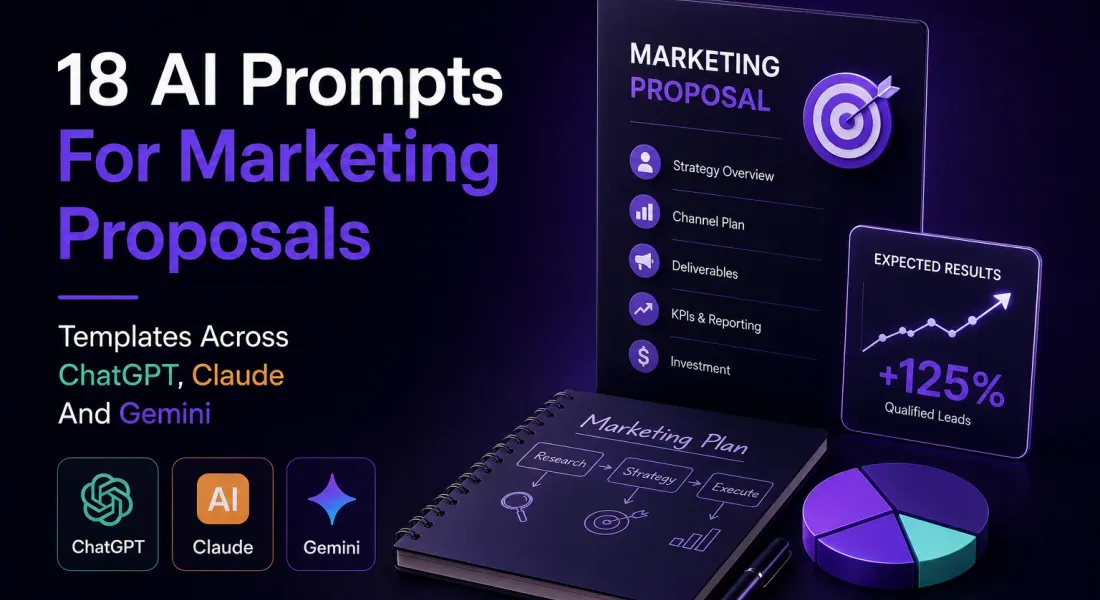
AI Prompts for Marketing Proposal: 18 Templates Across ChatGPT, Claude And Gemini
Marketing proposals fail in two predictable places. Either they read like a generic agency template with the client name swapped in, or they pile every possible deliverable into one bloated scope and let the price scare the client off. The proposals that win are specific about the client’s situation, honest about which channels will actually move the metrics, and structured so the buyer can see what each pound is buying.
An AI prompt for marketing proposal writing only helps if it forces that discipline into the brief. The 18 templates here, divided across ChatGPT, Claude and Gemini, are built that way. Six handle full proposals, tiered retainers and channel-specific pitches. Six turn long client briefs, discovery notes and competitive scenarios into structured documents. Six pull live research about the prospect, their market and their competitors.
Why AI Works Well For Marketing Proposals
Marketing proposals follow a fairly predictable structure: situation, strategy, deliverables, timeline, team, pricing, KPIs. That predictability is exactly what AI handles well, as long as the brief is specific. A well-built prompt gets you a strong first draft in minutes.
If you write proposals beyond marketing retainers, our AI prompts for business proposal writing guide covers 18 templates for general client-facing proposals across industries.
Each Model Brings A Different Edge
ChatGPT is the most flexible for general drafting and tone changes. Claude keeps long briefs and structured sections tightly organised. Gemini is the best choice when you need to research the prospect before pitching.
Many marketing agencies also need to pitch with slides before the written proposal. Our AI prompts for sales deck creation guide covers 18 templates for building the deck that opens the conversation.
KPIs Need To Be Specific
Generic AI output gives you generic KPIs. Spell out the channels, baseline metrics and target uplift in the prompt so the model commits to numbers that mean something.
Tiered Packages Make Proposals Easier To Buy
Marketing buyers respond well to two or three clearly differentiated packages. Many prompts below ask the model to structure the deliverables this way.
Avoid Buzzword Bingo
Marketing copy is the worst offender for jargon. Instruct every prompt to drop words like ‘synergy’, ‘leverage’, ‘best-in-class’ and ‘cutting-edge’. The output reads sharper immediately.
ChatGPT Prompts For Marketing Proposals
ChatGPT is the flexible workhorse for marketing proposal drafting. It handles full proposals, tiered packages and tone iteration quickly. These six ChatGPT prompts for marketing proposal building cover the situations agencies and freelancers face week to week. Each ChatGPT prompt for marketing proposal below is built around a specific scenario, so you can pick the right ChatGPT prompt for marketing proposal for the job rather than starting from a blank page.
For general-purpose proposal prompts that work across industries, our ChatGPT prompts for proposal writing guide covers ten additional templates for executive summaries, budgets, and RFP responses.
1. Full Marketing Proposal From Scratch
Act as a senior account director at a [type, e.g. performance
marketing] agency, writing a proposal to win a new client.

Context:
- Our agency: [name and core focus]
- Prospect: [client name and industry]
- Service area: [what they need help with]
- Their current situation: [what they do now and why it is
  not working]
- Their stated goal: [what success looks like]
- Budget signal: [what you know]
- Our relevant proof: [one comparable result]

Write a complete marketing proposal with:
1. Executive summary
2. Our read on their current situation
3. Recommended strategy, in plain terms
4. Deliverables broken into three phases
5. KPIs and how we will measure each one
6. The team who will run the account
7. Two pricing packages: Growth and Partner
8. Engagement timeline and onboarding
9. Why our agency over the alternatives

Rules:
- Tie every deliverable to a specific KPI.
- Confident, plain language. No buzzwords.
- Around 900 words.
Where it works best: ChatGPT produces a clean, well-ordered first draft and is easy to iterate with section by section. This is the ChatGPT prompt for marketing proposal most teams reach for first.
Best for: A first full draft when you need a marketing proposal ready in under an hour.
2. Retainer Proposal With Three Tiered Packages
Act as a senior account director pitching a monthly retainer.

Context:
- Agency: [name and focus]
- Client: [name and industry]
- Retainer type: [services covered]
- Their current marketing maturity: [in-house team, agencies,
  tools]
- The package you most want them to choose: [name it]

Write a retainer proposal that makes the recommended package
feel like the sensible default.

Structure:
1. Situation summary in three sentences
2. Why a retainer beats project-by-project for this client
3. Three packages: Essentials, Growth, Partner
   For each: monthly fee, deliverables, KPIs, team, reporting
4. One paragraph guiding the reader towards Growth by reason
5. Onboarding plan for the first 30 days
6. Cancellation and flexibility terms

Rules:
- Make every deliverable measurable.
- Keep the top tier present so the middle looks sensible.
- No artificial urgency or false scarcity.
Where it works best: ChatGPT formats tiered packages cleanly and writes neutral, reason-led nudges instead of pushy lines.
Best for: Agencies pitching ongoing retainers where you want the client to self-select a tier.
3. Channel-Specific Proposal
You are a paid media specialist writing a tightly scoped
proposal for a single channel.

Context:
- Channel: [e.g. Google Ads, Meta, LinkedIn, TikTok]
- Client: [name and industry]
- Current spend: [monthly budget on this channel]
- Current performance: [CAC, CPL, ROAS or what they shared]
- The goal: [target CAC, lead volume, or revenue]
- Our relevant proof: [a comparable result on this channel]

Write a focused proposal covering only this channel.

Structure:
1. Channel audit summary (three observations)
2. What we will change and why
3. Campaign structure we will build
4. Creative approach
5. Measurement and reporting
6. 90-day target metrics
7. Monthly fee and what it includes
8. What we will not do

Rules: be specific with numbers. Avoid jargon. The reader has
seen every agency deck.
Where it works best: ChatGPT handles channel-specific specifics and audit-style observations cleanly without vague claims.
Best for: Single-channel pitches where the buyer wants depth, not a generalist sweep.
4. Project-Based Marketing Proposal
Act as an account lead pitching a defined project rather
than an ongoing retainer.

Context:
- Project: [campaign name or scope, e.g. product launch, rebrand
  rollout, market expansion]
- Client: [name and industry]
- Target timeline: [start to finish]
- Budget signal: [what you know]
- Definition of done: [what they need at the end]

Write a project-based marketing proposal.

Structure:
1. Project objective in one sentence
2. Strategic approach
3. Workstreams (3-5), each with deliverables
4. Timeline with key milestones
5. Team and roles
6. Project fee, framed against the outcome
7. Assumptions and dependencies
8. Risks and mitigations
9. Next step

Rules:
- Make milestones measurable, not vibes-based.
- Be upfront about dependencies on the client.
- Around 850 words.
Where it works best: ChatGPT handles project-scope language cleanly and produces a structure clients can actually sign off on.
Best for: Defined-scope projects like launches, rebrands, or market entries.
5. Executive Summary Rewrite
You are an editor who specialises in tight, high-impact
proposal openings.

Context:
- The deal in one sentence: [what you are proposing]
- The single most compelling outcome: [the one result that
  matters]
- Why you over the alternatives: [one genuine reason]

Existing executive summary: [paste yours]

Rewrite it so it works even if it is the only thing the client
reads.

Rules:
- Under 150 words.
- Open with the client, not the agency.
- Cover: their problem, our solution, the outcome, the reason
  to choose us.
- No throat-clearing. The first sentence does real work.

Then give me one alternative version with a bolder opening line,
so I can choose between them.
Where it works best: ChatGPT is fast at producing multiple framings of the same opener, which is exactly what executive summary work needs.
Best for: When the body of your proposal is solid but the executive summary falls flat.
6. Follow-Up Sequence For A Sent Proposal
You are an account director writing follow-ups that get
replies without ever sounding desperate.

Context:
- Client: [name]
- What we proposed: [one line]
- Sent: [number] days ago, no reply
- What you suspect is happening: [budget review, approval, holiday]
- One new piece of value you can offer: [an idea, audit, case study]

Write a three-message follow-up sequence spaced a few days apart.

Rules:
- Message 1: light nudge, three sentences, end with one easy
  yes or no question.
- Message 2: deliver the new piece of value, no pressure to
  decide. Three to four sentences.
- Message 3: a clean, respectful close that leaves the door open
  without guilt-tripping. Three sentences.
- No "just circling back". No fake urgency.
- Each message under 80 words.

Format: clearly label Message 1, Message 2, Message 3.
Where it works best: ChatGPT writes light, varied follow-ups across multiple touches without slipping into pushy or robotic language.
Best for: Reviving a quiet marketing proposal thread across more than one message.
Claude Prompts For Marketing Proposals
Claude is the right model when you have a long brief, an RFP, or detailed discovery notes to turn into a proposal. These six Claude prompts for marketing proposal building handle the situations where structure and faithfulness to the source material matter most. Each Claude prompt for marketing proposal below is built around a specific scenario, so you can pick the right Claude prompt for marketing proposal for the job rather than starting from a blank page.
1. Marketing Proposal From A Client Brief
You are a marketing proposal specialist who is excellent at
reading a brief and answering exactly what was asked.

Brief:
[paste the full client brief, RFP or enquiry, however long]

Task:
Write a tailored marketing proposal that responds to this brief.

Instructions:
- Start with a short summary of their requirements in their own
  language, so they know you read carefully.
- Address every requirement in the order they listed them.
- For each requirement, map a specific deliverable and a
  measurable KPI.
- Where the brief is vague, propose a concrete metric and label
  it as a recommendation to confirm.
- Flag anything genuinely missing in a "Questions before we
  proceed" section at the end.
- Do not invent budget figures. Give a structured range and
  explain what moves the number.

Format:
Clear sections, confident tone, no filler. Around 900 words.
Where it works best: Claude reads a long brief faithfully and reflects priorities back without quietly inflating scope. This is the Claude prompt for marketing proposal most teams reach for first.
Best for: Responding to an inbound brief or a formal RFP where the client has spelled out what they want.
2. Proposal From Discovery Call Notes
You are a marketing strategist who is brilliant at making
clients feel genuinely listened to.

Notes:
[paste your raw discovery call notes or transcript]

Context:
What we do: [agency focus]
Our relevant proof: [one comparable result]

Task:
Turn these notes into a marketing proposal that proves we were
paying attention.

Instructions:
- Quote their priorities back in their own language.
- Map each priority to a specific deliverable.
- Surface any risk or concern they raised, address it directly.
- Note one thing they did not mention but should consider,
  framed as a helpful observation rather than a sales push.
- Stay grounded in what they actually said. Do not invent
  priorities.

Format:
Clear sections, warm and credible tone, around 850 words.
Where it works best: Claude reads long, messy notes faithfully and pulls clear structure out of them.
Best for: Fast follow-up after a sales call while the detail is still fresh.
3. Multi-Channel Strategy Proposal
You are a senior strategist building a marketing proposal
that covers several channels working together.

Context:
Client: [name and industry]
Channels in scope: [list them, e.g. SEO, paid social, email,
content, partnerships]
Their goal: [revenue, leads, brand outcome]
Current state of each channel: [bullet per channel]
Budget signal: [what you know]

Task:
Write a multi-channel proposal that shows the channels working
as a system, not a list.

Structure:
1. Strategic frame: how the channels connect
2. For each channel: role in the funnel, deliverables, KPIs,
   monthly spend
3. The cross-channel measurement model
4. Quarterly review cadence
5. Investment summary across channels
6. Recommended phasing if budget is constrained

Rules:
- Each channel section ties to a specific funnel stage and KPI.
- Be honest about which channels carry the most weight in the
  first 90 days versus the next year.
- Avoid generic channel rationales. Make each one fit this
  specific client.
Where it works best: Claude handles multi-channel architecture well and keeps the picture coherent rather than fragmented.
Best for: Full-funnel agency proposals where the value is in the integration, not any single channel.
4. Pitch For An Underperforming Account
You are a senior strategist auditing and pitching a recovery
plan for a client whose current marketing is not working.

Context:
Client: [name]
What is underperforming: [the symptom, e.g. dropping organic,
rising CAC, flat lead volume]
Likely causes (your honest hypothesis): [list 2-3]
What they have tried already: [bullet list]
Our angle: [why we think we can change the picture]

Task:
Write a recovery-style marketing proposal.

Sections:
1. Diagnostic summary: what is happening and why
2. What we think is causing it
3. What changes first (the 30-day sprint)
4. What changes second (60-90 days)
5. What changes third (90+ days)
6. KPIs and review checkpoints
7. Investment
8. A short "what would make us wrong" section listing the
   assumptions we are making

Rules:
- Lead with diagnosis, not solution.
- Do not blame the previous agency unless the facts make it
  unavoidable, and even then keep the tone neutral.
- Be honest about what we cannot yet know.
Where it works best: Claude is measured and credible on diagnostic-style proposals where overclaiming would lose the deal.
Best for: Pitching against an incumbent when the client wants someone to fix what is broken.
5. Pricing Section With Three Tiers
You are a pricing specialist writing the most-read section
of any marketing proposal.

Context:
Service: [what you offer]
Three tiers: [Tier 1 / Tier 2 / Tier 3 names]
What differentiates the tiers: [scope, speed, support, depth]
The tier you most want them to choose: [name it]
Their budget signal: [what you know]

Task:
Write the pricing section.

Requirements:
For each tier:
- Short, descriptive name
- What is included (tight bullets)
- Who it suits best (one line)
- The price (or "from" price)
- The value attached (what they get back)

Then:
- One sentence beneath the table guiding the reader towards
  the preferred tier by reason, not pressure.
- Keep the most expensive tier present so the middle looks
  sensible.

Rules:
- Plain language. No artificial urgency or false scarcity.
- No "premium experience" filler.
Where it works best: Claude formats clean comparison tiers and writes neutral, reason-led guidance instead of pushy language.
Best for: The pricing section is where most proposals lose. This one wins it back.
6. Side-By-Side Proposal Variants
You are a senior strategist writing two distinct versions of
the same proposal so the client can choose the approach that
fits.

Context:
Client: [name and industry]
Their stated goal: [one sentence]
Two genuine paths to that goal you can defend:
Path A: [the conservative or proven approach]
Path B: [the more ambitious or unconventional approach]

Task:
Write both versions side by side.

Structure:
For each path:
- The strategic frame in one paragraph
- What it looks like in the first 90 days
- What it looks like at 12 months
- The risk profile
- The investment range
- Who this path suits best

Then a short closing paragraph helping the client compare them,
without pushing one over the other.

Rules:
- Both paths must be genuinely defensible. No straw-man options.
- Be honest about the trade-offs of each.
Where it works best: Claude handles parallel structures cleanly and avoids the trap of subtly favouring one option.
Best for: Clients who want to feel like they are choosing, not being sold.
Gemini Prompts For Marketing Proposals
Gemini’s live web grounding is the right tool when the proposal needs current data about the client, their market or their competitors. These six Gemini prompts for marketing proposal writing turn generic templates into research-led pitches. Each Gemini prompt for marketing proposal below is built around a specific scenario, so you can pick the right Gemini prompt for marketing proposal for the job rather than starting from a blank page.
1. Research-Backed Marketing Proposal
You are a senior agency strategist who researches before pitching.

Step 1: Research [prospect company] and their industry using
current web information. Look for:
- Their digital footprint (website, ads, social, organic
  visibility)
- Recent campaigns or product launches
- How they currently position themselves
- Three or four obvious gaps a marketing agency could close
- Their main competitors and how they compare

Step 2: Using what you find, write a marketing proposal pitching
[your service area] to them.

The proposal should:
- Open with three specific observations about their current
  marketing, drawn from your research
- Identify the gap we can close, in their language
- Recommend a strategy with channels, tactics and timing
- Break deliverables into phases with target KPIs
- Present pricing as two packages
- Close with a 30-day starter option to lower the risk

Rules: cite any specific fact you use, with source. If you cannot
verify a claim, say so rather than inventing it. Around 1000 words.
Where it works best: Gemini’s live research turns a generic AI prompt for marketing proposal writing into a proposal that feels like you have already audited the prospect. This is the Gemini prompt for marketing proposal most teams reach for first.
Best for: Outbound to a named prospect where personalisation is the whole point.
2. Competitor Benchmark Section
You are an agency analyst building the competitor benchmark
section of a marketing proposal.

Step 1: Research [client industry / category] using web
information. Identify:
- The three or four competitors the client most directly compares
  against
- Their visible marketing posture (website, social, ads,
  organic presence)
- What each is doing well
- What each is missing
- How [client] currently compares

Step 2: Write a benchmark section for the proposal.

Output:
- One-paragraph framing of the benchmark
- A clean table-style comparison (description of layout)
- Bullets for each competitor: strongest move, biggest gap
- A one-paragraph read on where the client sits in the picture
- Three opportunities for the client that the benchmark reveals

Rules: cite any specific observation with the source. Do not
exaggerate competitor weaknesses. The client can verify.
Where it works best: Gemini’s live research catches recent competitor moves that older models would miss.
Best for: Proposals where the client wants to see how they compare before deciding what to spend.
3. Industry Trend Slide For The Proposal
You are a marketing strategist writing the "why now" section
of a marketing proposal, grounded in current industry shifts.

Step 1: Research [client industry] for the latest shifts. Look
for:
- Regulatory, technological, or consumer changes in the last
  6-12 months
- Recent industry incidents (failures, lawsuits, breaches) that
  shift buyer behaviour
- New channels or formats winning attention
- Any platform or algorithm changes affecting how the client
  reaches customers

Step 2: Write a one-page "why now" section for the proposal.

Output:
- A short opening paragraph naming the shift
- 3-4 bullets, each citing a specific recent development
- The implication for the client in two paragraphs
- One paragraph framing why this changes what the client should
  do in the next 90 days

Rules: cite every source. Recent (last 12 months) only. Avoid
generic "the marketing landscape is changing" filler.
Where it works best: Gemini’s recency is essential here. Older models will produce stale “why now” sections that experienced clients spot immediately.
Best for: Outbound where the client needs a reason to act this quarter, not next year.
4. Comparable Agency Win Section
You are an agency strategist sourcing the strongest
comparable customer story for this prospect.

Step 1: Using web research, find:
- Published case studies, press releases, or LinkedIn posts
  about marketing agencies that delivered for similar clients
- The reported results
- The strategy or channels involved
- Any quotes from named buyers

Step 2: Write a "comparable wins" section for the proposal.

Output:
- One-paragraph framing of why these are relevant
- 2-3 short customer stories, each with: starting situation,
  what was done, result, quote
- A paragraph drawing the connection to the prospect's situation

Rules: cite the source for every number and quote. Use
publicly verifiable examples only. Do not paraphrase quotes
into something they did not say.
Where it works best: Gemini can pull publicly verifiable comparable wins from sources beyond your own case study library.
Best for: Outbound to a buyer who needs to see comparable proof before believing the pitch.
5. Audience Research For Persona-Led Strategy
You are a research lead building the audience section of a
marketing proposal.

Step 1: Research [client's customer segment] using web
information. Find:
- What this segment publicly says about its pain points (forums,
  Reddit, LinkedIn, industry publications)
- How they currently discover and evaluate solutions
- Who they listen to (publications, podcasts, influencers)
- The language they use (verbatim phrases, not your paraphrase)
- Recent shifts in their buying behaviour

Step 2: Write a persona-led audience section.

Output:
- A short persona summary, no fluff
- 3-5 verbatim quotes from public sources, attributed
- A "where to find them" channel map
- Three messages likely to land, in the audience's own language

Rules: cite the source for every quote. Use the audience's
actual words, not your interpretation. Recent sources preferred.
Where it works best: Gemini’s web grounding produces audience research that uses real customer language rather than your assumptions.
Best for: Strategies where positioning depends on getting the voice exactly right.
6. Public Spend Estimate For Competitive Context
You are an agency analyst researching what a competitor or
peer is publicly spending on marketing, to give the client
context for their own decision.

Step 1: Using web information, find what is publicly known
about [competitor company]'s marketing investment:
- Public ad libraries (Meta, TikTok, Google) showing active ads
- Reported funding allocated to growth in press or earnings
- Job posts suggesting team size
- Public agency partnerships
- Tech stack signals (BuiltWith-style observations)

Step 2: Write a competitive spend section.

Output:
- One paragraph framing the question
- A bullet list of observable signals with sources
- A "best-estimate range" of what they are spending, with the
  reasoning shown
- A paragraph translating this into a recommendation for the
  client's own budget

Rules: never claim certainty about private figures. Frame
everything as best-estimate with sources cited. Acknowledge
what you cannot see.
Where it works best: Gemini can pull together public signals that approximate spend ranges, useful for context that older models cannot produce reliably.
Best for: Clients who want to know what good looks like for budget before committing to a number.
How To Get More From Each Prompt
A prompt is a starting point, not the finished article. A few habits get a lot more value out of every template above when you are working on a marketing proposal. Whether you use a ChatGPT, Claude or Gemini prompt, or any other AI prompt to write a marketing proposal you have saved, these habits apply.
Treat The First Reply As A Draft
Ask for a tighter version, push back on a weak section, or request more depth on a specific area. Each pass sharpens the document.
Chain Your Prompts
Use the output of one prompt as the input to the next. A research prompt can feed a full-draft prompt, which can feed a follow-up message prompt, all without leaving the model.
Save What Works
When a prompt produces a strong result for you, keep it with a note on why. Over time you build a personal library that beats writing from scratch every time.
From Prompt To Branded Document
AI gives you the words. It does not give you a branded marketing proposal your client actually sees, or tell you when they open it. That last stretch, branding the document, sending it, and following up at the right moment, is usually where the time stacks up.
This is where Proposal.biz fits in.
Paste Your Website URL - Proposal.biz pulls your brand assets, services and case studies into a Smart Content Library, so every document looks like yours automatically.
Generate From A Prompt - Describe what you need and it uses the AI-powered proposal generation engine to produce a fully branded marketing proposal, ready to refine in the Proposal Builder.
Send A Shareable, Trackable Link - Instead of a flat PDF, you send a live link and see views, time spent and section-level engagement, so you know exactly when to follow up.
Marketing proposals are just one document type. Explore how agencies create and send proposals, quotes, and contracts from the same platform.
The simplest workflow: draft your proposal using whichever AI prompt for marketing proposal writing fits the scenario, then drop the copy into Proposal.biz to brand, send and track. You keep the AI tool’s writing speed and add the document layer that closes the loop with your client, then use any AI prompt to write a marketing proposal you have saved alongside it.
Final Word
A marketing proposal is the document the client returns to when they have to defend the spend internally. Make it specific enough that they can. Generic KPIs, vague timelines and “best-in-class” adjectives lose deals. Named metrics, comparable wins, and a recommendation the client can articulate in a single sentence win them.
The faster you can turn a strong prompt into a finished proposal, the more deals you can pitch. Proposal.biz handles that last stretch: paste your agency website URL once and every future document pulls from the same Smart Content Library. The Proposal Builder formats the output, a live link replaces the PDF attachment, and section-level view tracking tells you exactly which part of the proposal the client read before going quiet. The follow-up email writes itself.
See how proposal software for marketing and advertising agencies helps your team move from AI-drafted pitch to signed retainer inside one workflow.
Try Proposal.biz for free →
Frequently Asked Questions
What is the best AI prompt for marketing proposal writing?
There is no single best prompt. The strongest results come from matching the prompt to the situation and the model. For a first full draft, the ChatGPT prompt for marketing proposal building at the top of this guide works well. For a named, researched pitch, the Gemini template is a better choice. For a response to a detailed brief, the Claude template handles long input most faithfully.
Which AI tool is best for writing marketing proposals?
It depends on the job. ChatGPT is the most flexible for general drafting. Claude is best when you have a long brief or detailed discovery notes to turn into a tightly structured document. Gemini is unmatched when you need to research the prospect live before writing.
How do I get the AI to write specific KPIs rather than vague goals?
Spell out the channels, baseline metrics and target uplift in your prompt. Every template in this guide asks the model to tie deliverables to measurable KPIs. If the output still feels vague, run a follow-up asking the model to convert each goal into a metric, a baseline, and a 90-day target.
Can I use the same AI prompt to write a marketing proposal for any industry?
The structure carries across industries, but the language, KPIs and channel mix do not. Use the templates here as a base, then adapt the channel-specific prompt or the retainer prompt to your vertical. Feed the model real benchmarks from your industry so the output speaks like a specialist.
How do I turn the AI output into a branded marketing proposal?
AI gives you the copy and structure, not a branded document tied to your agency’s visual identity. Tools like Proposal.biz close that gap: paste your website URL to pull your agency’s brand into a Smart Content Library, generate a fully branded marketing proposal from a prompt, then send a shareable link and track which sections the client actually read.
You've read the blog. Get your personalized prompt pack now.
Tailored to your exact document type, sent straight to your inbox.
No Credit Card.
Get a personalized prompt pack for your exact use case.
Pick your document type and we'll send it straight to you.
No Credit Card.

Ronak Surti
 Ronak Surti