
Table of Contents
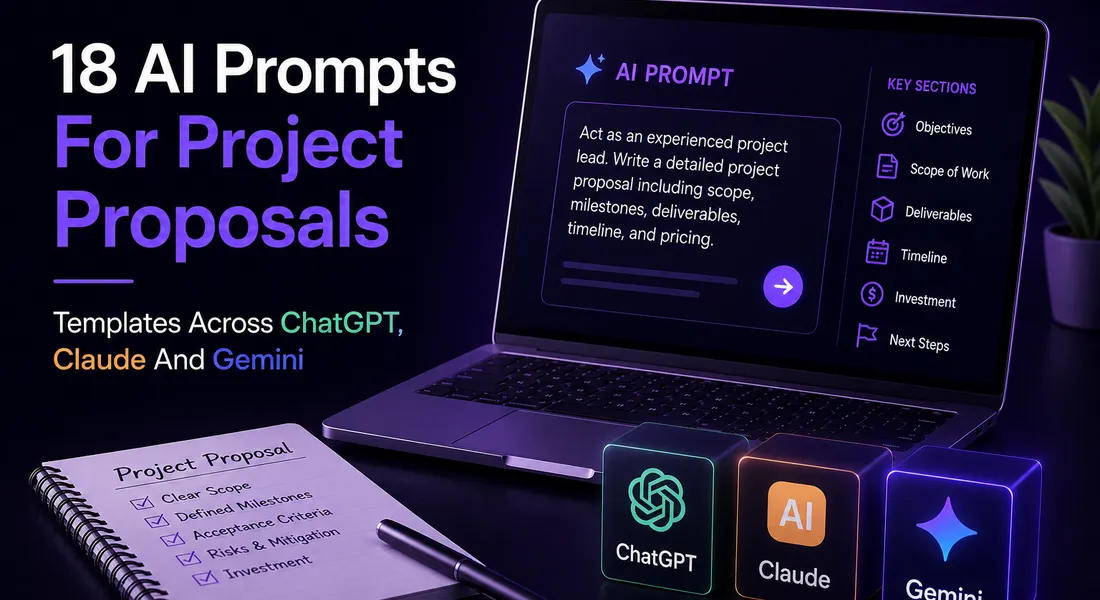
AI Prompts for Project Proposal: 18 Templates Across ChatGPT, Claude And Gemini
A project proposal that is vague about scope becomes a project that is impossible to deliver. Every disagreement six weeks in traces back to a sentence in the original document that meant two different things to two different readers. The proposals that protect both sides spell out exactly what is included, exactly what is not, what “done” looks like for each deliverable, and how change requests get handled when reality shifts.
The 18 templates here, divided across ChatGPT, Claude and Gemini, treat scope as the document’s most important job, not an afterthought. The ChatGPT prompts cover full project proposals, phased multi-month engagements and pilot pitches. The Claude prompts handle discovery notes, RFPs and the detailed acceptance criteria that prevent disputes later. The Gemini prompts pull industry benchmarks for scope sizing, regulatory context and comparable project outcomes.
Why AI Works Well For Project Proposals
Project proposals are structured documents with predictable sections: objectives, scope, deliverables, milestones, resources, risks, investment. AI handles structured documents well when the brief is specific. A strong, structured prompt produces a usable draft in one pass.
.png)
Each Model Has A Different Edge
ChatGPT is the most flexible for general drafting. Claude handles long discovery notes and detailed scope work best. Gemini is the strongest choice when you need to research the client’s situation before writing.
Scope Is The Whole Game
Spell out what is in scope, what is out of scope, and what assumptions you are making. Every template below treats scope as the most important section, not an afterthought.
Milestones Need Acceptance Criteria
A milestone without acceptance criteria invites disagreement later. The prompts here ask the model to write a clear definition of done for every milestone.
Risk Sections Build Trust
Most proposals hide risk. Strong proposals surface it. Ask the model to include a short risks and mitigations section and the proposal immediately reads more credible.
ChatGPT Prompts For Project Proposals
ChatGPT is the flexible workhorse for project proposal drafting. It handles full-scope proposals, milestone planning and quick rewrites. These six ChatGPT prompts for project proposal writing cover the situations consultants, agencies and in-house project leads face week to week. Each ChatGPT prompt for project proposal below is built around a specific scenario, so you can pick the right ChatGPT prompt for project proposal for the job rather than starting from a blank page.
.png)
1. Full Project Proposal From Scratch
Act as an experienced project lead writing a proposal to win
new work.

Context:
- Our company: [name and core capability]
- Client: [name and industry]
- Project: [what you are proposing to deliver]
- Their main objective: [what success looks like for them]
- Project duration: [target timeframe]
- Budget signal: [what you know about their budget]
- Our relevant proof: [a comparable project]

Write a complete project proposal with these sections:
1. Executive summary
2. Project objectives, stated as measurable outcomes
3. Scope of work, broken into phases
4. Deliverables for each phase, with acceptance criteria
5. Milestones with target dates
6. Team and responsibilities (ours and theirs)
7. Assumptions and dependencies
8. Risks and how we will mitigate them
9. Investment and payment schedule
10. Next steps

Rules:
- Be specific enough that a stranger could tell whether each
  deliverable was met.
- Tie every milestone to an acceptance criterion.
- Plain language, no buzzwords.
- Around 1000 words.
Where it works best: ChatGPT produces a complete, well-structured first draft with the level of scope detail a project proposal needs. This is the ChatGPT prompt for project proposal most teams reach for first.
Best for: A first full draft when you have agreed the project verbally but need a document to formalise it.
2. Multi-Phase Project Proposal With Milestones
Act as a programme manager writing a proposal for a phased
project that will run over several months.

Context:
- Project: [name and outcome]
- Total duration: [number of months]
- Number of phases: [usually 3-5]
- Major dependency or risk: [the one thing most likely to derail]
- Payment model: [fixed, milestone-based, retainer]

Write a phased project proposal.

For each phase, include:
- Phase number and name
- Phase objective in one sentence
- Key deliverables with acceptance criteria
- Milestone date
- Resources required (from us and from them)
- Payment trigger (if milestone-based)

Also include:
- A clear "go / no-go" review point between phases
- A risk register with the top 3-5 risks and mitigations
- An assumptions section listing what we are taking as given

Rules: every phase should produce something the client could
review on its own. No phase should be a black box.
Where it works best: ChatGPT handles multi-phase structure and milestone planning cleanly without slipping into generic project speak.
Best for: Larger, multi-month projects where the buyer wants visibility into every phase.
3. Pilot Or Proof-Of-Concept Proposal
Act as a delivery lead pitching a small, time-boxed pilot
designed to lead to a larger engagement if it succeeds.

Context:
- Pilot scope: [what you will deliver in the pilot]
- Pilot duration: [usually 4-12 weeks]
- Success criteria: [what good looks like at the end]
- The bigger engagement this opens up: [scope and value]
- Cost of the pilot: [fee]

Write a pilot proposal.

Structure:
1. The bet: what we will learn together
2. Pilot scope (in and out)
3. Pilot deliverables
4. Pilot timeline
5. Pilot success criteria (with the specific metric)
6. Cost and payment
7. What happens if the pilot succeeds
8. What happens if it does not (clean exit)
9. Next step

Rules:
- Define "success" before signing, not after.
- Make the exit clean and honest. No hidden lock-in.
- Around 600-700 words.
Where it works best: ChatGPT writes pilot proposals that feel fair to both sides, which is what makes pilots actually convert.
Best for: Risk-averse buyers who need a low-commitment way to test the relationship.
4. Project Proposal For A Sceptical Buyer
You are a project lead writing for a buyer who has been
burned by previous suppliers and is openly sceptical.

Context:
- Project: [what you are proposing]
- Why they are sceptical: [past failures, missed timelines,
  scope creep]
- What you can do differently: [specific operational changes]
- The proof you have that you do this differently: [evidence]

Write a project proposal designed to rebuild trust.

Structure:
1. Acknowledge what has not worked before, briefly and neutrally
2. What we do differently, with specifics
3. Operational guarantees (delivery checkpoints, transparency,
   pause clauses)
4. Standard project sections: scope, deliverables, milestones,
   risk, investment
5. A "what would make us wrong" section listing the assumptions
   we are making
6. Next step

Rules:
- Do not blame previous suppliers, even if invited to.
- Be specific about your operational guarantees. Vague promises
  read worse than no promises.
- Confident but humble tone.
Where it works best: ChatGPT writes credible trust-rebuilding language without slipping into either defensiveness or sales spin.
Best for: Clients who say upfront that they have been burned before.
5. Scope Of Work Section On Its Own
You are a delivery lead writing the most important section
of any project proposal.

Context:
- Project: [what you are delivering]
- Duration: [timeframe]
- Phases (if known): [list them]
- Known constraints: [budget, deadlines, dependencies]
- The riskiest part of the project: [your honest read]

Write a detailed scope of work section.

Structure:
For each phase:
- Phase name and objective
- In-scope items, listed explicitly
- Out-of-scope items, listed just as explicitly
- Deliverables with acceptance criteria
- Phase milestones and target dates
- Phase dependencies (on us and on them)

After the phases:
- A "Change request process" paragraph in plain language
- A "Roles and responsibilities" mini-table covering both sides

Rules: be specific enough that a stranger could tell whether
each deliverable was met. Pin down anything ambiguous now.
Where it works best: ChatGPT formats scope sections cleanly and respects the in/out distinction that holds projects together.
Best for: Pinning down a complex project where scope is the highest risk.
6. Project Status Update Template (Bonus)
You are a project manager writing weekly status updates
that clients actually read.

Context:
- Project: [name]
- Current phase: [where we are]
- This week's progress: [bullet list of what happened]
- Blockers: [list]
- Decisions needed from client: [list]
- Next week's plan: [bullet list]

Write a weekly status update.

Format:
- One paragraph opening with the headline status (Green / Amber / Red) and one sentence of context
- "Done this week" (3-5 bullets)
- "Up next" (3-5 bullets)
- "Need from you" (1-3 specific asks)
- "Watch list" (risks to track)

Rules:
- Under 250 words total.
- Lead with what they need to act on, not what we did.
- Honest. If we slipped, say we slipped.
Where it works best: ChatGPT writes status updates that respect the client’s time and surface decisions cleanly.
Best for: After a project proposal is signed, the same workflow extends to keeping the project on track.
Claude Prompts For Project Proposals
Claude is the right model when scope, acceptance criteria and risk sections need to hold up under scrutiny. These six Claude prompts for project proposal writing handle the situations where precision matters most. Each Claude prompt for project proposal below is built around a specific scenario, so you can pick the right Claude prompt for project proposal for the job rather than starting from a blank page.
.png)
1. Project Proposal From Discovery Notes
You are a project lead who is excellent at turning rough
discovery notes into a precise project proposal.

[paste your raw discovery call notes or workshop output, however
messy]

What we deliver: [type of work]
Typical project duration: [range]

Turn these notes into a project proposal that reflects what they
told us, with the scope tightened to something we can actually
deliver.

- Pull out their stated objectives and quote one or two in their
  own words.
- Translate their priorities into measurable outcomes.
- Where they were vague, propose a specific scope and label it
  as a recommendation to confirm.
- Surface any risk or dependency they mentioned and address it
  directly in the risks section.
- Add one observation they did not raise but should consider.
- Include acceptance criteria for every deliverable.

Sections: objectives, scope, deliverables with acceptance criteria,
milestones, assumptions, risks, investment range, next step.
Around 1000 words.
Where it works best: Claude reads long, unstructured notes faithfully and produces tightly scoped output. This is the Claude prompt for project proposal most teams reach for first.
Best for: Fast turnaround after a discovery call or scoping workshop.
2. Detailed Scope Of Work Section
You are a delivery lead writing the most important section
of a project proposal.

Context:
Project: [what you are delivering]
Duration: [timeframe]
Phases (if known): [list them]
Known constraints: [budget, deadlines, dependencies]
The riskiest part of the project: [your honest read]

Task:
Write a detailed scope of work that protects both sides from
scope creep.

Structure:
For each phase:
- Phase name and objective
- In-scope items, listed explicitly
- Out-of-scope items, listed just as explicitly
- Deliverables with acceptance criteria
- Phase milestones and target dates
- Phase dependencies (on us and on them)

After the phases:
- A "Change request process" paragraph in plain language
- A "Roles and responsibilities" mini-table covering both sides

Rules:
- Be specific enough that a stranger could tell whether each
  deliverable was met.
- Pin down anything ambiguous now.
- Neutral, professional tone.
Where it works best: Claude is precise with scope boundaries and acceptance criteria, which is exactly what a strong project proposal needs.
Best for: Pinning down a complex project where scope is the highest risk.
3. Risks And Assumptions Section
You are a delivery lead who handles risk conversations
honestly rather than burying them.

Context:
Project: [what you are delivering]
Duration: [timeframe]
The riskiest aspects in your honest view: [list them]
Common assumptions on this kind of project: [list them]

Task:
Write a risks and assumptions section.

Structure:
Risks: short intro, then each risk as:
- The risk (one sentence)
- Likelihood and impact (low / medium / high)
- Our mitigation (one or two sentences)
- Trigger or warning sign (so both sides know when to act)

Assumptions: a clean list of what we are taking as given. Make
each one specific enough that the client can confirm or push back.

End with one paragraph framing the section: surfacing risk early
is how we deliver on time and on budget, not the opposite.

Rules:
- Honest, not defensive.
- No vague risks. Be specific.
- Mitigations should be actions, not promises.
Where it works best: Claude is measured and credible on risk and avoids the defensive language that makes risk sections feel like fine print.
Best for: Higher-stakes projects where being upfront about risk wins more deals than hiding it.
4. Long Project Proposal From An RFP
You are a senior project lead responding to a formal RFP
for a multi-phase project.

RFP:
[paste the full RFP]

Task:
Write a project proposal that addresses every requirement
faithfully.

Instructions:
- Open with a short executive summary that signals you have read
  the entire document.
- Address every numbered requirement in the RFP, in order.
- For each requirement: our approach, our deliverable, our
  acceptance criteria, our responsible role.
- Where a requirement is ambiguous, propose a specific
  interpretation and label it as an assumption to confirm.
- Include sections required by most procurement teams: scope,
  schedule, resourcing, risk, change control, exit terms.
- End with a "Clarifications requested before final pricing"
  section.

Rules:
- Do not invent capabilities. If we cannot meet a requirement,
  flag it transparently and offer the closest alternative.
- Length: match the depth of the RFP, but stay focused.
Where it works best: Claude handles long, structured input faithfully and produces responses that hold up under procurement scrutiny.
Best for: Formal RFPs, especially in regulated or procurement-heavy industries.
5. Acceptance Criteria For Every Deliverable
You are a delivery lead who knows most project disputes
trace back to weak acceptance criteria.

Context:
Project: [what you are delivering]
Deliverables: [list them]
Type of work: [strategy, design, build, content, advisory]
Who reviews and signs off each deliverable: [client roles]

Task:
Write a detailed acceptance criteria section covering every
deliverable.

Requirements:
For each deliverable, include:
- The deliverable name and a one-line description
- What "done" looks like, in objective, testable language
- The review process (who reviews, how long they have, what
  format)
- The number of revision rounds included
- What happens after revision rounds are exhausted
- What does not count as acceptance (e.g. silence is not
  approval)

Rules:
- Avoid subjective language ("high quality", "professional").
  Replace with measurable criteria.
- Make the review process simple enough to use every cycle.
Where it works best: Claude is excellent at converting subjective standards into measurable criteria.
Best for: Engagements where the quality bar is the most likely point of dispute.
6. Two-Path Project Proposal
You are a senior project lead presenting two genuine paths
to the same outcome.

Context:
Client: [name]
Goal: [the outcome they want]
Path A: [the proven, conservative path]
Path B: [the faster or more ambitious path]

Task:
Write a two-path project proposal.

Structure:
For each path:
- Strategic frame in one paragraph
- Scope of work
- Timeline
- Resourcing
- Investment
- Risk profile (be honest)
- Who this path suits best

Then a closing paragraph helping the client compare them without
subtly weighting one over the other.

Rules:
- Both paths must be defensible. No straw man.
- Trade-offs honest.
- Balanced length across both.
Where it works best: Claude handles parallel structures cleanly and resists the urge to nudge the reader.
Best for: Clients who want to feel like they are choosing, not being sold.
Gemini Prompts For Project Proposals
Gemini’s live web grounding is the right tool when the project proposal needs current data about the client, the industry or comparable projects. These six Gemini prompts for project proposal writing turn generic templates into research-led pitches. Each Gemini prompt for project proposal below is built around a specific scenario, so you can pick the right Gemini prompt for project proposal for the job rather than starting from a blank page.
.png)
1. Research-Backed Project Proposal
You are a senior project lead who researches the client's
situation before scoping a project.

Step 1: Research [client company] and their industry using
current web information. Look for:
- Their stated strategic priorities
- Recent initiatives or changes that suggest where this project
  fits
- The maturity of their current setup for [project area]
- Industry benchmarks for the outcome we are targeting

Step 2: Write a project proposal pitching [project type] to them,
informed by what you find.

Requirements:
- Open with two or three specific observations about their
  current situation, drawn from research.
- Tie the project objectives to a public priority of theirs.
- Use industry benchmarks to anchor the target outcome.
- Cite any specific fact, with the source.
- If you cannot verify something, say so.

Structure: situation, objectives, scope, deliverables with
acceptance criteria, milestones, risks, investment, next step.
Around 1100 words.
Where it works best: Gemini’s live web grounding turns a generic AI prompt for project proposal writing into a proposal that feels genuinely informed about the client. This is the Gemini prompt for project proposal most teams reach for first.
Best for: Pitches to a named prospect where the project needs to feel tailored, not templated.
2. Industry Benchmark For Project Scope Sizing
You are an analyst researching what a project of this type
typically takes, so the client can sanity-check our scope.

Step 1: Research [project type] for [client industry]. Find:
- Reported timelines from comparable projects
- Reported team sizes
- Reported budget ranges
- Common scope inclusions and exclusions
- The two or three most common reasons projects of this type
  go off the rails

Step 2: Write a "what good looks like" section for the
proposal.

Output:
- One paragraph framing comparable projects
- A bullet list with sources covering: timeline range, team
  size range, budget range
- A paragraph explaining what is typically in scope and what
  is typically separate
- A paragraph naming the common failure modes and how we
  mitigate them

Rules: cite every figure with the source. Use ranges. Do not
overclaim certainty about private projects.
Where it works best: Gemini’s web grounding produces credible scope-sizing context, which is hard for older models to do reliably.
Best for: Clients who want third-party validation that our scope is reasonable.
3. Comparable Project Wins Section
You are a research lead sourcing the strongest publicly
verifiable comparable projects.

Step 1: Research published case studies, press releases or
articles about similar projects for similar clients. Find:
- The scope they covered
- The reported timeline
- The reported result
- Any named champion and their quote
- Lessons mentioned in retrospect

Step 2: Write a "comparable projects" section.

Output:
- One-paragraph framing
- 2-3 short summaries, each with: scope, timeline, result, quote
- A paragraph connecting these to the current client's situation

Rules: cite the source for every figure and quote. Use publicly
verifiable examples. Do not paraphrase quotes into something they
did not say.
Where it works best: Gemini can pull comparable projects from sources beyond your own case study library.
Best for: Outbound to buyers who need to see comparable proof before committing.
4. Regulatory Or Compliance Context Section
You are a research lead building the regulatory section of
a project proposal.

Step 1: Research [client industry] for regulatory or compliance
changes in the last 12 months affecting [project area]. Find:
- New rules, regulations or guidance
- Enforcement actions against peers
- Industry-body advisories
- Anticipated changes in the next 12 months

Step 2: Write a regulatory context section for the proposal.

Output:
- Opening paragraph framing the regulatory environment
- Bullet list of specific changes with citations
- A paragraph translating the changes into project impact
- A paragraph showing how our scope accommodates them

Rules: cite every regulation by name and source. Use actual
regulatory language where possible. Do not exaggerate impact.
Where it works best: Gemini’s web grounding is essential for regulatory writing where older models miss recent changes.
Best for: Regulated industries where compliance shapes the project scope.
5. Current State Audit Section
You are an analyst auditing the client's current state for
[project area] using public information.

Step 1: Research [client company] publicly visible state in
[project area]. Find:
- What their website, ads or product reveal about their current
  approach
- Public hiring patterns suggesting team capability
- Public technology signals (tools they use, partners they have)
- Recent public statements about this area
- Visible gaps a project of this type would close

Step 2: Write a "what we see today" section for the proposal.

Output:
- One paragraph framing the audit approach
- 3-5 specific observations with citations
- The implication for the project scope
- A paragraph framing the project as filling the visible gaps

Rules: only use publicly visible information. Cite every
observation. Be neutral, not judgemental.
Where it works best: Gemini can surface public observations that show the client we have done genuine homework.
Best for: Outbound where a real audit would be impossible but a visible-signals audit is genuinely useful.
6. Investor And Owner Context For Project Pitches
You are a strategist researching the ownership context of
the prospect, so the project proposal speaks to the full
decision logic.

Step 1: Research [prospect company] and its ownership using web
information. Find:
- The investor, PE firm, or owner of record
- Their published thesis or stated priorities
- Portfolio-wide trends affecting how this client makes
  decisions
- Hold period and likely exit window

Step 2: Write an investor-aware paragraph and a project framing
that connects the project to ownership-level priorities.

Output:
- A short framing paragraph about what the owner is optimising
  for
- A bullet list of how this specific project moves owner-level
  metrics
- A paragraph showing how this strengthens the buyer's internal
  case

Rules: cite specific claims. Do not name the investor in the
final proposal unless natural. Frame as helping the buyer make
their case internally.
Where it works best: Gemini can surface investor-thesis context that turns a generic AI prompt to write a project proposal into one that addresses the buyer’s full decision logic.
Best for: PE-backed or investor-driven companies where ownership-level priorities shape what gets funded.
How To Get More From Each Prompt
A prompt is a starting point, not the finished article. A few habits get a lot more value out of every template above when you are working on a project proposal. Whether you use a ChatGPT, Claude or Gemini prompt, or any other AI prompt to write a project proposal you have saved, these habits apply.
Treat The First Reply As A Draft
Ask for a tighter version, push back on a weak section, or request more depth on a specific area. Each pass sharpens the document.
Chain Your Prompts
Before you invest time scoping a full project proposal, make sure the lead is real. Learn how to qualify serious prospects before writing so every proposal you draft has a buyer who is ready to move.
Use the output of one prompt as the input to the next. A research prompt can feed a full-draft prompt, which can feed a follow-up prompt.
Save What Works
When a prompt produces a strong result, keep it with a note on why. Over time you build a personal library that beats writing from scratch.
From Prompt To Branded Document
AI gives you the words. It does not give you a branded project proposal your client actually sees, or tell you when they open it. That last stretch, branding the document, sending it, and following up at the right moment, is usually where the time stacks up.
This is where Proposal.biz fits in.
Paste Your Website URL - Proposal.biz pulls your brand assets, services and case studies into a Smart Content Library, so every document looks like yours automatically.
Generate From A Prompt - Describe what you need and it produces a fully branded project proposal, ready to refine in the Proposal Builder.
Send A Shareable, Trackable Link - Instead of a flat PDF, you send a live link and see views, time spent and section-level engagement, so you know exactly when to follow up.
The simplest workflow: draft your proposal using whichever AI prompt for project proposal writing fits the scenario, then drop the copy into Proposal.biz to brand, send and track. You keep the AI tool’s writing speed and add the document layer that closes the loop with your client, then use any AI prompt to write a project proposal you have saved alongside it.
Final Word
A project proposal is the document everyone returns to when the project gets hard. Make it specific enough to settle disputes without a phone call. The discipline lives in the sections most templates skip: explicit out-of-scope items, measurable acceptance criteria, and a change request process the client understands before they sign. Get those right and the rest of the project gets easier.
Proposal.biz makes the document side of that work simpler. Paste your website URL and your services, deliverables and case studies populate a Smart Content Library you draw from on every project. The Proposal Builder turns your AI draft into a branded document, a shareable link replaces the PDF, and view tracking shows you which sections the client read carefully and which they skipped. The conversation you have next is grounded in what they actually engaged with, not guesswork.
If you deliver software projects, see how proposal software for software development teams helps you move from scoped draft to signed document inside one workflow.
**Try Proposal.biz for free →**
Frequently Asked Questions
What is the best AI prompt for project proposal writing?
There is no single best prompt. The strongest output depends on where you are in the conversation and which model you reach for. For a first full draft after a verbal agreement, the ChatGPT prompt for project proposal building works well. For a tightly scoped document after a discovery workshop, the Claude templates handle long input most faithfully. For a researched pitch to a named prospect, the Gemini template is the best fit.
Which AI tool is best for writing a project proposal?
Each model has a different strength. ChatGPT is the most flexible for general drafting. Claude is best when you need scope, acceptance criteria and risk sections to hold up under scrutiny. Gemini wins when you need to research the client before scoping.
How do I get the AI to write a proper scope of work, not just a list?
Spell out the scope structure you want: in-scope items, out-of-scope items, deliverables with acceptance criteria, milestones, and dependencies. The dedicated scope of work prompts in this guide are built for this. If the output still feels thin, ask the model to convert each deliverable into an acceptance criterion in plain language.
Should an AI-generated project proposal include risks and assumptions?
Yes, and most templates skip them. Surfacing risk and assumption builds trust, especially on bigger projects. Use the dedicated risks and assumptions prompt in this guide, or add a clear instruction to any other template asking for a risks section with likelihood, impact, mitigation and warning signs.
How do I turn the AI output into a branded project proposal?
AI gives you the words, not a branded document or a way to know whether the client read it. Tools like Proposal.biz close that gap: paste your website URL to pull your brand into a Smart Content Library, generate a fully branded project proposal from a prompt, then send a shareable link and track views, time spent and section-level engagement.
You've read the blog. Get your personalized prompt pack now.
Tailored to your exact document type, sent straight to your inbox.
No Credit Card.
Get a personalized prompt pack for your exact use case.
Pick your document type and we'll send it straight to you.
No Credit Card.

Ronak Surti
 Ronak Surti