
Table of Contents
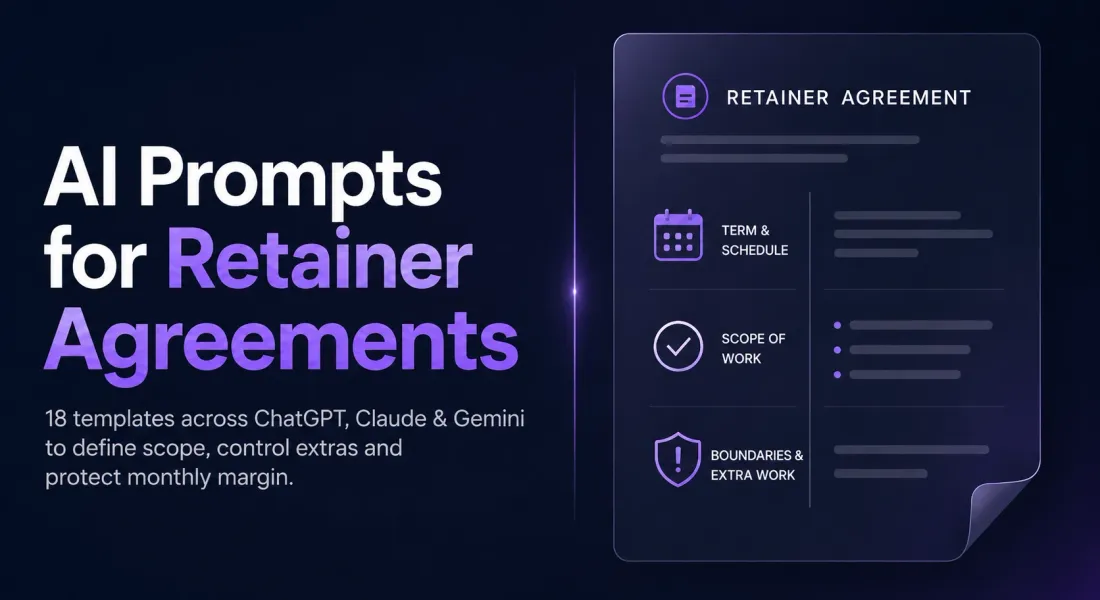
AI prompts for Retainer Agreement: 18 Templates Across ChatGPT, Claude And Gemini
A retainer is a promise to be available, and availability is the easiest thing in business to overspend. The document that defines one has a single job everything else hangs from: drawing the line between what the monthly fee covers and what it does not. Get that line wrong and you spend the relationship doing favours you never priced, or the client feels charged for things they assumed were part of the deal. The agreements that keep both sides happy are specific about the monthly scope, honest about what counts as extra, clear on what happens in the quiet months and the overloaded ones, and calm about how either party walks away.
The 18 templates below sit six each with ChatGPT, Claude and Gemini, and each is built to draw that line cleanly. The ChatGPT set produces full agreements, tiered service levels and scope schedules. The Claude set handles the clauses that decide disputes later: inclusions and exclusions, hour banking, rate reviews and termination. The Gemini set researches market rates, the retainer structures common in your field, and the benchmarks that tell you whether your pricing will hold.
Why AI Works Well For Retainer Agreements
A retainer agreement is mostly a set of boundaries written down: what is included, what is not, how much, for how long, and what happens at the edges. Models are dependable at boundary-setting language once you tell them exactly where the lines sit. The commercial judgement stays with you. The clean, unambiguous wording, where most disputes are actually won or lost, is where AI earns its keep.
Each Model Has A Different Edge
ChatGPT drafts the full agreement and the service tiers fastest. Claude is the most careful with the clauses that settle arguments, the inclusions, exclusions and exit terms. Gemini is best for checking your rates and structure against the market before you commit them to paper.
The Monthly Boundary Is Everything
A retainer lives or dies on what the fee includes. Every template here forces an explicit included list and an explicit excluded list, because the gap between the two is exactly where your margin quietly leaks away.
Decide What Happens To Quiet And Busy Months
Most retainers go wrong in the months that are unusually slow or unusually heavy. The prompts make the model handle rollover, caps and out-of-scope requests up front, while the relationship is still friendly.
Make The Exit Calm And Mutual
A retainer a client cannot leave cleanly is one they hesitate to sign in the first place. These templates write notice periods and wind-down terms that read as fair, which makes the whole agreement easier to say yes to.
ChatGPT prompts For Retainer Agreements
ChatGPT is the drafter that gets you from a rough idea to a structured agreement fastest. It is well suited to laying out the full document, building service tiers and writing a scope schedule you can hand to a client. The six templates here cover the documents you reach for most, from a complete agreement to a plain-English summary page.
1. Full Retainer Agreement From Scratch
Act as an experienced service provider drafting a monthly
retainer agreement for a client.

Context:
- My service: [what you provide]
- Client: [name and what they do]
- Monthly fee: [figure]
- What the fee covers each month: [the core deliverables]
- Term: [minimum commitment, then rolling]
- How they pay: [in advance, monthly]

Write a clear retainer agreement with these sections:
1. Parties and start date
2. Services included each month, listed specifically
3. Services not included (out of scope)
4. Fee, billing date and payment terms
5. How additional work is requested, quoted and approved
6. Response times or availability, if any
7. Term, renewal and notice to end
8. What happens to work in progress if it ends

Rules:
- Plain business English, not heavy legal drafting.
- Make the included and excluded lists equally specific.
- Note at the end that a qualified professional should review
  it before signing.
Where it works best: ChatGPT produces a complete, readable agreement with the included and excluded lists already separated, so the monthly boundary is clear from the first draft.
Best for: Setting up a new ongoing client when you have agreed the arrangement verbally and need it written down.
2. Tiered Retainer With Three Service Levels
Act as a service provider offering a retainer at three
levels so clients can choose their commitment.

Context:
- My service: [what you provide]
- The three tiers I have in mind: [rough idea]
- The constraint clients usually weigh: [budget, volume,
  speed]

Write a tiered retainer with:
1. Three named tiers, each with its own monthly fee
2. A clear list of what each tier includes
3. What changes as you move up: volume, speed, access
4. A short note on how to switch tiers month to month

Rules:
- Each tier must include something the one below does not.
- Make the middle tier the natural recommendation.
- Keep every inclusion specific and countable where possible.
Where it works best: ChatGPT lays out tiered service levels cleanly and keeps the differences between them concrete rather than vague adjectives like ‘priority’ with nothing behind it.
Best for: Productising a service so clients self-select a commitment instead of negotiating every deal from zero.
3. Scope Schedule: What The Monthly Fee Covers
Act as a service provider writing the scope schedule that
sits behind a retainer fee.

Context:
- Service: [what you do]
- Monthly fee: [figure]
- The deliverables the fee should cover: [list]
- The requests clients try to slip in for free: [list them]

Write a one-page scope schedule with:
1. Included this month: each item, with a quantity or limit
2. Not included: the adjacent work that is quoted separately
3. Fair-use note: how you handle requests that sit on the line

Rules:
- Put a number on anything that can have one (rounds of
  revisions, pieces, meetings).
- The not-included list is the point. Make it thorough.
Where it works best: ChatGPT turns a fee into a defensible schedule by attaching quantities and limits, which is what stops ‘unlimited’ creeping in by default.
Best for: Existing retainers where the client keeps adding small requests that were never priced in.
4. Retainer That Converts A Project Client To Ongoing Work
Act as a service provider proposing a retainer to a client
who just finished a one-off project with me.

Context:
- The project we just delivered: [what it was]
- The ongoing need it revealed: [what they will keep needing]
- Proposed monthly scope and fee: [details]

Write a short proposal plus retainer terms that:
1. Reference the project and the momentum we have built
2. Name the ongoing work that is better handled monthly than
   as repeated one-offs
3. Lay out the monthly scope, fee and term
4. Make the included and excluded lists explicit
5. Offer a clean first-month review point

Rules:
- Lead with their continuing need, not your desire for
  recurring revenue.
- Keep it warm and specific.
Where it works best: ChatGPT frames the move from project to retainer around the client’s continuing need rather than your cash flow, which is what makes the pitch land.
Best for: The end of a successful project, when the relationship is warm and the ongoing need is obvious.
5. Plain-English Summary Page For A Dense Agreement
Act as a service provider writing a one-page summary that
sits in front of a detailed retainer agreement.

Here is the full agreement:

[paste it]

Write a plain-English summary covering:
- What the client gets each month
- What it costs and when they pay
- What is not included
- How to ask for extra work
- How either side ends it

Rules:
- No jargon. A non-specialist should understand it in a
  minute.
- The summary must not contradict the full agreement.
Where it works best: ChatGPT distils a dense agreement into a readable front page without quietly changing the terms underneath it.
Best for: Reducing back-and-forth by giving a busy client the gist before they read the detail.
6. Retainer For A Client Who Wants Everything
Act as a service provider setting firm, friendly boundaries
with a client who expects the monthly fee to cover anything
they ask for.

Context:
- Service: [what you do]
- Monthly fee: [figure]
- The 'just one more thing' requests I keep absorbing: [list]

Write retainer terms that:
1. State generously what the fee genuinely includes
2. Draw a clear line at the work that has to be quoted
   separately
3. Give a simple, low-friction way to request and approve
   extra work
4. Keep the tone collaborative, not defensive

Rule: the client should feel well looked after and still
understand exactly where the line is.
Where it works best: ChatGPT writes boundaries that hold without souring the relationship, pairing a generous inclusion list with a clear edge.
Best for: The good client whose scope keeps expanding because nobody has written the limit down.
Claude prompts For Retainer Agreements
Claude is the model for the careful parts. It keeps long, interlocking clauses consistent and is the least likely to write an exclusion on page two that contradicts an inclusion on page four. Use these six when the wording has to be precise and the input is a tangle of emails or an old agreement that needs fixing.
7. Inclusions And Exclusions Clause, Line By Line
Act as a careful drafter writing the inclusions and
exclusions clause of a retainer, where most disputes start.

Context:
- Service: [what you provide]
- Everything the fee should cover: [full list]
- Everything clients assume is included but is not: [list]
- The genuine grey areas: [list]

Write two parallel lists and a grey-area rule:
1. Included: each item, specific and bounded
2. Excluded: each item, with a one-line reason it sits
   outside the fee
3. For each grey area, state plainly which side of the line
   it falls on and why

Rules:
- No item should appear ambiguous after this clause.
- Keep included and excluded perfectly consistent with each
  other.
Where it works best: Claude holds the two lists consistent so an excluded item never accidentally reappears as included, which is the failure that causes most retainer arguments.
Best for: The clause you will point to in every disagreement about what the fee actually buys.
8. Hour Banking, Rollover And Overflow Terms
Act as a careful drafter writing the clauses that govern
quiet months and busy months on a retainer.

Context:
- Monthly fee and the capacity it buys: [hours or volume]
- My policy on unused capacity: [rolls over / expires]
- My policy on going over: [extra is quoted / billed at a
  set rate]

Write clear terms covering:
1. What the monthly capacity is and how it is measured
2. What happens to unused capacity at month end
3. What happens when a month runs over, and how overflow is
   approved before it is charged
4. A cap so neither side gets a surprise

Rules:
- Remove every ambiguity about counting and timing.
- Make the overflow approval step explicit so nothing is
  billed without a yes.
Where it works best: Claude keeps the counting, rollover and overflow rules internally watertight, so the edge-case months do not become invoices nobody agreed to.
Best for: Capacity-based retainers where some months run light and others run hot.
9. Rate Review And Annual Increase Clause
Act as a careful drafter writing a fair, predictable rate
review clause for a retainer.

Context:
- Current monthly fee: [figure]
- How often I want to review the rate: [annually]
- The basis for any increase: [inflation, scope growth, a
  fixed percentage]
- Notice I will give before any change: [period]

Write a rate review clause that:
1. States when reviews happen and how much notice precedes
   a change
2. Explains the basis for an increase in plain terms
3. Gives the client a clear option if they do not accept it
4. Avoids any open-ended right to raise the fee at will

Rule: the client should always be able to see a price
change coming and decide what to do about it.
Where it works best: Claude writes a balanced review clause that protects your pricing over time without reading as an unlimited licence to raise the fee, which clients refuse to sign.
Best for: Long-running retainers where holding the same rate for years quietly erodes your margin.
10. Termination, Notice And Wind-Down Terms
Act as a careful drafter writing the clauses for ending a
retainer cleanly, from either side.

Context:
- Notice period I want: [e.g. 30 days]
- What I hand over at the end: [files, access, work in
  progress]
- How the final month is billed: [pro rata, full]

Write termination terms covering:
1. How either party gives notice and when it takes effect
2. What is delivered and handed over during wind-down
3. How the final invoice is calculated
4. What happens to prepaid but unused capacity

Rules:
- Make it symmetrical and fair to both sides.
- Keep it practical. Do not stray into enforceability or
  legal remedies.
Where it works best: Claude produces a clean, even-handed exit that covers handover and the final bill, the details people forget until the relationship is already ending.
Best for: Giving a prospective client the confidence that signing on does not mean being trapped.
11. Turn A Messy Email Thread Into A Clean Retainer
Act as a drafter turning an informal email negotiation into
a structured retainer agreement.

Below is the full email thread where the client and I agreed
the arrangement. Read all of it first.

[paste the thread]

From the thread:
1. Extract everything we actually agreed: scope, fee, term,
   payment, anything about extras
2. Draft a clean retainer agreement from those points
3. List anything we discussed loosely but never pinned down,
   so I can confirm it before sending

Rules:
- Do not invent terms we did not discuss.
- Flag every gap rather than filling it silently.
Where it works best: Claude reads a long thread faithfully and separates what was agreed from what was only floated, so the formal document matches the real conversation.
Best for: Formalising a deal that was hammered out over a week of back-and-forth emails.
12. Stress-Test An Existing Retainer For Loopholes
Act as a reviewer pressure-testing my current retainer for
the gaps a client could exploit, intentionally or not.

Here is the agreement:

[paste it]

Review it and report:
1. Where the scope is ambiguous enough to be argued
2. Where 'unlimited' or undefined terms create open-ended
   obligations
3. Where the exit, rate review or overflow terms are unclear
4. For each issue, a tighter wording I could use instead

Rules:
- Be specific about which sentence is the problem.
- Suggest fixes in plain language, and note that a
  professional should review any change.
Where it works best: Claude reads a whole agreement and finds the soft spots, pointing at the exact sentence rather than offering generic advice.
Best for: An old retainer you copied from somewhere and never properly checked.
Gemini prompts For Retainer Agreements
Gemini is the model that checks your assumptions against the outside world. Before you set a monthly fee or decide how many hours it buys, these six templates research what your field actually charges and how peers structure the same arrangement, so your terms are competitive rather than guessed.
13. Benchmark Retainer Pricing In Your Field
Act as a research analyst helping me price a retainer.

Service: [what you provide]
Region: [where you and the client are]
Client type: [size or sector]

Research and report:
1. The typical monthly retainer range for this service
2. What is usually included at the low, middle and high end
3. Whether the norm is fee-for-access or fee-for-output
4. Where my proposed fee would sit against the market

Rules:
- Give ranges and note where sources disagree.
- Do not present a single figure as if it were settled fact.
Where it works best: Gemini gathers current pricing signals so you set a monthly fee with a sense of the market rather than a finger in the air.
Best for: Pricing a retainer for the first time, or suspecting you have been undercharging for years.
14. Research Typical Retainer Structures For Your Service
Act as a research analyst summarising how retainers are
normally structured in my field.

Service: [what you do]

Research and report:
1. The common structures (hours-based, deliverable-based,
   access-based) and where each suits
2. The typical minimum term and notice period
3. How peers usually handle extra work beyond the retainer
4. The structure clients in this field tend to prefer, and
   why

Rules:
- Cite sources.
- Note any structure that is falling out of favour.
Where it works best: Gemini maps the structures that are normal in your field, so your agreement matches what clients already expect instead of confusing them.
Best for: Deciding whether to sell access, hours or output before you draft anything.
15. Check Your Inclusions Against The Market
Act as a research analyst checking whether my retainer
inclusions are competitive.

Service and monthly fee: [details]
What I currently include: [list]

Research and report:
1. What providers at a similar fee typically include
2. Anything I include that is more generous than the norm
3. Anything clients now expect as standard that I have left
   out
4. Where I could trim or add to match the market

Rules:
- Distinguish genuine market norms from one-off examples.
- Cite where each point comes from.
Where it works best: Gemini compares your inclusions to the going rate, catching both the over-generous terms costing you margin and the gaps that make you look thin.
Best for: A retainer that feels mispriced but you cannot tell whether you are giving away too much or too little.
16. Find The Right Hours-To-Fee Ratio
Act as a research analyst helping me set a defensible
hours-to-fee ratio for a retainer.

Service: [what you do]
Proposed monthly fee: [figure]
Hours I am considering attaching to it: [number]

Research and report:
1. The typical effective rate per hour implied by retainers
   in this field
2. Whether my proposed ratio is generous, fair or thin
3. How peers protect themselves when hours and fee drift
   apart

Rules:
- Give ranges, not false precision.
- Note the conditions that move the rate up or down.
Where it works best: Gemini grounds the hours you attach to a fee in researched rates, so the capacity you promise still leaves you profitable.
Best for: Capacity-based retainers where the number of hours decides whether the deal makes money.
17. Research How Peers Handle Scope Creep
Act as a research analyst gathering practical approaches to
scope creep on retainers.

Service: [what you do]

Research and report:
1. The methods providers use to keep extra requests from
   eroding a retainer
2. How they word the moment a request becomes chargeable
3. The approaches clients accept without friction, and the
   ones that cause resentment

Rules:
- Favour approaches that preserve the relationship.
- Cite sources where you can.
Where it works best: Gemini surfaces the scope-control tactics that work in practice, so you can borrow wording that clients accept rather than inventing your own and hoping.
Best for: Writing the extra-work clause when you know scope creep is your weak point.
18. Build The Renewal Case With Industry Context
Act as a research analyst helping me make the case to renew
or extend a retainer.

Client: [name and sector]
What the retainer has delivered: [results so far]
What I am proposing for the next term: [scope and fee]

Research and draft:
1. The industry context that makes continuing the work
   sensible right now
2. Two or three references that support the value of ongoing
   support over stop-start work
3. The objection the client is most likely to raise at
   renewal, and the answer

Rules:
- Ground the case in the results already delivered.
- No unverified figures.
Where it works best: Gemini frames a renewal in current industry context and arms you for the predictable objection, turning a nervous renewal conversation into a confident one.
Best for: The renewal discussion at the end of a term, when the client is quietly weighing whether to continue.
How To Get More From Each Prompt
Each template is a head start, not a finished contract. A few habits get noticeably more out of every prompt above, on any model, and they hold for any AI prompt to write a retainer agreement you keep for your own use.
Make It Specific Before You Trust It
The first draft will hedge. Tell the model which clause is too loose, ask it to put a number on a limit, make it name the grey areas. Specificity is the whole value of a retainer, so keep pushing until nothing is ambiguous.
Run The Prompts In A Chain
Use one output as the next input. A benchmarking prompt sets the fee, the fee feeds the full agreement, the agreement feeds the plain-English summary. Each step builds on a checked foundation.
Keep The Clauses That Held Up
When an inclusions list or an exit clause survives a real negotiation without trouble, save it. A library of clauses that have already worked beats redrafting the same boundary every time.
From Prompt To Branded Retainer Agreement
A model gives you the wording. It does not give you a branded retainer agreement your client can read, sign and refer back to, or any way to know whether they actually opened it. Branding the document, sending it for signature and confirming it is signed is the part that usually drags.
This is where Proposal.biz fits in.
Bring In Your Brand Automatically
Paste your website address and your logo, colours and services populate a Smart Content Library, so the agreement looks like yours without you formatting a thing.
Generate The Branded Agreement
Describe the retainer and it produces a fully branded document, ready to refine in the editor rather than rebuilt by hand.
Send It For Signature And Track It
Send a shareable link, see when the client views it, and once they sign you have the signed status and date with a confirmation email to both parties.
The workflow is simple: draft with whichever prompt above fits the arrangement, then move it into Proposal.biz to brand, send and have it signed. You keep the speed of the model and add the layer that gets the agreement in front of the client and confirmed.
Final Word
A retainer agreement is the document both sides reach for the first time there is a disagreement about what the fee covers. Make the boundary unmistakable. The discipline lives in the parts most templates skim: an excluded list as careful as the included one, clear rules for the quiet and busy months, and an exit either side can take without a fight. Write those well and the relationship runs on goodwill instead of arguments. None of this is legal advice, so have a qualified professional check anything contractual before you sign.
A prompt gives you the words. Proposal.biz gives you a branded retainer agreement you can send, sign and confirm in about 60 seconds, and shows you when the client opened it. If that final stretch is what slows you down, start your free trial and put your next agreement together the easy way.
Frequently Asked Questions
What is the best AI prompt for retainer agreement writing?
It depends on which part you are stuck on. For a complete first draft, the from-scratch ChatGPT template is the quickest start. For the clauses that decide disputes, the Claude inclusions, overflow and termination templates are the most reliable. For pricing the thing in the first place, the Gemini benchmarking templates come first. Any AI prompt to write a retainer agreement is a frame you adapt with your own scope and fee, not a finished contract you sign as-is.
Which AI tool is best for writing a retainer agreement?
Each has a role. ChatGPT is fastest at drafting the full agreement and service tiers. Claude is the most careful with long, interlocking clauses where one ambiguous line causes the next argument. Gemini is the strongest for researching market rates and structures before you set your terms. Used together, one researches, one drafts and one stress-tests the wording.
How do I write retainer scope so the client cannot keep adding work?
Write the excluded list as carefully as the included one, put a number on anything countable like revisions or meetings, and add a simple step where extra work is quoted and approved before it is done. The dedicated scope and inclusions templates in this guide do exactly that. The line you write while the relationship is friendly is what protects you in the month it gets tested.
Can I reuse these prompts for different services and retainer sizes?
Yes. The shape of a retainer holds whether you are charging a few hundred a month or a five-figure fee. The variables that change, the service, the inclusions, the fee, the term, all live in the bracketed inputs, so you swap those and keep the structure. For an unfamiliar service, run the Gemini structure and pricing templates first so your terms match the norm.
How do I turn the AI output into a branded retainer agreement I can send and sign?
A model gives you the words, not a branded document or a way to know whether the client read it. Tools like Proposal.biz close that gap: paste your website address to pull your brand into a Smart Content Library, generate a fully branded retainer agreement from a prompt, then send a shareable link and track views. When the client signs, you see the signed status and date and both parties get a confirmation email. For anything legally significant, have a professional review the terms first.

Ronak Surti

 Ronak Surti