
Table of Contents
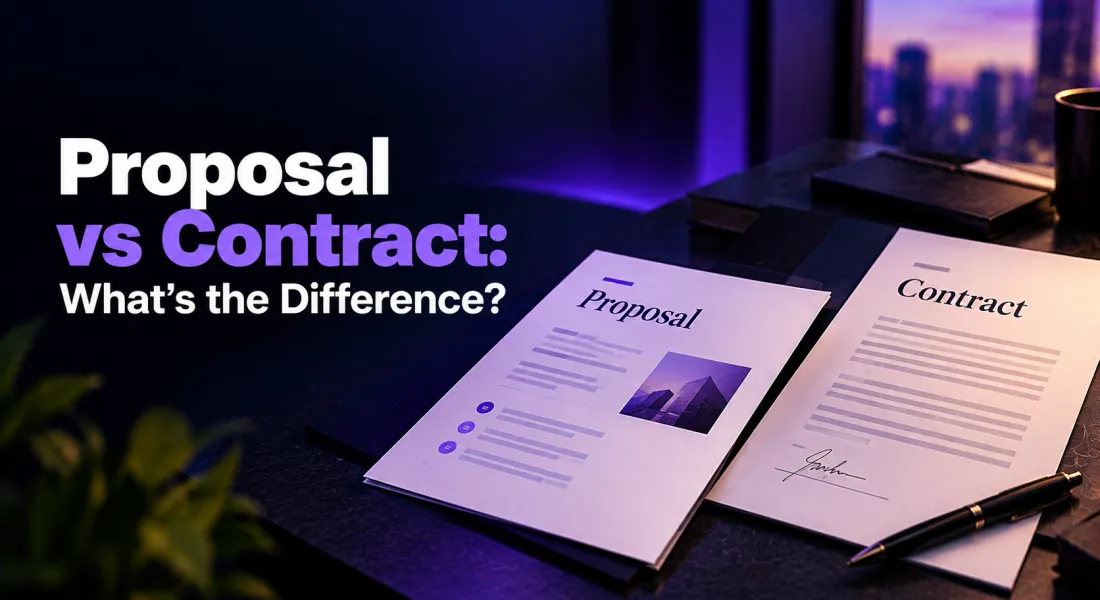
Proposal vs Contract: What’s the Difference?
A proposal is a persuasive offer that explains what you will do for a client and why it is worth the price. A contract sets out the obligations both sides must meet once the work is agreed. Most client work needs both: the proposal wins the work, and the contract protects it.
The confusion is understandable. Both documents describe scope, timelines and pricing, both get sent to the same client, and both often end with a signature. But they do different jobs, at different moments, in a different tone.
This guide puts proposal vs contract side by side (including what people usually mean when they search for a contract proposal), answers whether a proposal counts as a contract, and shows when one document is enough and when you need both. If you send client documents every week, proposal and contract software keeps the two connected so nothing gets lost between them.
Proposal vs Contract: Key Differences at a Glance
| Proposal | Contract | |
|---|---|---|
| Purpose | Win the work | Protect the work |
| Timing | Before the client says yes | After the client agrees in principle |
| Who writes it | Usually the seller or service provider | The provider, the client’s legal team, or both |
| Tone | Persuasive and client-focused | Precise and neutral |
| Typical contents | Problem, approach, scope, timeline, pricing options, proof | Deliverables, payment terms, revisions, IP, termination, liability |
| Length | Often 3 to 15 pages, built to be skimmed | As long as the terms require |
| Creates obligations? | Usually not on its own, though an accepted proposal with clear terms can | Yes, once both parties agree |
Send the proposal and the terms in one document your client can sign. Create your first document free.
What Is a Proposal and What Does It Do?
A proposal exists to win the work. It shows the client you understand their problem, explains how you will solve it, and makes the price feel like a fair trade for the outcome.
A strong proposal usually covers six things: your understanding of the client’s situation, your approach, the scope of work, a timeline, pricing (often with two or three options), and proof such as case studies or relevant results. The tone is persuasive, but every claim should be specific enough for the client to check.
Because a proposal is a sales document, it gets read by people who never joined your calls. Write it to stand on its own. If you want a full structure to follow, see this guide on how to write a business proposal.
What Is a Contract and What Does It Do?
A contract exists to protect the work once the client has agreed to it. It turns the promises in your proposal into obligations both sides can rely on, and it sets the rules for what happens when something changes or goes wrong.
Most service contracts cover deliverables, payment terms and schedule, the number of revisions included, who owns the intellectual property, how either side can end the agreement, and limits on liability. The tone is precise. Ambiguity that reads as friendly in a proposal becomes a dispute in a contract.
Contracts also come in different shapes. A one-off project usually needs a single services agreement. An ongoing relationship often uses a master agreement with separate statements of work for each project.
Is a Proposal the Same as a Contract?
No, a proposal is not the same as a contract, but the line between them is thinner than most people assume.
What Turns an Agreement Into a Contract
A contract generally needs three things: an offer, acceptance of that offer, and consideration (something of value exchanged, usually work for payment).
When an Accepted Proposal Creates Obligations
A proposal is an offer. If the client accepts it and the proposal already states clear terms, such as scope, price and payment schedule, that acceptance can create obligations for both sides. Whether it does depends on how the proposal is worded and the law where you and your client operate.
So, Is a Proposal a Contract?
So is a proposal a contract? Treat it as one only if you have written it to be one. For most client work, the safer approach is to keep the proposal persuasive and put the binding terms in a contract or a dedicated terms section the client signs.
This article is general information, not legal advice. For anything high-value or unusual, ask a lawyer to review your contract template once, then reuse it.
When to Send a Proposal, a Contract or Both
The right combination depends on the size and shape of the work. Here are three common scenarios.
Small Fixed-Fee Jobs: One Proposal With Signed Terms
For a small, clearly defined job, one document is often enough: a short proposal with a terms section the client signs. It covers scope, price, payment terms and revisions in a few pages, and the signature confirms agreement.
Monthly Retainers: A Proposal Plus a Retainer Agreement
Retainers run for months, so the terms matter more than the pitch. Send a proposal to agree the scope and the monthly fee, then a retainer agreement covering hours, rollover rules, notice periods and what happens to unused time.
Large Projects: A Proposal, a Contract and a Statement of Work
Larger projects usually need three documents: a proposal to win the work, a master contract that sets the legal terms, and a statement of work that defines deliverables, milestones and acceptance criteria. You can create and send statements of work from the same place as the proposal, so the scope never has to be retyped.
The order matters here. The proposal agrees the outcome and the budget, the master contract sets the rules for the whole relationship, and each SOW adds a defined piece of work under those rules. When the next project comes along, you only need a new SOW, not a new contract.
If you write SOWs often, these AI prompts for statement of work drafting speed up the first draft.
How a Proposal Becomes a Contract in 5 Steps
In practice, most deals follow the same path from first pitch to first payment.
• Proposal. You send the offer: approach, scope, timeline and pricing.
• Acceptance. The client agrees, often after a round of questions or a revised option.
• Terms. The agreed scope and price move into a contract or a signed terms section.
• Signature. Both parties sign to confirm the agreement.
• Payment. The client pays the deposit or first invoice and work begins.
Every handoff on that path is a chance for something to slip. Pricing gets retyped, a revision limit disappears, or the signed version lives in an email thread nobody can find. Proposal.biz keeps it in one place: you create and send proposals and contracts from your own content library, share one trackable link, and the client signs and pays in the same window.
Keeping both documents in one system also means one version of the truth. When the client asks to change the scope, you update one document and resend one link, instead of editing a proposal, a contract and an invoice separately.
With built-in e-signatures, signing records the signed status and the signing date, and both parties receive a confirmation email.
Draft the proposal and the contract from your website in minutes. Start free and send both in one link.
Before you send anything for signature, confirm who on the client side can sign on behalf of their company. This guide to signatory authority explains what to check.
What to Include in a Proposal and a Contract
Proposal Checklist: 7 Sections to Include
• A summary of the client’s problem in their own words
• Your approach and why it fits this client
• Scope of work, including what is out of scope
• Timeline with key milestones
• Pricing, ideally with two or three options
• Proof: case studies, results or relevant experience
• A clear next step and an expiry date for the offer
Contract Checklist: 7 Clauses to Include
• Names and details of both parties
• Deliverables and acceptance criteria
• Fees, payment schedule and late payment terms
• Number of revisions included and the rate for extra work
• Intellectual property ownership and usage rights
• Confidentiality, termination and notice periods
• Limits on liability and how disputes are handled
4 Common Proposal and Contract Mistakes
1. Keeping the Scope Only in the Proposal
If the contract does not reference the agreed scope, the client can read the persuasive language in your proposal as a promise. Copy the final scope into the contract or attach it.
2. Leaving Out Revision Limits
“Unlimited revisions” is rarely written down, but it is often implied when nothing is. State how many rounds are included and what extra rounds cost.
3. Pricing That Disagrees Between Documents
A discount offered in the proposal and missing from the contract creates an awkward conversation at the worst moment. Generate both from the same source so the numbers match.
4. Burying Agreed Terms in an Email
A payment schedule agreed in a reply chain is hard to prove and easy to forget. Put every agreed term in the signed document, and keep a record of when it went out so your follow-up on a sales proposal is based on facts.
Final Word on Proposal vs Contract
Proposal vs contract is not a choice between two documents. It is a sequence. The proposal earns the yes, the contract makes the yes dependable, and the faster you move from one to the other, the less time the deal has to stall.
Proposal.biz handles both. Paste your URL, generate a branded proposal and contract from your own content, send one trackable link, and let your client sign and pay in the same window. See the plans on the pricing page.
FAQs About Proposal vs Contract
Is a Signed Proposal Enforceable?
It can be. If a proposal contains clear terms such as scope, price and payment schedule, and the client signs to accept it, many jurisdictions treat that as an agreement. The result depends on the wording and local law, so ask a lawyer when the stakes are high.
Can a Proposal Include Terms and Conditions?
Yes. Many service providers add a terms section to the end of a proposal for smaller jobs. Keep the persuasive sections and the terms clearly separated so the client knows which parts set out obligations.
Do I Need a Contract if the Client Has Accepted My Proposal?
For anything beyond a small fixed-fee job, yes. A proposal rarely covers intellectual property, termination, liability or what happens when scope changes. A short contract closes those gaps before they become disputes.
Which Comes First, the Proposal or the Contract?
The proposal comes first. It persuades the client and agrees the scope and price. The contract follows once the client has agreed in principle and turns that agreement into terms both sides sign.
What Is the Difference Between a Proposal, a Statement of Work and a Contract?
A proposal sells the work. A contract sets the legal terms of the relationship. A statement of work defines the deliverables, milestones and acceptance criteria for a specific project, usually under an existing contract.

Ronak Surti

 Prabir Chaudhary
 Ronak Surti

 Dimple Maru