
Table of Contents
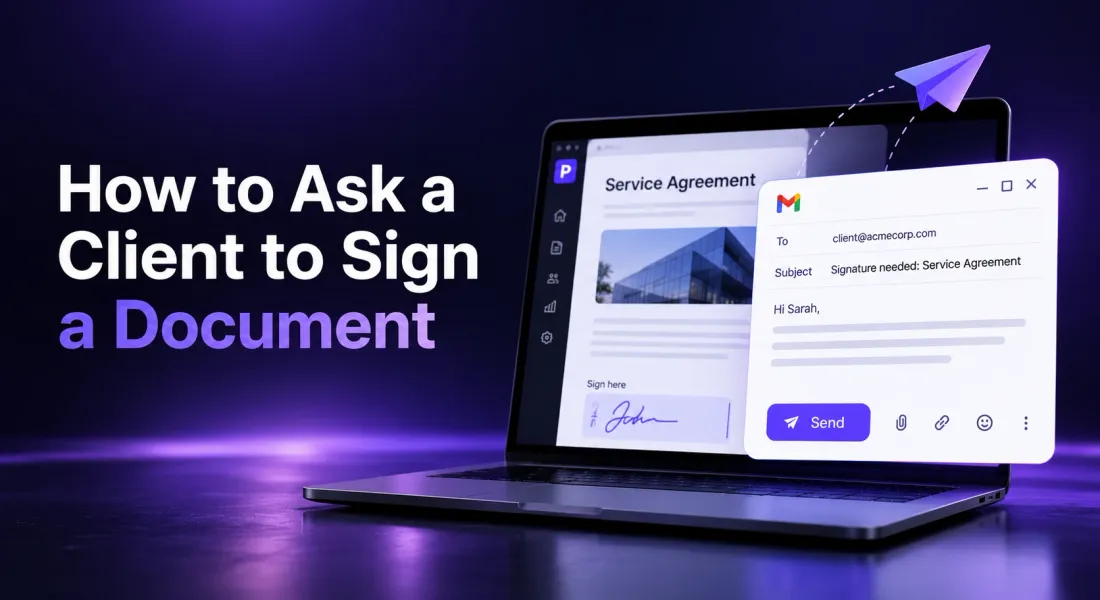
How to Ask a Client to Sign a Document: NDA and Contract Email Examples
To ask a client to sign a document by email, name the document in the subject line, explain in one sentence why it needs signing, link to it, and give a clear date. A good request for signature is short, specific and makes signing take less than a minute.
The awkward part is rarely the wording. It is the gap between “yes, let’s do it” on a call and a signature on the page. Small business owners and freelancers describe the same pattern over and over: the client agrees verbally, the contract goes out, and then it sits unsigned for days or weeks while the work is supposed to be starting.
If you have searched how to ask someone to sign an NDA email templates, the same principles apply to every document. Below you will find why signatures stall, the structure of a good request, ready-to-copy emails for NDAs, proposals, contracts, SOWs and renewals, and follow-ups for when the document is still sitting unsigned.
Why Documents Sit Unsigned
Most unsigned documents are not hidden rejections. When people share what was actually holding things up, the same few causes appear.
The Person You Emailed Cannot Sign
Your champion agreed to the deal, but the signature belongs to a director, a founder or a finance lead who has not seen the document yet. Your email is now waiting in an inbox for an internal conversation you are not part of.
The fix is to ask on the call, before you send anything: “Who will sign this on your side?” Then address the request to that person, with your contact copied.
Legal or Procurement Wants a Look
Larger clients often route contracts through legal or procurement, even for modest amounts. That review can add days or weeks, and nobody tells you it is happening.
Ask early whether the document needs internal review, and offer to send it straight to the reviewer. Knowing the process lets you set a realistic start date instead of guessing.
Something in the Document Changed
If the contract contains anything the client did not expect, such as a new clause, a different payment schedule or a price that does not match the proposal, they often pause rather than ask. Surprises slow signatures more than anything else.
Signing Takes Too Much Effort
Print, sign, scan, email back. Every extra step is a reason to leave it for later. A document the client can read and sign on their phone in a couple of minutes gets signed much sooner.
Send documents your clients can read and sign in one link. Create your first document free.
What a Good Signature Request Email Includes
Every signature request email, whatever the document, needs the same five parts. Get these right and most of the stalls above disappear.
A Subject Line That Names the Document and the Action
“Signature needed: mutual NDA, [Company] and [Your company]” tells the reader exactly what to do before they open the email.
Avoid vague subjects such as “Documents” or “Next steps”. They look like routine admin and get pushed down the list.
One Sentence on Why It Matters Now
Connect the document to something the client wants: “so we can share the product roadmap on Thursday” or “so we can start the project on the 1st”.
This one sentence turns the signature from your admin task into their next step towards an outcome they care about.
A Short Summary of What They Are Signing
Two or three lines covering what the document does and anything that changed since you last spoke. Nobody likes discovering a surprise clause on page six.
If nothing changed, say so: “This matches the scope and fees in the proposal you approved.” That single line removes the need to reread everything.
A Link That Makes Signing Easy
A shared link where the client can read and sign in one place beats printing, scanning and emailing back. With built-in e-signatures, the client signs inside the document, signing records the signed status and the date, and both parties receive a confirmation email.
A Clear Date and a Way to Ask Questions
Give a specific date and invite questions: “If anything needs changing, reply here and we will sort it before then.”
This removes the most common reason for delay: a small question the client did not want to make into a big conversation.
How to Ask Someone to Sign an NDA by Email
NDAs are usually the first document in a relationship, so tone matters. The request should feel like a routine step that protects both sides, not a sign of mistrust.
In consulting and supplier communities, a few points come up again and again. Prospects frequently ask the supplier to sign their NDA before they will share details, and that is normal. When a company sends a one-way NDA that only protects itself, suppliers often push back and ask for a mutual version. And people are understandably wary of long NDAs; a short, plain one gets signed much faster than five pages of dense clauses.
Every how to ask someone to sign an NDA email sample below follows the five-part structure above.
NDA Before a First Meeting
Use this when you want to speak openly in a first meeting. Offering a mutual NDA signals fairness from the start.
Subject: Mutual NDA before our call on [date]
Hi [Name],
I am looking ahead to our call on [date]. So we can talk openly about [topic], we use a short mutual NDA that protects both companies equally.
You can review and sign it here: [document link]
It takes about two minutes. If you would like any changes, just reply and we will update it before the call.
Thanks,
[Your name]
NDA Before Sharing Confidential Material
Use this when you are about to send something sensitive, such as pricing models, a roadmap or client data. Tie the signature directly to what they will receive.
Subject: Signature needed: NDA so we can share [material]
Hi [Name],
We are ready to send over [pricing model, roadmap or data]. Before we do, we need a signed NDA covering it.
The agreement is here: [document link]
Once it is signed, I will send the files the same day. Could you sign by [date]?
Best,
[Your name]
Mutual NDA With a Potential Partner
Partnership talks usually involve both sides sharing information, so a mutual NDA is the natural choice. Offer to involve their legal team rather than waiting for them to ask.
Subject: Mutual NDA: [Company] and [Your company]
Hi [Name],
As discussed, here is the mutual NDA for our partnership talks. It is two-way and standard: it covers anything either side shares about [scope] for [term].
Review and sign here: [document link]
Happy to send it to your legal team first if that is easier. Just let me know who to include.
Best regards,
[Your name]
If you need to draft the NDA itself, these AI prompts for NDA drafting give you a solid first version to review with a lawyer.
Request for Signature Email Examples for Other Documents
The same structure works for every document. What changes is the reason it matters now.
Signing a Proposal
When a client has already said yes to the proposal, the email should feel like a formality that unlocks the start date.
Subject: Ready to start: please sign your [project] proposal
Hi [Name],
Great to hear the proposal works for you. To lock in the [date] start, please sign on the final page: [document link]
As soon as it is signed, I will send the kickoff invite.
Thanks,
[Your name]
Signing a Contract or Service Agreement
Contracts get more scrutiny, so point out anything that differs from what was agreed and offer to involve their legal team.
Subject: Signature needed: [service] agreement, [Company]
Hi [Name],
Below is our service agreement, matching the scope and fees in the approved proposal. The only addition is [clause] that we discussed.
Review and sign: [document link]
Could you sign by [date] so we can start on time? If your legal team needs to review it, let me know who to include.
Best regards,
[Your name]
If agreements go through your own legal team before they are sent, see how Proposal.biz supports legal teams handling a high volume of contracts and NDAs.
Signing a Statement of Work
SOWs often follow a master agreement that is already signed, so keep the email focused on the deliverables and dates.
Subject: SOW for [project phase]: ready for signature
Hi [Name],
Here is the statement of work for [phase], covering [deliverables] and a [date] completion.
Sign here: [document link]
Once signed, the team will begin on [date].
Thanks,
[Your name]
Signing a Renewal
Renewals are easy to delay because nothing breaks immediately. Make the consequence of missing the date clear and calm.
Subject: Your renewal for [period]: signature needed by [date]
Hi [Name],
Your current agreement ends on [date]. The renewal keeps everything the same, apart from [change].
Review and sign: [document link]
Signing by [date] avoids any gap in service.
Best,
[Your name]
”Please Review, Sign and Return”: Wording That Works
Searches for “please review sign and return”, and even “please signed and return”, show how often people reach for this phrase. The correct wording is “please review, sign and return”.
It is grammatically fine, but it is also one of the most formal, impersonal lines in business email. It works better when you replace it with something that tells the reader what they get out of signing.
| Instead of | Try |
|---|---|
| Please sign and return at your earliest convenience. | Could you sign by Friday so we can start on the 1st? |
| Kindly find attached the contract for signature. | Here is the agreement we discussed. You can sign it here: [link] |
| Please review, sign and return. | Please review and sign here. It takes about two minutes: [link] |
| Awaiting your signature. | Once you sign, I will send the files the same day. |
If the document is signed through a link, “return” no longer applies. Signing is recorded automatically, with a confirmation email to both parties, so you can drop that word entirely.
How to Choose the Right Tone for a Signature Request
The same request can sound routine or pushy depending on a few words. Match the tone to the relationship and the document.
New Relationships: Explain and Reassure
With a new client or partner, explain why the document exists and what it protects. A sentence such as “this is our standard mutual NDA and it protects both sides equally” removes suspicion before it starts.
People in founder and partnership communities make the same point: asking someone to sign an NDA should never feel confrontational. Framed well, it signals that you take their information seriously.
Existing Clients: Keep It Brief
A client who has signed with you before needs less context. Name the document, note any change from last time, and link it.
Over-explaining to a long-standing client can even feel odd, as if something unusual is going on. Match the tone of your previous exchanges and keep it as routine as it really is.
Urgent Deadlines: Tie the Date to Their Goal
When time matters, connect the deadline to something the client wants, such as a start date or a launch. A deadline that serves them reads as helpful; one that serves only you reads as pressure.
Subject Lines for Signature Request Emails
• Signature needed: [document], [Company]
• Ready to start: please sign by [date]
• Mutual NDA before our call on [date]
• Final step: your [project] agreement
• [Document] ready for your signature
How to Follow Up When a Document Is Still Unsigned
Follow up with help, not pressure. Many small business owners settle on a simple rule: send the document straight after the call, follow up once after about three days, then escalate with a clear deadline if it is still unsigned.
A Gentle Reminder After Two or Three Days
Assume the best. The client is busy, not avoiding you, and a short reminder with the link is often all it takes.
Subject: Re: Signature needed: [document]
Hi [Name],
Just bringing this back to the top of your inbox. Is there anything in the [document] you would like to change before signing?
Here is the link again: [document link]
Thanks,
[Your name]
A Reminder With a Real Deadline
If the start date depends on the signature, say so plainly and give the consequence: the next available start.
Subject: [Document]: signature by [date] to keep [start date]
Hi [Name],
To keep the [start date] we agreed, we need the signed [document] by [date]. After that, the next available start is [later date].
Sign here: [document link]
Happy to jump on a quick call if anything is holding it up.
Best,
[Your name]
When to Stop Work Until It Is Signed
A painful lesson that comes up often in freelance forums: starting work before anything is signed, then struggling to get paid when the client goes quiet. If the work has a meaningful cost, wait for the signature, and say so politely in your reminder.
If you can see whether the document has been opened, your follow-up gets sharper. An unopened document needs a nudge or a different contact; an opened one that is still unsigned usually means a question. Read more on why e-signatures matter in proposals.
Let clients read, sign and pay from one link. Start free.
4 Signature Request Mistakes to Avoid
Sending an Attachment Without Context
An email that only says “Please see attached” forces the client to work out what the document is and why it matters. Always summarise it in a line or two.
The client then has to open the file, skim it and guess what you need from them. One sentence such as “This is the SOW for phase two, matching what we agreed on Tuesday” saves them that work and gets a faster signature.
Changing Terms Without Saying So
If anything changed since the last version, point it out. Hidden changes destroy trust faster than any delay, and a client who finds one will reread everything else with suspicion.
Even small edits, such as a changed payment date or a tightened revision limit, should be listed in the email. Clients forgive changes they are told about; they rarely forgive changes they discover.
Asking the Wrong Person
Your champion does not always have authority to sign. Ask early who signs, and include them from the start.
Our guide to signatory authority explains what to check before you send.
Making Signing Hard
Printing, scanning and emailing back adds days. A link where the client can sign on their phone removes the friction entirely.
Many clients read email on their phone between meetings. If they can sign there and then, they often will. If signing needs a printer, it waits until they are back at a desk, which can be days.
Final Word on Asking a Client to Sign a Document
Most signature delays are caused before the email is written: the wrong signer, an unexpected clause or a review process nobody mentioned. Ask who signs, flag changes, and make signing take less than a minute. Then follow up with help, not pressure.
Proposal.biz lets you create and send contracts, NDAs and proposals from your own content library, share them as one trackable link, and collect the signature in the same window. With every agreement in one place, you always know which documents are signed, which are opened and which still need a nudge.
FAQs About Asking for a Signature
How Do I Politely Ask Someone to Sign an NDA?
Frame the NDA as a routine step that protects both sides, explain what it lets you share, link to the document, and offer to make changes. A short, mutual NDA usually feels fairer and gets signed faster than a long one-way agreement.
What Is the Correct Phrase: Please Sign and Return or Please Signed and Return?
“Please sign and return” is correct. “Please signed and return” is a common typo. If the client signs through a link, you can simply say “please review and sign here”.
How Long Should I Wait Before Following Up on an Unsigned Document?
Two to three working days is a sensible first follow-up. After that, follow up again with a clear deadline tied to something the client cares about, such as a start date.
Who Should Sign a Document on Behalf of a Client’s Company?
Someone with authority to commit the company, such as a director, an owner or a manager given that authority in writing. Your day-to-day contact is not always that person, so ask who signs before you send the document.
Should I Start Work Before the Contract Is Signed?
For anything with a meaningful cost, it is safer to wait. Starting early leaves you with little leverage if the client changes their mind or delays payment.

Ronak Surti

 Prabir Chaudhary
 Ronak Surti

 Dimple Maru