
Table of Contents
How to Write a Proposal Email (With Examples and Templates)
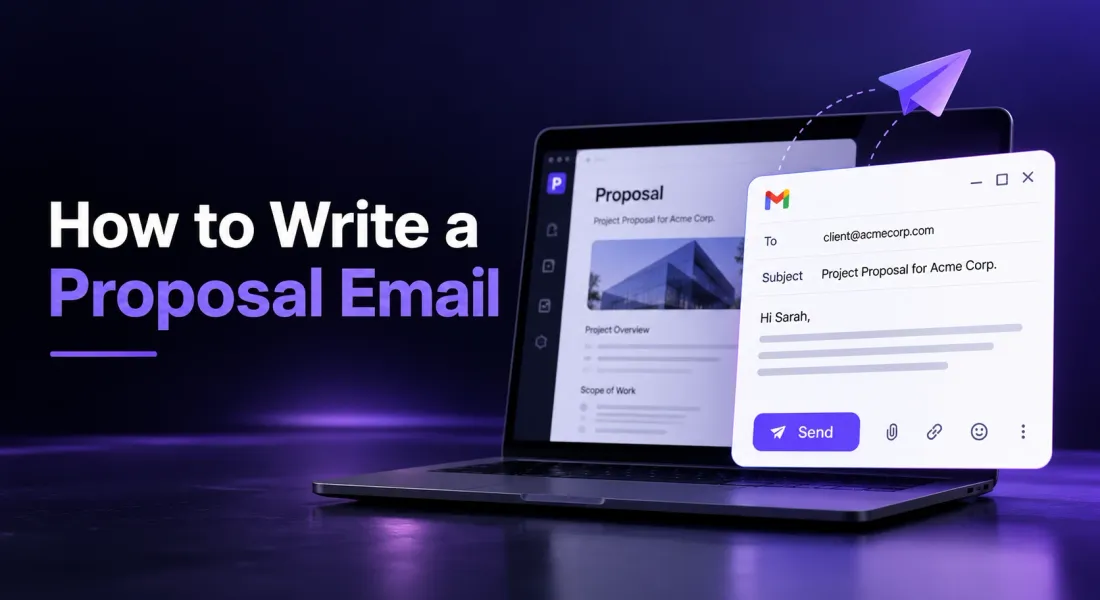
A proposal email introduces your proposal, gives the client a reason to open it, and asks for one clear next step. Keep it under 150 words: open with the client’s goal, summarise your offer in three lines, link to the proposal, and say exactly what happens next.
That sounds simple, but it is where a lot of good work quietly dies. Spend any time in freelance and sales communities and the same complaint comes up again and again: the call went well, the proposal went out, and then nothing. No reply, no rejection, just silence.
Most of that silence has little to do with the proposal itself. It comes from how the proposal was delivered: the wrong moment, the wrong person, a price the client was not expecting, or an email that asked for nothing in particular.
This guide covers how to write a proposal email step by step, the delivery mistakes that cause silence, subject lines, six proposal email examples and a template you can copy. If you also need help with the document itself, start with how to create and send proposals your clients can read on any device.
Why Proposal Emails Get Ignored
Before writing a better email, it helps to know why so many get no reply. These are the patterns that come up most often when freelancers, consultants and sales reps compare notes.
”Send Me a Proposal” Was a Polite Exit
Experienced sellers often point out that “just send me a proposal” is sometimes a way to end a call without saying no. The prospect is not ready, not the decision-maker, or not convinced, and asking for a document is the easiest way out.
If you write a full proposal in that situation, no email wording will save it. The fix comes earlier: before agreeing to send anything, ask what the proposal needs to show, who else will read it and when they plan to decide.
The Price Arrived as a Shock
A recurring story goes like this: a friendly call, no mention of budget, then a proposal with a number the client did not expect. Instead of replying with a question, they simply go quiet.
The common advice is to never let the proposal be the first time the client sees a price. Share a range on the call (“projects like this usually land between X and Y”) so the proposal confirms a number rather than introduces one.
It Went to the Wrong Person
Your contact can love the proposal and still be unable to approve it. If the email only reaches them, it sits in their inbox until they find the time to pass it to whoever decides.
Ask early who signs off on decisions like this and include them, or at least make the proposal easy for your contact to share.
It Arrived Too Late
Interest fades fast after a good call. A proposal that turns up a week later lands in a different week, with different priorities, and often after a competitor has already sent theirs.
Aim to send within 24 to 48 hours of the conversation, while the problem still feels urgent and your call is still fresh in their mind.
Send a proposal worth opening, the same day as the call. Create your first branded proposal free.
Should You Email the Proposal or Present It Live?
This is one of the most debated questions in sales and consulting communities. A strong camp of consultants says they never simply email a proposal. They book a short call, walk the client through it, answer questions on the spot, and send the document afterwards.
The reasoning is sound. On a call, you see reactions to the price, you hear objections while you can still answer them, and the client cannot quietly park the decision.
Others prefer to send the proposal first so the client can review the numbers privately, without feeling pressured. Some send a draft, walk through it together and build the final options with the client, which turns the proposal into a shared plan rather than a pitch.
A practical rule: for larger or more complex deals, present first and email second. For small, well-understood jobs, email the proposal with a clear next step. Either way, the email still matters, because it is what the rest of the buying group will see.
Proposal Email vs Proposal Document: What Goes Where
The most common writing mistake is asking the email to do the proposal’s job. In a business proposal email, the body sets context and earns the click; the proposal itself carries the detail: scope, timeline, pricing, terms and proof.
Because the email usually follows a call, a request or an RFP, the reader is already expecting it. Your job is to make the handover feel effortless.
| Proposal email | Proposal document | |
|---|---|---|
| Job | Get the proposal opened and answered | Win the work |
| Length | Under 150 words | As long as the decision needs |
| Contains | Client goal, three-line summary, link, next step | Problem, approach, scope, timeline, pricing, proof, terms |
| Pricing | A headline figure or range at most | Full pricing with options |
| Read by | Your main contact | Everyone involved in the decision |
How to Write a Proposal Email in 7 Steps
1. Write a Subject Line That Names the Outcome
The subject line decides whether the email gets opened today or next week. Name the client and the result they want, not the document type.
“Proposal: cutting onboarding time for Northwind” tells the reader exactly what is inside and why it matters to them. “Proposal attached” or “Following up” tells them nothing, and gets filed accordingly.
2. Open With the Client’s Goal
Your first sentence should prove you listened. Restate the problem or goal in the client’s own words from the call, for example: “You mentioned onboarding takes three weeks and you want it under one.”
Skip the warm-up lines such as “I hope this email finds you well”. They push the useful part of your email below the preview text, which is often all the client sees before deciding whether to open it.
3. Summarise the Offer in Three Lines
Give the shape of your solution in two or three short lines: what you will do, how long it takes, and the investment range. The detail lives in the proposal; the summary gives the reader a reason to go and read it.
Those three lines should mirror the opening of the proposal itself, so the reader sees the same promise twice. This guide on how to write an executive summary shows how to build that opening.
4. Link to the Proposal Instead of Attaching It
A link opens on any device, never bounces off an attachment filter, and always shows the latest version. If you change a price after sending, the client never ends up reading the old one.
It also tells you whether the proposal has been opened. Email open tracking is unreliable, because some mail apps load messages automatically, but a proposal link only registers when someone actually opens the document.
5. Ask for One Clear Next Step
End with a single, specific ask: a 20-minute call on Thursday, a reply with questions, or a signature by a date. “Let me know your thoughts” puts the work on the client and usually produces no reply at all.
If you are unsure what to ask for, ask for the next conversation. A short call to walk through the proposal is a small commitment, and it is far easier to say yes to than a purchase.
6. Add a Timeline or Validity Date
If the price or start date depends on a decision by a certain day, say so plainly and explain why: “To start on the 1st, we would need a decision by the 20th.”
A real, explained deadline gives the reader a reason to act. An artificial one (“this offer expires Friday!”) tends to read as a sales tactic and erodes trust.
7. Keep the Sign-Off Short and Human
Sign off with your name, role and one line of contact detail. Long signatures with banners, disclaimers and social icons push the important part of your email out of view on a phone.
Read the whole email once on your phone before sending. If the ask is not visible without scrolling, cut something.
Proposal Email Subject Lines That Get Opened
Good subject lines are specific, short and about the client. Adapt these to your situation:
• Proposal: [outcome] for [Company]
• [Company] + [Your company]: plan to [goal]
• Your [project] proposal, as discussed on [day]
• Three options for [goal], [Company]
• Revised proposal: [Company] [project], updated scope
• Following [referrer]‘s introduction: proposal for [goal]
Avoid subject lines that read like marketing (“Exciting opportunity!”), that hide the purpose (“Quick question”), or that only say “Proposal”. The client should know what the email is about before opening it.
Proposal Email Examples for 6 Common Situations
Each proposal email example below follows the same structure: goal, summary, link, next step. Swap the bracketed details for your own, and keep the length roughly the same.
After a Discovery Call
This is the most common situation. The client already knows you and expects the proposal, so the email can be short and direct.
Subject: Proposal: onboarding in under a week for [Company]
Hi [Name],
Thanks for the time on Tuesday. You said new customers take three weeks to go live and you want that under one.
Our proposal covers a four-week project to rebuild your onboarding flow, with two pricing options in the range we discussed. You can read it here: [proposal link]
Could we take 20 minutes on Thursday to walk through any questions?
Best,
[Your name]
Business Proposal Email to a New Prospect
When you are proposing work the prospect has not asked for, the email needs more context and a smaller ask. Lead with something specific you noticed about their business, not with who you are.
For the wider strategy behind this kind of approach, see this guide to the unsolicited business proposal.
Subject: An idea to lift [metric] at [Company]
Hi [Name],
I noticed [specific observation about their business]. Teams in [industry] usually lose [problem] at that stage.
I have put together a short proposal showing how we would fix it, including a pilot that takes two weeks. It is here: [proposal link]
If it looks useful, would a 15-minute call next week make sense?
Best,
[Your name]
Responding to a Request or RFP
Formal requests reward precision. Confirm you have met the brief, mention the decision date and offer to present to the panel.
Subject: [Company] [project]: our proposal
Hi [Name],
Thank you for inviting us to propose on [project]. Our response covers every requirement in your brief, with a timeline that meets your [date] launch.
You can read the full proposal here: [proposal link]
We are happy to present it to your team before your decision on [date]. Would [day or time] work?
Best regards,
[Your name]
Sending a Revised Proposal
When you revise a proposal, say exactly what changed. Clients rarely reread the whole document, and hidden changes create suspicion.
Subject: Revised proposal: [project], updated scope
Hi [Name],
As agreed on our call, we have removed [item] and moved the start date to [date]. The new total is [amount].
The updated proposal is at the same link: [proposal link]
If this matches what you discussed with [stakeholder], the next step is your signature on the final page.
Thanks,
[Your name]
After a Referral
A referral is borrowed trust. Name the referrer in the subject line and connect your proposal to the result you delivered for them.
Subject: Following [referrer]'s introduction: proposal for [goal]
Hi [Name],
[Referrer] mentioned you are planning [project] this quarter. We did similar work for [referrer's company], where [result].
I have outlined how we would approach it for [Company]: [proposal link]
Would a short call this week help you decide if it is worth taking further?
Best,
[Your name]
Renewal or Expansion Proposal
For an existing client, lead with what you achieved together. The renewal should feel like the obvious next step, not a new sale.
Subject: [Company]: next year's plan, building on [result]
Hi [Name],
This year we [specific result]. The renewal proposal builds on that with [new scope], starting [date].
You can review it here: [proposal link]
Could we confirm by [date] so there is no gap in service?
Best,
[Your name]
Proposal Email Template You Can Copy
If you want a single proposal email template to adapt for any client, use this one. It also works as a proposal mail template for teams that want every rep sending the same standard format.
Subject: Proposal: [outcome] for [Company]
Hi [Name],
[One sentence restating the client's goal in their words.]
[Two or three lines: what you will do, how long it takes, the investment range.]
The full proposal is here: [proposal link]
[One specific next step with a day or date.]
Best,
[Your name]
[Role, company, phone]
Turn your call notes into a branded proposal and send it as a link. Start free.
Words and Phrases to Avoid in a Proposal Email
Small wording choices change how an email lands. These come up repeatedly in discussions about emails that annoy clients.
”Kindly” and “Please Find Attached”
Both read as stiff, and “kindly” in particular often comes across as passive-aggressive rather than polite. Write the way you would speak: “Here is the proposal we discussed.”
The test is simple: would you say it out loud to the client across a table? If not, rewrite it. Plain, direct language reads as confident; formal filler reads as a template.
”Just Checking In” and “Per My Last Email”
“Just checking in” adds nothing for the client to respond to. “Per my last email” reads as a complaint. Every follow-up should add something: an answer, a resource or a decision to make.
A better follow-up gives the client a reason to reply: “One question that often comes up at this stage is how the timeline works around your launch. Happy to talk it through.” It moves the conversation on without sounding impatient.
Long Credentials Paragraphs
“We are a full-service agency founded in 2012” tells the reader nothing about their problem. Your credentials belong in the proposal, next to the claims they support.
This guide on how to write a business proposal covers where each section belongs.
What to Do After You Send the Proposal Email
Sending is not the finish line. With document analytics and engagement tracking, you can see when the client opened the proposal and how far they scrolled, so you know whether to answer a pricing question or resend the link.
Use what you see to shape the follow-up. An unopened proposal after three days usually needs a gentle nudge or a different contact. A proposal opened several times and read to the pricing section usually means a conversation is happening internally, and a question is coming.
A common follow-up rhythm among freelancers and sales reps is a light check-in after two or three working days, a follow-up with something useful after a week, a direct question about timing after two weeks, and finally a polite close-out email. That last one, which asks whether to close the file, often gets the reply the others did not.
For full timings and wording, read our guide on how to follow up on a sales proposal.
Final Word on Writing a Proposal Email
Knowing how to write a proposal email comes down to restraint and timing. Agree the price range before you send, send within a day or two, lead with the client’s goal, summarise in three lines, link to the proposal and ask for one next step.
Write the proposal first and the email second: when you know exactly what the document says, the summary almost writes itself.
The email only works if the proposal behind it is strong. Proposal.biz uses AI-powered document generation to turn your call notes and website into a branded proposal, shares it as a trackable link, and lets the client sign in the same window.
FAQs About Proposal Emails
How Long Should a Proposal Email Be?
Aim for under 150 words. The email introduces the proposal and asks for a next step; the proposal carries the detail. Anything longer gets skimmed on a phone, and the ask gets lost.
Should I Attach the Proposal or Send a Link?
Send a link. It opens on any device, avoids attachment filters, always shows the latest version and tells you when the client opened it.
Should I Present the Proposal on a Call or Just Email It?
For larger or complex deals, presenting on a short call and sending the document afterwards usually works better, because you can answer questions and see reactions to the price. For small, well-defined jobs, a clear email with one next step is enough.
How Do I Write a Business Proposal Email to Someone I Have Not Met?
Open with a specific observation about their business, explain the problem it usually causes, link a short proposal, and ask for a small next step such as a 15-minute call.
When Should I Follow Up on a Proposal Email?
Two to three working days is a sensible first follow-up. After that, follow up with something useful, such as an answer to a likely question or a revised option, rather than simply asking if they have read it.

Ronak Surti

 Prabir Chaudhary
 Ronak Surti

 Dimple Maru