
Table of Contents
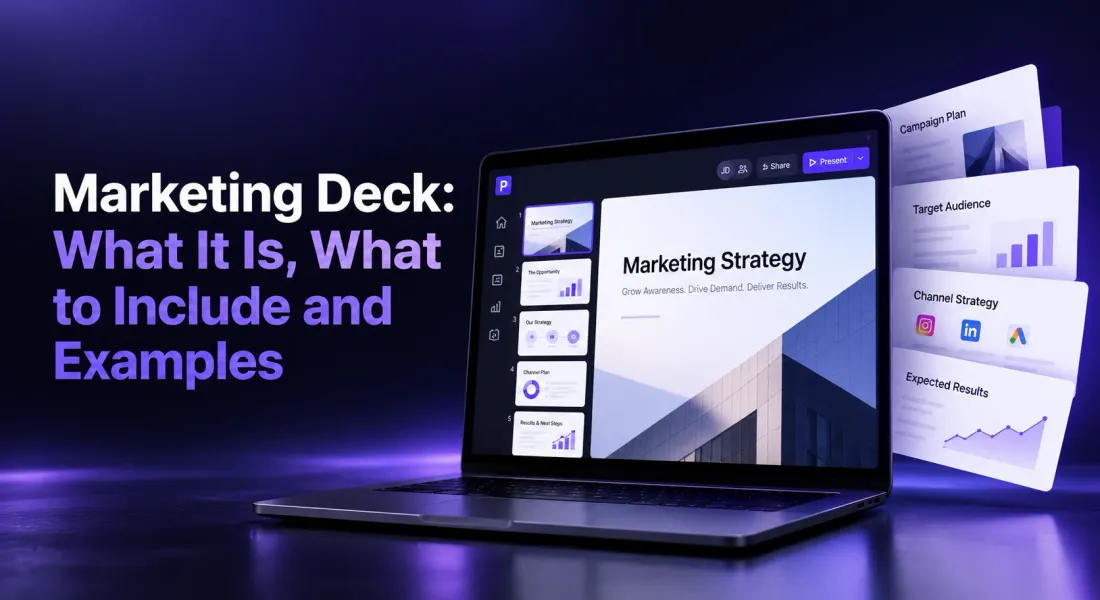
Marketing Deck: What It Is, What to Include and Examples
A marketing deck is a short slide presentation that explains a marketing strategy, plan or campaign: who you are targeting, what you will do, what it costs and how success will be measured. Agencies use it to win clients, and in-house teams use it to win budget and alignment.
The best marketing decks are built around one decision: approve the strategy, fund the campaign, hire the agency. Every slide either moves the reader towards that decision or gets cut.
That last part is where most decks go wrong. In agency communities, a familiar complaint is that pitch decks have crept past 30 slides, take days to assemble and lose the client’s attention long before the strategy appears. This guide is built to help you avoid that.
It answers what is a marketing deck, covers the five types teams use, lists the ten slides most decks need, shares three marketing deck samples, and explains how to build and send one without losing a week to it.
What Is a Marketing Deck?
A marketing deck is a presentation, usually 10 to 20 slides, that turns marketing thinking into a decision someone can make. It sits between a one-page summary and a full marketing plan: detailed enough to justify the spend, short enough to read in one sitting.
It is close to a sales deck but answers a different question. A sales deck asks “should you buy this product?”. A marketing deck asks “should you back this plan?”.
For the sales version, see our guide to the sales deck.
Turn your marketing plan into a branded deck from one prompt. Create your first deck free.
Why Most Marketing Decks Do Not Work
When marketers and agency owners swap notes on decks that lost, the same few problems come up. Fixing these matters more than any design choice.
Too Much Setup Before the Point
Slides about the agency’s history, team, awards and process come first, and the client’s problem appears on slide eight. By then the decision-maker is checking their phone.
Lead with the client’s situation and the one insight that changes how they should think about it. Your credentials can come later, next to the plan they support.
Too Many Slides
Long decks are usually a sign that the team has not decided what matters. A common piece of advice in startup and agency forums is blunt: if it cannot be said in about ten core slides, the thinking is not finished yet.
Move supporting detail to an appendix. Decision-makers read the core; specialists can dig into the rest.
The Slides Duplicate the Presentation
When every slide is a paragraph of text, the presenter ends up reading it aloud, and the room stops listening. Slides should carry the evidence: charts, examples, mock-ups and numbers. The spoken pitch carries the argument.
The exception is a deck that will be read without you, which needs more words. That is why it helps to keep two versions, covered below.
Giving the Strategy Away for Free
Agencies regularly worry about prospects taking the ideas from a pitch and executing them in-house. Show enough to prove you understand the problem and have a credible approach, but keep the detailed execution plan for the paid engagement.
5 Types of Marketing Decks
Marketing Strategy Pitch Deck
An agency or consultant pitching a strategy to a prospective client. A marketing strategy pitch deck needs a sharp diagnosis of the client’s situation, a clear strategy, proof you have done it before, and pricing options.
It is the deck with the most at stake and the most temptation to overbuild. Keep the focus on the client’s problem and the decision you want.
Investor pitch decks follow a different structure, focused on the business rather than a marketing plan. For those, try these AI prompts for pitch deck creation.
Annual or Quarterly Marketing Plan Deck
An internal deck that asks leadership to approve priorities and budget for the period ahead. It focuses on goals, channel mix, budget allocation and the metrics the team will report against.
Leadership will compare it with last period’s plan, so be explicit about what changes and why.
Campaign Proposal Deck
A deck for a single campaign or launch: the audience, the message, the channels, the timeline and the expected result. It is often the shortest of the five, and the best place to show actual creative.
Marketing Performance Review Deck
A deck reporting results against goals, usually monthly or quarterly. It shows what worked, what did not, and what changes next, so it reads more like a report than a pitch.
The most useful slide here is usually the last one: what you will do differently next period, based on what you learned.
Brand or Media Kit Deck
A deck that introduces a brand, publication or creator to partners and advertisers: audience, reach, formats and rates. Keep the numbers current; outdated audience figures undermine everything else.
These decks are often sent cold to potential partners, so the first slide must explain who the audience is and why it matters to the reader. Lead with the audience, not the brand story.
What to Include in a Marketing Deck: 10 Slides
Not every deck needs all ten, but most strong marketing decks follow this order.
1. Title Slide
The client or team name, the decision you are asking for and the date. “Growth plan for [Company], Q1 to Q2” says more than “Marketing Strategy”.
The title slide is also what appears as the preview when the deck is shared, so it should make sense on its own. Avoid clever titles that only work once someone has heard the pitch.
2. Executive Summary
The whole deck on one slide: the problem, the strategy, the investment and the expected result. Some readers will stop here, so it has to stand alone.
Write this slide last, once you know exactly what the deck argues.
3. Situation and Goals
Where things stand today and the specific goals the plan targets. Use the client’s or leadership’s own numbers where you can; numbers they recognise build trust faster than industry averages.
Be honest about the starting point. Decks that exaggerate the problem to make the plan look better are easy to spot, and the client’s team knows their own numbers better than you do.
4. Audience
Who you are trying to reach, what they care about and where they spend their attention. One or two clear personas beat a list of demographics.
Base personas on real evidence where you can: sales call notes, customer interviews or support tickets. A persona built from real quotes is far more convincing than one built from assumptions.
5. Insight
The one observation that makes your strategy the right one: a gap competitors miss, a channel the audience trusts, a message that has not been tried.
This is the slide that wins pitches. If you remove it and the strategy still makes sense, the insight is not strong enough.
6. Strategy
How you will reach the goal, in plain words. If you cannot state it in two sentences, the strategy is not clear yet.
A useful test is to state the strategy as a single choice: “We will win by doing X instead of Y.” Strategy is as much about what you will not do as what you will.
7. Channel and Tactics Plan
Which channels you will use, what you will do in each, and why. A simple table often works better than a slide per channel, and it keeps the deck short.
For each channel, show what it is for (awareness, consideration or conversion) and how it connects to the others. Decision-makers want to see a system, not a list of separate activities.
8. Timeline
Phases and milestones, with the first 30 to 90 days in the most detail. Decision-makers want to know when they will see the first results, so make that date obvious.
Be realistic about ramp-up time. Promising results in week two creates a problem in week three, while an honest timeline with early milestones builds trust.
9. Budget and Pricing
The investment, broken down by phase or channel. In an agency pitch, two or three options let the client choose scope instead of saying no.
Show what each part of the budget buys, and what changes if the budget is smaller. That turns a potential “no” into a conversation about which option fits.
10. Measurement and Next Steps
The metrics you will report, how often, and the one next step you are asking for, such as approval by a date.
Choose metrics the client already cares about and can verify, such as qualified leads or pipeline, rather than vanity numbers. Then end with a single, dated next step.
Marketing Deck Samples: 3 Example Outlines
These marketing deck samples show how the ten slides flex for different situations. Use them as starting outlines.
Agency Marketing Strategy Pitch Deck for a SaaS Client
| Slide | Content |
|---|---|
| 1. Title | Pipeline growth plan for [Client], next two quarters |
| 2. Summary | Organic and paid plan to grow demo requests, three pricing options |
| 3. Situation | Current demo volume, channel mix and cost per lead |
| 4. Audience | Two buyer personas from sales call notes |
| 5. Insight | Comparison searches are underserved by competitors |
| 6. Strategy | Own comparison and use-case search, retarget engaged visitors |
| 7. Plan | Content, paid search and email nurture, with owners |
| 8. Timeline | Weeks 1 to 4 setup, months 2 to 6 scale |
| 9. Pricing | Three retainer options with deliverables per tier |
| 10. Next steps | Kick-off call and signature by a set date |
Internal Annual Marketing Plan Deck
Title and ask, last year in one slide, goals for next year, audience priorities, strategy, channel and budget split, quarterly roadmap, team and hiring, metrics dashboard, approval request.
Keep last year’s review to a single slide so the deck stays focused on what comes next.
Product Launch Campaign Deck
Launch goal, audience, core message and proof, channel plan by launch phase (pre-launch, launch week, follow-through), creative examples, budget, timeline, success metrics, risks and fallback plans.
Show actual creative where you can. A mock-up of the hero ad makes the plan concrete in a way a description never will.
If you write marketing proposals as well as decks, these AI prompts for marketing proposal writing speed up the first draft.
Presenting vs Sending: Build Two Versions
Marketing decks live two lives. In the meeting, you present them, and the slides should be visual and sparse. Afterwards, they get shared around the client’s team and read by people who never heard you speak.
A deck designed for presenting falls flat when read alone, and a deck designed for reading is painful to present. The practical answer is two versions from the same content: a lean presenting deck, and a reading version with short explanatory notes on each slide.
If you only have time for one, build the reading version. More people will read your deck than will ever see you present it.
How to Tailor a Marketing Deck to Your Audience
The same strategy needs a different deck depending on who reads it. Adjust the emphasis before you send it.
For a Founder or CEO
Lead with the business outcome and the investment. Founders want to know what the plan does for revenue or growth and what it costs, before they look at channels.
Keep channel detail to an appendix. A CEO who wants to dig in will ask; one who does not should not have to wade through it to find the answer they need.
For a Marketing Leader
Show the strategy, the audience insight and the channel plan in more depth. A marketing leader will test whether your thinking holds up, so include the reasoning behind each choice.
Expect challenge on the insight and the channel mix, and welcome it. A marketing leader who argues with your plan is engaging with it, which is far better than polite silence.
For a Finance or Procurement Reader
Make costs, payment terms and measurement easy to find. Separate one-off and recurring costs, and show how you will report on results so they can track the return.
Finance readers also want to know what happens if results come in below plan. A short slide on how you will adjust spend shows you have thought about risk to their budget, not just the upside.
Marketing Deck Design Tips
One Idea per Slide
Each slide should make one point, stated in the headline. A reader flicking through the headlines alone should understand the argument.
If a slide needs two headlines, it is two slides. Splitting it often makes the deck shorter overall, because each slide becomes clearer and needs less supporting text.
Use Real Numbers and Real Examples
Replace generic stock imagery with the client’s own data, screenshots of competitors’ ads or mock-ups of your creative. Specifics persuade; decoration does not.
Even one real data point from the client’s own business, such as their current conversion rate, does more than three industry statistics.
Keep a Library of Reusable Slides
Agencies that pitch often keep a set of ten or so core slides (approach, team, case studies, process) that are refreshed regularly and reused, so each new deck only needs the client-specific slides built from scratch.
When you reuse slides from past work, remove anything confidential about previous clients. It is a common slip, and it tells the prospect how you will treat their information.
Keep Your Brand Consistent
Fonts, colours and logo should match across every slide and every deck you send. Inconsistent formatting reads as rushed work.
Paste your website, generate a branded marketing deck and share it as a link. Start free.
This matters even more when decks are assembled from several team members’ slides. A shared template and content library stop a pitch from looking like it was stitched together.
How to Build a Marketing Deck Faster
Building a deck from a blank template usually means hours of copying content, fixing layouts and checking that pricing and case studies are current. That is a big part of why agency decks take so long.
Proposal.biz removes most of that. Paste your website URL and it extracts your logo, colours, fonts, services, pricing and case studies. Then use AI-powered document generation with a prompt such as “Marketing strategy pitch deck for a B2B SaaS client, three retainer options, six-month plan” and get a full branded presentation to refine.
Share the deck as a trackable link instead of a heavy file. You can see when the client opened it and how far they went, then follow up on the slides that matter. When they are ready, they can sign the proposal in the same window.
See how agencies use it on our page for proposal software for marketing agencies.
4 Marketing Deck Mistakes to Avoid
Starting With Your Agency
Three slides about your history before the client’s problem appears loses the room. Put credentials near the pricing, where they support the decision.
Clients already know who you are; they agreed to the meeting. What they want to know is whether you understand their problem, so show that first.
Listing Tactics Without a Strategy
A slide of channels and activities is not a strategy. Explain why these channels, for this audience, now.
A list of tactics also makes your deck easy to compare with any other agency’s. A clear strategy is what makes your pitch different.
Hiding the Price
Decision-makers look for the number first. Make the investment clear and tie it to the expected result.
Burying the investment at the end of an appendix suggests you are nervous about it. State it clearly, next to the result it buys.
No Clear Ask
End with the decision you need and the date you need it by. A deck without an ask becomes a deck without a reply.
If you are unsure what to ask for, ask for the next meeting with the decision-maker. A small, specific ask is easier to agree to than a vague one.
Final Word on Building a Marketing Deck
A marketing deck exists to get one decision made. Lead with the reader’s goal, earn the strategy with an insight, make the plan and the price easy to follow, and end with a clear ask. Keep the core to about ten slides, and build it so it still works when you are not in the room.
For in-house teams producing plans, reports and campaign decks every quarter, see how Proposal.biz supports marketing teams. Every deck starts from your own brand and content, so each version stays consistent.
FAQs About Marketing Decks
What Is a Marketing Deck Used for?
A marketing deck is used to get approval for a marketing strategy, plan or campaign. Agencies use it to win clients; in-house teams use it to secure budget and align leadership.
How Many Slides Should a Marketing Deck Have?
Aim for about ten core slides, and no more than 20 including supporting detail. Move everything else to an appendix so decision-makers can follow the argument quickly.
What Is the Difference Between a Marketing Deck and a Pitch Deck?
A pitch deck usually asks investors to back a company. A marketing deck asks a client or leadership team to back a marketing plan, so it focuses on audience, channels, budget and measurement.
What Should a Marketing Strategy Pitch Deck Include?
A diagnosis of the client’s situation, the insight behind your strategy, the plan and timeline, proof from similar work, pricing options and a clear next step.
How Do I Stop Prospects Taking My Ideas Without Hiring Me?
Show the diagnosis, the insight and the shape of the strategy, but keep the detailed execution plan for the paid engagement. The prospect should understand what you would do, not have a ready-made plan to run without you.

Ronak Surti
![[Stop Wasting Time] A Properly Structured BRD Can Save Your Software Projects](/_astro/How-to-write-BRD.Aqx8EpxY_1tfOOf.webp)
 Dimple Maru
 Ronak Surti