
Table of Contents
Buying Signals in Sales: How to Spot Them and What to Do Next
Buying signals in sales are the words, actions and behaviours that show a prospect is getting closer to a purchase: asking about price or implementation, bringing in colleagues, reopening your proposal, or asking what happens after they sign. Spotting them tells you when to press ahead and what to say next.
The hard part is not noticing signals. It is telling real intent from polite interest. Sales communities are full of reps who are tired of chasing prospects who seemed keen on every call and then disappeared. The cause is almost always the same: reading enthusiasm as commitment.
This guide covers what are buying signals in sales, the signals experienced sellers trust most, the five types to watch, 20 examples with the right response to each, the false positives to ignore, and how to read signals after you send a proposal.
What Are Buying Signals in Sales?
A buying signal is any sign that a prospect is mentally moving from “is this interesting?” to “how would this work for us?”. The shift shows up as a change in the questions they ask, the people they involve and the attention they give your materials.
So what are buying signals, in practice? They are rarely a single dramatic moment. They are a pattern: a pricing question, then a request for references, then a new stakeholder on the next call.
One signal is a hint. Several together, especially ones that cost the buyer time or effort, are a deal making progress.
See when a prospect opens your proposal and how far they read. Send your first trackable proposal free.
Why Buying Signals Matter More When Buyers Research Alone
Buyers do far more of the journey before they talk to you. A Gartner survey published in March 2026 found that 67% of B2B buyers prefer a rep-free experience, up from 61% a year earlier.
That means fewer conversations and fewer chances to read the room. The signals you do get, in calls, in emails and in how prospects engage with what you send, carry more weight than ever.
It also creates tension between teams. Marketing sees research activity and calls it interest; sales finds the same prospects are not ready to talk. Both are right, which is why agreeing on what counts as a real signal matters so much.
For more on how B2B buying is shifting, see our take on the sales trends shaping 2027.
The Buying Signals Experienced Sellers Trust Most
When sales reps discuss which signals actually predict a closed deal, a clear theme emerges: the strongest signals are the ones that cost the buyer something. Enthusiasm is free. Time, access and internal information are not.
They Share Internal Information
A prospect who openly explains their internal politics, budget process, past failures or the real reason the project matters is investing in the conversation. Many reps say this willingness to open up is the single best sign they have a real deal.
They Give You Access to Other People
Introducing you to their boss, finance or the team who will use the product puts their own reputation on the line. Buyers do not do that for vendors they are not seriously considering.
Pay attention to who they introduce you to. Access to the budget holder or the person who will use the product daily is a stronger signal than a meeting with someone else exploring options.
They Commit to Next Steps With Dates
“Let’s talk again soon” is polite. “Let’s get your team on a call on Tuesday and aim to decide by the end of the month” is a buyer. Agreeing on dated next steps, ideally written down together, is one of the most reliable signals there is.
They Do Work on Their Side
Pulling data for you, filling in a requirements document, or testing your product with real work all take effort. A buyer who does homework between calls is moving towards a decision.
The reverse is also telling. If every action item from a call sits on your side and none on theirs, the buyer is letting you do the work while they keep their options open.
5 Types of Buying Signals
Verbal Buying Signals on Calls
Changes in language during a conversation: switching from “if” to “when”, asking about onboarding or timelines, or describing how their team would use the product day to day.
Listen for ownership language too. “Our onboarding would…” or “my team would need…” means they are picturing life after the purchase.
Written Buying Signals in Emails
Faster replies, detailed questions, requests for documents such as procurement questionnaires or sample contracts, and new names appearing in the copy line.
A request for your standard contract or supplier paperwork is especially strong. Nobody asks for that out of curiosity.
Engagement Signals on Your Documents
How a prospect interacts with what you send: opening a proposal several times, reading all the way to the pricing section, or returning to it just before a meeting.
Treat email open tracking with caution. Some mail apps load messages automatically, which can record an “open” nobody made. Engagement with a shared document is a better guide, because it only registers when someone actually opens it.
Organisational Buying Signals
Changes inside the prospect’s company: new funding, a new leader in the role you sell to, hiring for a team your offer supports, or a budget cycle starting.
These signals tell you when to reach out, not whether someone will buy. They open doors; they do not close deals.
Digital Buying Signals on Your Website and Content
Visits to pricing, comparison and case study pages, repeat visits from the same company, and downloads of late-stage content such as ROI calculators or implementation guides.
Many sellers are openly sceptical of third-party intent data, describing much of it as noise. First-party signals, such as someone from a target account reading your pricing page three times this week, are far more useful.
20 Buying Signals Examples and How to Respond
| Buying signal | What it usually means | How to respond |
|---|---|---|
| Asks about pricing or payment terms | Checking whether the budget fits | Give a clear range and ask what budget they are working with |
| Asks how long implementation takes | Picturing life after purchase | Share a realistic timeline and the first 30 days |
| Says “when we” instead of “if we” | Has mentally committed to a change | Ask what a successful first quarter looks like for them |
| Brings a new stakeholder to the call | Building internal support | Ask what that person needs to see and tailor the next step |
| Asks for references or case studies | Looking for proof to share internally | Send one closely matched example, not a list |
| Asks about contract length or cancellation | Assessing risk before committing | Explain terms plainly and offer a shorter first term if possible |
| Requests a proposal or quote | Ready to compare options formally | Agree what it must cover and who will read it, then send within 48 hours |
| Opens the proposal several times | Reviewing or sharing it internally | Offer to walk the team through it |
| Reads to the pricing section | Evaluating cost against value | Offer to talk through options or adjust scope |
| Reopens the proposal before a meeting | Preparing to discuss it | Prepare for pricing and scope questions |
| Asks about integration with their tools | Testing fit with their workflow | Confirm what connects and how setup works |
| Asks what happens after signing | Close to a decision | Explain onboarding and propose a start date |
| Raises a specific objection | Engaged enough to look for problems | Answer directly; objections often come before a yes |
| Asks for a trial or pilot | Wants low-risk proof | Agree success criteria before the pilot starts |
| Replies faster than before | Priority has gone up | Match the pace and suggest a concrete next step |
| Mentions a deadline or event | Has a reason to buy now | Build your timeline backwards from their date |
| Asks about discounts | Planning to buy, negotiating terms | Trade price for commitment, such as term length |
| Visits your pricing page repeatedly | Comparing cost internally | Offer a quote tailored to their size |
| New leader joins in your buyer’s role | New priorities and budget | Reach out with a relevant idea in their first 90 days |
| Asks who else uses the product in their industry | Looking for safety in numbers | Share peer examples and offer a reference call |
How to Respond to Buying Signals
Acknowledge the Signal Directly
When a prospect asks about implementation, answer the question and then ask about their timeline. Treat the signal as an invitation to progress the deal, not just a question to answer.
Many deals stall because the seller answered the question perfectly and then waited.
Move to a Specific Next Step
Every signal should end with a concrete next step: a call with the new stakeholder, a revised proposal, a start date. Vague responses let momentum fade.
Write the agreed steps down and share them after the call. A short list with owners and dates turns a good conversation into a plan both sides can see.
Respond Quickly
Interest cools fast. A proposal requested on Monday and sent on Friday arrives after the buyer has moved on to other priorities.
Speed also signals how you will work together. A seller who takes a week to send a proposal makes the buyer wonder how long support requests will take after they sign.
Confirm Before You Assume
A strong signal is still a hypothesis. “It sounds like the team is keen to start in March. Is that right?” turns a guess into a fact, and surfaces problems while you can still solve them.
False Buying Signals to Watch For
Sales communities have a name for misreading these: “happy ears”, hearing what you want to hear. These are the signals most likely to fool you.
Enthusiasm Without Authority
A junior contact who loves the product is not the same as a decision. Find out early who signs and what they need.
A friendly champion is still valuable; they can help you reach the people who decide. Ask them directly: “Who else will need to be comfortable with this before it goes ahead?”
Pricing Questions That Are Really Budget Checks
Some prospects ask about price to rule you out. If price questions are not followed by implementation or contract questions, the deal is probably still early.
Answer with a range and ask about their budget in return. If the range clearly does not fit, you have saved both sides weeks of effort.
”Send Me a Proposal” With No Context
A request for a proposal at the end of a lukewarm call is often a polite way to end the conversation. Before writing anything, ask what the proposal needs to show and who will read it. Vague answers mean the deal is not real yet.
Information Gathering for a Competitor Comparison
Detailed questions with no stakeholder involvement and no timeline can mean you are the comparison quote. Ask directly where they are in their decision.
There is nothing wrong with being one of several options, but you should know it. It changes how much effort to invest and what your proposal needs to emphasise.
A Single Signal in Isolation
One proposal open or one pricing page visit means little. Look for patterns across several signals before changing your forecast.
Changing your forecast on one data point is how pipelines become unreliable. Wait until two or three signals point the same way before treating a deal as late-stage.
Buying Signal Marketing Strategies
Buying signals are not only a sales concern. The best buying signal marketing strategies make signals easier to see and act on before a rep is involved.
Create Content for Late-Stage Questions
Pricing guides, implementation timelines, comparison pages and ROI examples attract prospects who are close to buying. Visits to these pages are stronger signals than blog traffic.
This content also helps sales directly. A rep who can send an implementation guide in reply to an implementation question looks prepared and keeps the deal moving.
Agree on What Counts as a Signal
Sales and marketing need one shared list of signals and an agreed response to each. Without it, marketing celebrates downloads that sales never follows up, and sales complains the leads are not ready.
Our guide to sales and marketing alignment covers how to set this up.
Route Signals to the Right Person Fast
A pricing page visit from a target account is only useful if the account owner knows about it the same day. Build a simple process for passing high-intent signals to sales.
Keep the process simple: a short daily or weekly list of high-intent accounts, sent to the account owner with a suggested next step, works better than a complex scoring system nobody trusts.
Personalise the Response to the Signal
A prospect who read a comparison page needs a different follow-up from one who downloaded an onboarding guide. Match the next message to what they just looked at.
Generic follow-ups after a specific action waste the signal. The more closely your message reflects what the prospect just did, the more likely they are to reply.
How to Read Buying Signals After You Send a Proposal
The weeks after you send a proposal are where many deals go quiet. Without visibility, you cannot tell whether silence means “not interested” or “discussing it internally”.
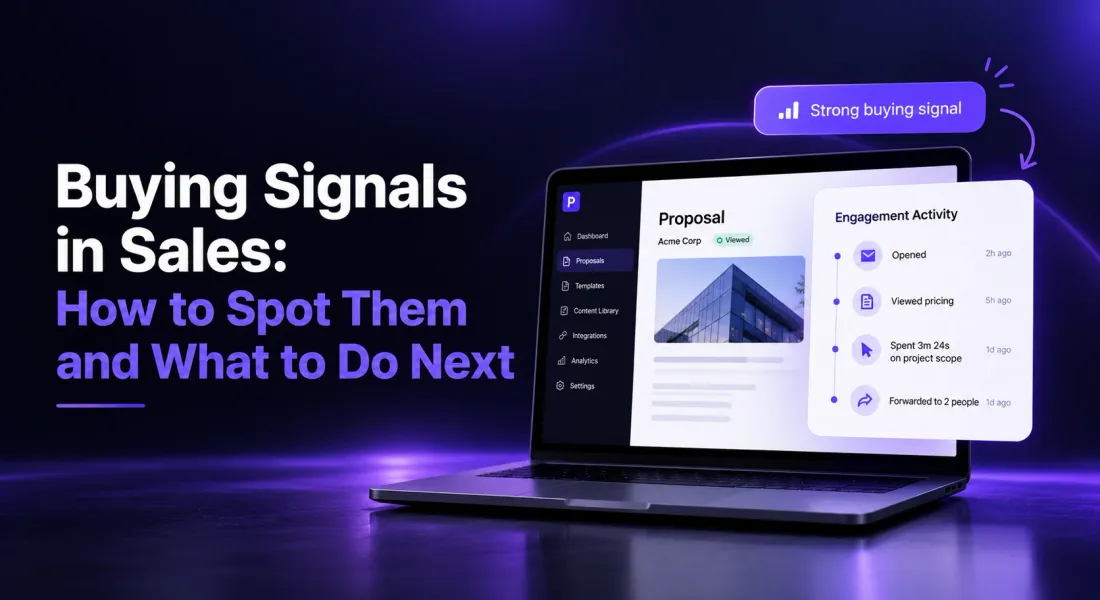
Document analytics and engagement tracking close that gap. You can see when a prospect opened your proposal, how far they scrolled and whether they came back to it.
Read the pattern, not the single event. One open after a long silence means the proposal is back on someone’s desk. Several opens in a day usually means it is being discussed. A proposal never opened after a week usually means it went to the wrong person, or the deal was never real.
For a full walkthrough of what to measure, read our guide on how to track proposal engagement.
Then make the follow-up specific. Instead of “just checking in”, try: “I noticed you have had a look at the options. Would it help to talk through which one fits your team?”
For more timings and wording, see how to follow up on a sales proposal.
Send proposals that show you who is reading. Start free.
Final Word on Buying Signals in Sales
Buying signals sales teams can act on are everywhere: in the questions prospects ask, the people they bring in and the attention they give your documents. The ones to trust most cost the buyer something: time, access, information or a dated commitment. Read them as patterns, confirm before assuming, and turn every signal into a specific next step.
Combine what prospects say with what they do. When you create and send proposals as trackable links, you can see how each one is read, so your follow-ups land at the right moment with the right message.
FAQs About Buying Signals
What Are the Most Common Buying Signals in Sales?
Questions about pricing, implementation, contract terms and what happens after signing; bringing new stakeholders into the conversation; requesting references or a proposal; and repeated engagement with your proposal or pricing page.
What Is the Strongest Buying Signal?
Signals that cost the buyer something are the strongest: sharing internal information, introducing you to decision-makers, doing work between calls and agreeing dated next steps.
What Is the Difference Between a Buying Signal and an Objection?
A buying signal shows movement towards a purchase; an objection raises a concern. They often appear together. A prospect who raises a specific objection is usually engaged enough to look for problems, which can be a signal in itself.
Are Email Opens a Reliable Buying Signal?
Not on their own. Some mail apps load messages automatically, which records opens nobody made. Engagement with a shared document, combined with replies and questions, is a much better guide.
Can Marketing Teams Track Buying Signals?
Yes. Visits to pricing and comparison pages, repeat visits from target accounts and downloads of late-stage content are all signals marketing can track and pass to sales.

Ronak Surti

 Prabir Chaudhary
 Ronak Surti
 Dimple Maru