
Table of Contents
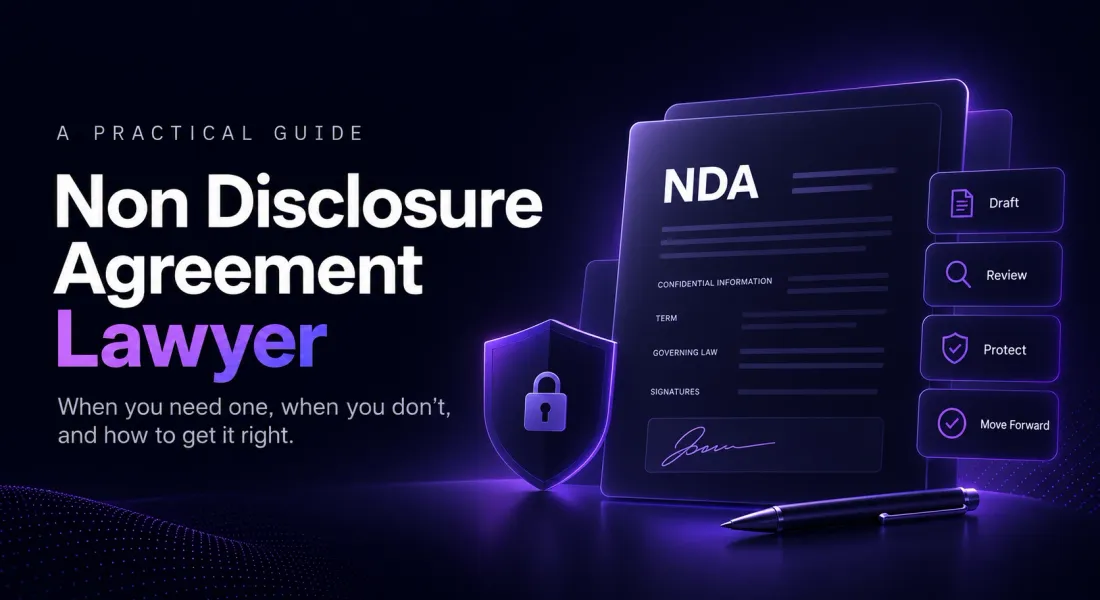
Non Disclosure Agreement Lawyer: A Practical Guide
Most people searching for a non disclosure agreement lawyer are not actually sure yet whether they need one. They have a standard business situation, a new vendor, a contractor, an employee, a potential partner, and a nagging sense that getting this wrong could be expensive. The honest answer is that most routine NDAs do not need a lawyer at all, and a smaller set genuinely do. This guide covers how to tell which situation you are in.
What A Non Disclosure Agreement Lawyer Actually Does
An NDA lawyer, sometimes searched as a non disclosure agreement attorney, reviews or drafts confidentiality agreements to make sure the terms actually protect the information you are trying to protect, under the law that applies to your situation. That includes checking the definition of confidential information is not so broad it becomes unenforceable, or so narrow it misses what you actually needed covered, confirming the term length and post termination obligations are appropriate, and flagging jurisdiction issues when the other party operates in a different state or country.
For a standard, one directional NDA between two parties in the same jurisdiction covering ordinary business information, this is usually straightforward work. For anything involving multiple jurisdictions, unusual intellectual property, or terms that will sit inside a larger deal, it is where legal judgement genuinely earns its cost.
When You Actually Need An NDA Lawyer
- The agreement crosses international borders, where enforceability and remedies differ significantly by country.
- The information involved is unusually sensitive, such as unpatented IP, trade secrets central to your competitive position, or pre acquisition financials.
- The NDA is part of a larger negotiation, such as a merger, acquisition, or investment round, where it interacts with other legal terms.
- You are the one receiving a heavily one sided NDA from a larger counterparty and need someone to identify what is actually unusual in it.
- You have reason to believe a breach has already happened or is likely, and need to understand your enforcement options before signing anything further.
In any of these situations, the cost of a lawyer is small relative to what is actually at stake, and treating it as optional is the mistake, not the caution.
When A Template Is Genuinely Enough
- A routine mutual NDA between two ordinary businesses discussing a standard commercial relationship.
- A one way NDA protecting your business information when briefing a contractor, freelancer, or job candidate.
- An employee confidentiality agreement covering standard business information, using your company’s own established format.
- Any situation where the information involved is genuinely ordinary, meaning its loss would be inconvenient rather than materially damaging.
A search for an employee non disclosure agreement template, an NDA format for employees, or a non disclosure template free of charge usually reflects exactly this situation: a standard, low risk confidentiality need that a well drafted template handles perfectly well. The template itself is not the risky part. The risk is using a badly worded one, or one written for a different jurisdiction than yours.
What Makes A Template Actually Reliable
Not every free template found online is worth using. Before relying on one, check for a small number of things that separate a usable template from a risky one.
- A clear, specific definition of what counts as confidential information, not a vague catch all phrase.
- A stated term length for the confidentiality obligation, rather than leaving it open ended or silent.
- Standard carve outs, information that was already public, already known to the receiving party, or independently developed, so the agreement is not so broad it becomes unenforceable.
- Clarity on whether the obligation is mutual or one directional, matching the actual relationship between the parties.
- A governing law clause naming the jurisdiction the agreement falls under.
If a template is missing several of these, that is the signal to get a lawyer to review it once, even if the underlying situation itself does not require ongoing legal involvement.
Building And Sending NDAs Without Starting From Scratch Each Time
For businesses that send NDAs regularly, whether that is onboarding new contractors, briefing vendors, or protecting information before a sales conversation, rebuilding the same document by hand each time is where errors creep in: an old term length left unchanged, the wrong party name carried over from the last version, a mutual clause used when the situation actually called for one directional.
A Smart Content Library that stores your approved NDA language once and reuses it consistently removes that repeated risk. Every document pulled from it starts from the same reviewed base rather than a copy of whatever was sent last, and built in e-signatures let both sides sign inside the same document, with a signed status, a signing date, and a confirmation email sent automatically once it is complete.
A Note On Legal Advice
This guide is general information about when to involve a lawyer, not legal advice for your specific situation. Confidentiality law varies by jurisdiction, and what counts as a routine NDA in one context can carry real risk in another. If anything above sounds uncertain once you apply it to your actual circumstances, that uncertainty is itself a reason to get a qualified lawyer to look at it before you sign.
Common Mistakes
- Using a one directional template for what is actually a mutual exchange of confidential information.
- Leaving the confidentiality term open ended instead of setting a clear end date.
- Copying a template built for a different jurisdiction without checking whether it still applies.
- Hiring a lawyer for every routine NDA when the situation genuinely does not call for one, and treating the cost as unavoidable overhead.
- Skipping legal review entirely on a cross border or high stakes agreement to save time.
Final Word
Most non disclosure agreements are routine, and routine situations do not need a lawyer, they need a well built template used correctly. The judgement call is knowing which category your situation falls into, and a short honest look at what is actually at stake usually makes that clear.
For the routine cases, keep a reliable NDA format ready to go rather than rebuilding one from scratch each time you need it. Create and send contracts from the same reviewed content every time, so consistency, not memory, is what protects you. This matters most for smaller teams without in-house legal support, a gap covered in more depth in this guide to proposal software for small businesses.
Frequently Asked Questions
How much does an NDA lawyer typically cost?
It varies widely by region and complexity, from a flat fee for a straightforward review to an hourly rate for something more involved. For a routine NDA, ask for a flat fee quote before committing, since the work involved is usually predictable.
Can I use a free NDA template for a real business situation?
Yes, for routine situations. Check that it includes a clear confidentiality definition, a stated term length, standard carve outs, and a named governing jurisdiction before relying on it.
What is the difference between a mutual and a one way NDA?
A mutual NDA protects information both parties share with each other, common in partnership or investment discussions. A one way NDA protects information shared by only one party, typical when briefing a contractor or candidate on your business.
Do NDAs need to be reviewed by a lawyer to be valid?
No. A properly drafted NDA can be perfectly valid without legal review. The value of a lawyer is in catching problems specific to your situation, not in the act of review itself being a legal requirement.
Is an NDA generated from a template as enforceable as one drafted by a lawyer?
Enforceability depends on the quality and clarity of the terms, not on who wrote them. A well built template covering the right elements can hold up just as well as a lawyer drafted one for a routine situation. The gap appears in unusual or high stakes situations, where a lawyer’s judgement adds real value a template cannot replicate.
Should employees sign a different NDA than contractors?
Often yes, since the relationship and the obligations involved differ. Many businesses keep a separate employee confidentiality format from their contractor or vendor NDA, reflecting the different context each is used in.

Ronak Surti

 Dimple Maru
 Ronak Surti