
Table of Contents
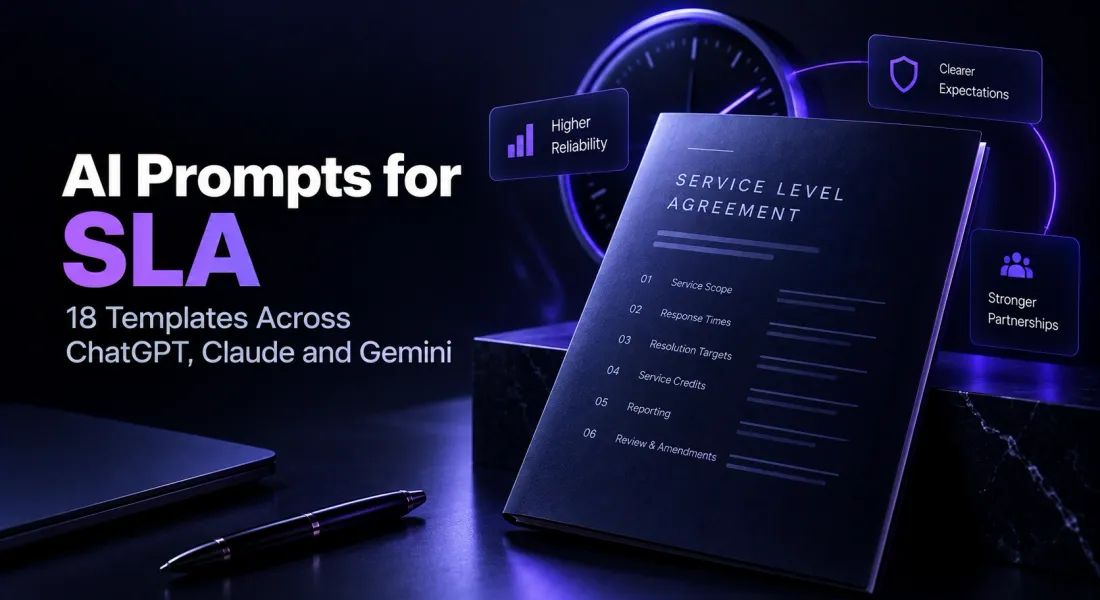
AI Prompts for SLA: 18 Templates Across ChatGPT, Claude And Gemini
A service level agreement is only as good as the metrics inside it. A vague uptime promise or a response time with no defined severity levels protects nobody when something actually breaks. Most SLAs either copy generic percentages from a template that has nothing to do with the service being delivered, or list metrics without defining how they are measured, which is exactly where disputes start.
The 18 templates here, divided across ChatGPT, Claude and Gemini, treat an SLA as a measurement document first, a legal formality second. The ChatGPT prompts cover full drafts, plain-language summaries and quick metric rewrites. The Claude prompts handle severity level definitions, remedy and credit structures, and comparing a client’s own SLA draft against a standard. The Gemini prompts research industry-standard benchmarks and jurisdiction context so the numbers hold up against scrutiny. As with any contract, none of this replaces legal review before signature.
Why AI Works Well For Service Level Agreements
An SLA is a short, metric-dense document where the specific numbers matter more than the prose around them. AI handles that combination well once the brief specifies the actual service being measured, not a generic category, and once you know who actually needs to sign off on the commitment.
Each Model Has A Different Edge
ChatGPT is the most flexible for a first draft and plain-language summaries. Claude is strongest on severity definitions and remedy structures that need to be precise. Gemini is the right choice when an industry benchmark should shape the actual numbers.
Undefined Metrics Are Not Metrics
“99.9% uptime” means nothing without a measurement window, an exclusion list for planned maintenance, and a clear definition of what counts as downtime. Every number in an SLA needs its definition attached, not assumed.
Severity Levels Drive Everything Else
Response and resolution times only make sense relative to how severe the issue is. A P1 outage and a cosmetic bug cannot share a response time, and the SLA should define severity before it defines speed.
This Is A Drafting Starting Point, Not Legal Advice
Every template below produces a strong first draft. Have a qualified lawyer review any SLA before it goes to a client, particularly the remedy, credit and liability sections.
ChatGPT Prompts For Service Level Agreements
ChatGPT is the flexible workhorse for a first SLA draft. It handles full documents, plain-language summaries and quick metric rewrites. These six ChatGPT prompts for SLA writing cover the situations IT providers, agencies and SaaS companies face when committing to a service standard. Each ChatGPT prompt for SLA below is built around a specific scenario, so you can pick the right ChatGPT prompt for SLA for the job rather than starting from a blank page.
1. Full SLA From Scratch
Act as a service delivery manager drafting a standard SLA.
Context:
- Service provided: [what is being delivered, e.g. managed IT
support, SaaS platform, hosting]
- Provider: [our company]
- Client: [name]
- Support hours: [e.g. business hours, 24/7]
- Severity levels needed: [e.g. P1-P4, or Critical/High/Medium/Low]
Write a complete SLA.
Sections:
1. Service scope, what is and is not covered
2. Severity level definitions, with examples of each
3. Response time targets per severity level
4. Resolution time targets per severity level
5. Measurement window and exclusions (planned maintenance,
force majeure)
6. Remedies or service credits for missed targets
7. Escalation process
8. Reporting cadence
9. Review and amendment process
10. Signature blocks
Rules: every number must have its measurement method defined
alongside it. Flag as a drafting starting point requiring legal
review.
Where it works best: ChatGPT produces a complete, correctly structured SLA in one pass, with measurement definitions attached to every metric rather than left implicit. This is the ChatGPT prompt for SLA most teams reach for first.
Best for: Setting the first formal service standard with a new client before delivery begins.
Turn this SLA into a branded, signed document in 60 seconds
Paste your website URL and Proposal.biz pulls your brand and service details into a Smart Content Library, so every SLA you send looks like yours automatically, not like a legal template.
Try for free
2. Severity-Based Response Time Table
Act as a service delivery manager building the response
and resolution time table for an SLA.
Context:
Service type: [what is being supported]
Support hours: [coverage window]
Realistic team capacity: [rough sense of how fast issues can
genuinely be handled]
Task:
Build a severity-based response and resolution time table.
For each severity level (typically 3-4 levels):
- Definition, with a concrete example
- Response time target (acknowledgement, not resolution)
- Resolution time target
- Who is notified or escalated to at this level
Rules: targets must be realistic against stated team capacity,
not aspirational numbers that will be missed immediately.
Where it works best: ChatGPT structures the severity table cleanly and keeps targets grounded in the stated capacity rather than defaulting to generic aggressive numbers.
Best for: Building the core metrics table that the rest of the SLA depends on.
3. Plain-Language Summary Of An SLA
You are explaining a draft or signed SLA to someone
without a technical or legal background.
SLA text:
[paste the SLA, or the sections in question]
Task:
Write a plain-language summary of what this SLA actually commits
to.
Output:
- What is covered and what is not, in plain terms
- How fast issues get responded to and resolved, by severity
- What happens if the provider misses a target
- How to escalate if something feels wrong
Rules: no jargon. Write it the way you would explain it to a
client stakeholder who will never read the full document.
Where it works best: ChatGPT translates dense metric tables into something a non-technical stakeholder can actually act on before signing.
Best for: Getting internal or client sign-off from someone who needs to understand the commitment but will not read the full document.
4. Rewrite An Unrealistic Metric
You are a service delivery manager fixing an SLA metric
that was set without checking whether it is achievable.
Metric in question:
[paste the specific target, e.g. "15 minute response time,
24/7, all severities"]
What is unrealistic about it: [your concern, e.g. team size,
coverage hours, no severity distinction]
Task:
Rewrite this metric to be both credible and still competitive.
Rules:
- Tie the target to actual team capacity or a realistic staffing
model.
- Introduce severity distinction if the original metric applies
a single number to everything.
- Explain in one sentence why the rewrite is more defensible.
- Flag that any client-facing change should go through internal
review first.
Where it works best: ChatGPT is quick at spotting why a metric is unrealistic and proposing a version that will not immediately be breached after signature.
Best for: Reviewing an SLA metric that was set by sales or leadership without operational input.
5. SLA Amendment For A Scope Change
You are a service delivery manager updating an SLA
because the scope of service has changed.
Context:
Original SLA: [paste key terms or the full document]
What is changing: [new service added, coverage hours extended,
a metric being renegotiated]
Effective date: [date]
Write an SLA amendment covering this change.
Rules:
- Reference the original SLA and confirm what stays the same.
- State clearly what changes and from when.
- If a new severity level or service type is added, define it
with the same rigour as the original document.
- Keep it short, an amendment, not a full re-draft.
Where it works best: ChatGPT writes a clean, scoped amendment quickly rather than requiring a full re-draft of the original agreement.
Best for: An existing SLA that needs updating for a scope or coverage change, not a brand new document.
6. SLA Breach Notification (Bonus)
You are writing the notification sent to a client when
an SLA target has been missed.
Context:
Which target was missed: [the specific metric]
By how much: [the gap]
Root cause, if known: [what happened]
Remedy being applied: [service credit, or whatever the SLA
specifies]
Write a short, honest breach notification.
Rules:
- State plainly that the target was missed, do not bury it.
- Give the root cause in plain terms, without excessive technical
detail unless the client would want it.
- Confirm the remedy being applied per the SLA.
- State what is being done to prevent recurrence.
- Under 150 words. Direct, not defensive.
Where it works best: ChatGPT writes a notification that stays direct and non-defensive, which is exactly the tone that preserves trust when something has actually gone wrong.
Best for: The moment an SLA target is missed and the client needs to hear about it before they notice on their own.
Claude Prompts For Service Level Agreements
Claude is the right model when severity definitions, remedy structures or a client’s own SLA draft need careful, precise handling before anyone reaches for e-signature. These six Claude prompts for SLA writing handle the situations where precision carries the most weight. Each Claude prompt for SLA below is built around a specific scenario, so you can pick the right Claude prompt for SLA for the job rather than starting from a blank page.
1. Full SLA From A Messy Internal Request
You are a contracts and service delivery specialist
turning a rough internal request into a precise SLA.
[paste the internal request, email thread, or notes asking for
an SLA, however unstructured]
Our standard service commitments, if any: [your usual position]
Task:
Turn this request into a complete, correctly structured SLA.
Instructions:
- Pull out the actual service being covered and any hinted
performance expectations.
- Where the request is vague about severity levels or targets,
propose a reasonable default and label it clearly as something
to confirm.
- Produce the full SLA: scope, severity definitions, response and
resolution targets, measurement method, remedies, escalation,
reporting, signature blocks.
Flag as a drafting starting point requiring legal and operational
review before it goes to any client.
Where it works best: Claude reads unstructured internal requests faithfully and proposes sound, clearly labelled defaults where the request left gaps. This is the Claude prompt for SLA most teams reach for first.
Best for: The common real case: someone asks for “an SLA for this client” with minimal detail attached.
Know exactly when the client reviews the metrics
Send the SLA as a trackable link instead of a flat PDF, and see whether the client actually reviewed the severity table and remedy section before they sign.
Try for free
2. Severity Level Definitions With Examples
You are a service delivery specialist writing severity
level definitions precise enough that no two people would
disagree on how to classify a real issue.
Context:
Service type: [what is being supported]
Number of severity levels wanted: [e.g. 4]
Task:
Write severity level definitions.
For each level:
- Name (e.g. P1, Critical)
- Precise definition, what makes an issue this severity
- Two concrete, realistic examples
- What it explicitly excludes (to prevent over-classification)
Rules: definitions must be specific enough to remove ambiguity
in the moment an issue is reported, not generic descriptions
that could apply to almost anything.
Where it works best: Claude writes severity definitions precise enough to actually resolve disputes in the moment, rather than generic descriptions that sound right but classify nothing clearly.
Best for: The single section of an SLA most likely to cause disagreement later if it is vague now.
3. Remedy And Service Credit Structure
You are a contracts specialist designing the remedy
structure for missed SLA targets.
Context:
Service type and typical monthly fee: [context for credit sizing]
Severity levels: [from the SLA]
How strict the remedy should be: [your intended posture, e.g.
meaningful but not punitive]
Task:
Design a service credit structure for missed targets.
Requirements:
- Tie credit size to the severity of the miss and how far off
target it was, not a single flat percentage.
- Cap total credits in a billing period at a defined maximum.
- State clearly how credits are calculated and applied (invoice
deduction, credit note).
- Address repeated breaches within a period, escalating remedy
or a termination right if it becomes severe.
Explain the reasoning behind the structure in one paragraph.
Where it works best: Claude reasons carefully about tying remedy severity to breach severity rather than a single blunt percentage, which is where most remedy clauses fall short.
Best for: SLAs where the remedy structure needs to feel genuinely fair to both sides, not just present.
4. SLA Redline Against A Client’s Draft
You are a contracts specialist comparing a client's own
SLA draft against our standard position.
Our standard SLA terms: [paste key terms or the full template]
Client's draft: [paste their draft]
Task:
Compare the two and produce a redline summary.
Output:
- A list of every material difference: response times, severity
definitions, remedy structure, exclusions
- For each, a one-line note on whether it favours us, them, or
is neutral
- A recommended negotiating position for anything worth pushing
back on
Rules: be precise about what actually changed. Flag any target
that looks operationally unrealistic for us to commit to.
Where it works best: Claude compares two dense metric-heavy documents accurately, which is easy to get wrong by skimming when the differences are numeric rather than obviously worded.
Best for: Reviewing a client’s own SLA draft instead of sending your standard template.
5. Multi-Service SLA (Different Metrics Per Service)
You are a service delivery specialist drafting an SLA
that covers multiple distinct services with different metrics
each.
Context:
Services covered: [list each, e.g. hosting uptime, support
response time, data processing turnaround]
Whether metrics should differ per service: [yes, and how]
Task:
Write an SLA covering multiple services, each with its own
appropriate metrics.
Requirements:
- A clear section per service, not one blended metric set that
does not actually fit any of them.
- Explicit statement of which metrics apply to which service.
- A consolidated summary table at the end for quick reference.
Rules: do not force a single uptime or response metric across
services that behave differently.
Where it works best: Claude keeps genuinely different service metrics cleanly separated rather than collapsing them into one blended, meaningless number.
Best for: Providers delivering more than one distinct service type under a single client relationship.
6. Tighten An Existing SLA Draft
You are a careful editor of legal and technical drafting,
working on an SLA.
Draft:
[paste the full SLA draft]
Task:
Tighten this draft without changing any metric or obligation.
Instructions:
- Simplify dense sentences without losing precision on the
numbers.
- Flag any metric that lacks a measurement method or exclusion
list, since that is a substantive gap, not a style issue.
- Note anything missing compared to a standard SLA (e.g. no
escalation process, no reporting cadence).
- Do not change any target, only clarity.
Output:
1. The tightened draft.
2. A list of anything flagged as ambiguous or missing, for review
before this goes any further.
Where it works best: Claude separates genuine clarity edits from substantive gaps in measurement definitions, and is explicit about which is which rather than quietly patching over a gap.
Best for: A metrics-complete draft that reads as dense or was assembled from mismatched sections.
Gemini Prompts For Service Level Agreements
Gemini’s live web grounding is the right tool when industry-standard benchmarks or jurisdiction context should inform the SLA’s actual numbers before they are committed to, the same discipline that belongs in any service agreement. These six Gemini prompts for SLA writing turn generic targets into ones grounded in current context. Each Gemini prompt for SLA below is built around a specific scenario, so you can pick the right Gemini prompt for SLA for the job rather than starting from a blank page.
1. Research-Backed Industry Benchmark SLA
You are a service delivery manager who checks industry
benchmarks before committing to SLA targets.
Step 1: Research typical SLA benchmarks for [service type, e.g.
managed IT support, SaaS uptime, hosting] in [industry or company
size segment]. Find:
- Common uptime and response time benchmarks
- How they are typically measured and what is usually excluded
Step 2: Write an SLA metrics section informed by what you find,
for [service type] with [our team's context].
Requirements: cite the source for any benchmark claim. If you
cannot verify something, say so rather than guessing. Flag as a
drafting starting point requiring operational and legal review.
This turns a generic AI prompt for SLA writing into one grounded
in actual industry norms.
Where it works best: Gemini’s live web grounding surfaces real industry benchmarks that a generic template would guess at rather than source. This is the Gemini prompt for SLA most teams reach for first.
Best for: Setting SLA targets for the first time, or checking whether existing targets are in line with the market.
Draft, brand, send and e-sign the whole agreement in one window
Keep the SLA lifecycle in one place: AI-assisted drafting, automatic branding, a trackable link to send, and built-in e-signature so the agreed metrics get signed off without a separate tool.
Try for free
2. Competitor SLA Comparison
You are an analyst researching what comparable providers
commit to, so our SLA is competitive without over-promising.
Step 1: Research publicly available SLA terms from [comparable
providers in our category]. Find:
- Published uptime or response time commitments
- Common remedy structures
Step 2: Write a short comparison summary, then flag whether our
current SLA is more or less generous than the norm.
Our current SLA or key terms: [paste them]
Output: comparison paragraph with sources, then a short
recommendation.
Where it works best: Gemini’s web grounding produces a credible competitive comparison that is hard to source reliably without live search.
Best for: Checking whether your SLA commitments are a genuine differentiator or a liability compared to competitors.
3. Regulatory Context For SLA Obligations
You are a research lead checking whether regulatory
requirements affect SLA obligations in a specific sector.
Step 1: Research [relevant regulation, e.g. data residency,
uptime requirements for financial services, healthcare
availability standards] as it applies to [our service type] in
[jurisdiction]. Find:
- Any regulatory minimums that affect SLA terms
- Recent guidance or enforcement relevant to this area
Step 2: Write a short note flagging anything our SLA needs to
account for.
Rules: cite sources. This is informational context, not legal
advice.
Where it works best: Gemini’s web grounding catches sector-specific regulatory minimums that a generic SLA template would not know to include.
Best for: SLAs for regulated sectors like healthcare, finance, or government services.
4. Uptime Measurement Methodology Research
You are a service delivery manager researching how
uptime is typically measured and calculated, so our methodology
is defensible.
Step 1: Research common uptime measurement methodologies for
[service type]. Find:
- How measurement windows are typically defined (monthly,
rolling)
- What is commonly excluded (planned maintenance, force majeure)
- Common calculation formulas
Step 2: Write a measurement methodology section for the SLA based
on what you find.
Rules: cite sources. Use a defensible, commonly accepted
methodology rather than an unusual one that would draw scrutiny.
Where it works best: Gemini’s research grounds the measurement methodology in accepted practice, which is exactly the kind of detail that prevents disputes about how a breach is even calculated.
Best for: Any SLA with an uptime commitment, since the methodology behind the number matters as much as the number itself.
5. Vendor SLA Dependency Check
You are a service delivery manager checking whether our
own vendors' SLAs can actually support what we are promising a
client.
Step 1: Research the published SLA terms of [our key vendor or
infrastructure provider, e.g. a cloud host]. Find their
committed uptime and any relevant exclusions.
Step 2: Write a short note on whether our proposed client SLA is
realistic given what our vendor actually commits to.
Rules: cite sources. Flag clearly if our proposed target exceeds
what our vendor's own SLA would support.
Where it works best: Gemini’s web grounding surfaces a vendor’s actual published commitments, which is a check most teams skip until a client SLA breach traces back to an upstream vendor limit.
Best for: Any SLA where our own commitment depends on a third-party vendor’s infrastructure or service.
6. Recent Outage Trends In The Category
You are a research lead checking recent, publicly
reported outage trends in a service category, to sanity-check
our own targets.
Step 1: Research recent (last 12 months) publicly reported
outages or reliability issues in [service category]. Find:
- Notable incidents and their reported cause
- Any resulting industry commentary on realistic reliability
targets
Step 2: Write a short note on what this suggests about setting
realistic targets for our own SLA.
Rules: cite sources. Use this as context, not as a reason to
either inflate or deflate our own genuine capability.
Where it works best: Gemini’s recency surfaces genuinely current reliability context that shapes a more grounded, credible target than an assumption based on how things used to be.
Best for: Sanity-checking ambitious targets against what is actually achievable in the current environment.
How To Get More From Each Prompt
Treat The First Reply As A Draft
Ask for a tighter severity definition, push back on an unrealistic target, or request a clearer remedy structure. Each pass sharpens the document before it goes to legal and operational review.
Chain Your Prompts
An SLA usually sits inside a broader master service agreement as a referenced exhibit, so keep the two documents consistent with each other rather than drafting them in isolation.
Use the output of one prompt as the input to the next. A benchmark-research prompt can inform the severity-definition prompt, which feeds the full-draft prompt.
Save What Works
When an SLA’s targets and remedy structure clear review cleanly and a client accepts them without much negotiation, keep it as your standard, with a note on why. Over time you build a defensible baseline that gets faster to deploy with every new client.
From Prompt To Branded Document
AI gives you the words. It does not give you a branded document the client actually reviews closely, or tell you whether they engaged with the metrics that matter most. That last stretch, formatting, sending, and knowing whether the severity table actually got read, is usually where the time stacks up.
This is where Proposal.biz fits in.
Paste Your Website URL – Proposal.biz pulls your brand assets into a Smart Content Library, so the SLA and every document around it look like yours automatically.
Generate From A Prompt – Describe the service and the target metrics and it produces a fully branded document, ready to refine in the Proposal Builder.
Send, Sign And Track – Send a shareable, trackable link instead of a flat PDF, and use built-in e-signing so the agreed SLA gets signed and returned inside the same workflow.
If you would rather start from a ready-made structure instead of a blank page, the managed IT service level agreement template gives you the metrics table already built, ready to adapt from any of the prompts above.
The simplest workflow: draft your SLA using whichever AI prompt for SLA writing fits the scenario, have it reviewed by counsel and operations, then drop the final copy into Proposal.biz to brand, send and track. You keep the AI tool’s drafting speed and add the document layer that gets it signed, then use any AI prompt to write an SLA you have saved alongside it.
Final Word
An SLA earns trust the first time something breaks, not the day it is signed. Define every metric’s measurement method alongside the number, build severity levels precise enough to remove ambiguity in the moment, and set a remedy structure that scales with the severity of the miss. The discipline lives in the section most rushed drafts skip: an honest, capacity-checked target rather than an aspirational number copied from somewhere else.
Proposal.biz makes the document side of that work simpler. Paste your website URL and your service details populate a Smart Content Library you draw from on the SLA and every document around it. The Proposal Builder turns your AI draft into a branded document, a shareable link replaces the PDF, and e-signature keeps the whole chain, SLA through to signed agreement, inside one workflow.
If the SLA sits inside a broader engagement, the prompts in AI prompts for Statement of Work cover the project-level document an SLA often accompanies.
Frequently Asked Questions
What is the best AI prompt for SLA writing?
There is no single best prompt. For a first full draft, the ChatGPT prompt for SLA building works well. For the sections that need to be precise, severity definitions and remedy structures, the Claude templates handle the detail that matters most. For setting targets grounded in real industry benchmarks, the Gemini template researches that context first.
Which AI tool is best for writing an SLA?
Each model has a different strength. ChatGPT is the most flexible for a first draft and plain-language summaries. Claude is best when a specific clause, severity levels or remedy structure, needs to be exact rather than approximate. Gemini wins when industry benchmarks or jurisdiction context should shape the actual numbers.
What is the difference between an SLA and an MSA?
A master service agreement sets the overall legal terms of a relationship, liability, IP, payment, term. An SLA defines the specific performance standard for the service itself, response times, uptime, remedies for missing them. An SLA is often referenced as an exhibit inside an MSA rather than standing entirely alone.
Should an AI-drafted SLA be reviewed before it is signed?
Yes, always, by both legal and the operations team that will actually deliver against it. These templates produce a strong, well-structured first draft, but the targets need to be checked against real capacity, and the remedy and liability sections genuinely need a qualified lawyer’s review before anything goes to a client.
How do I turn the AI output into a branded, signed document?
AI gives you the words, not a branded document or a way to know whether the client actually reviewed the metrics. Tools like Proposal.biz close that gap: paste your website URL to pull your brand into a Smart Content Library, generate a fully branded document from a prompt, then send a shareable, trackable link and get it e-signed inside the same workflow.

Ronak Surti
 Ronak Surti