
Table of Contents
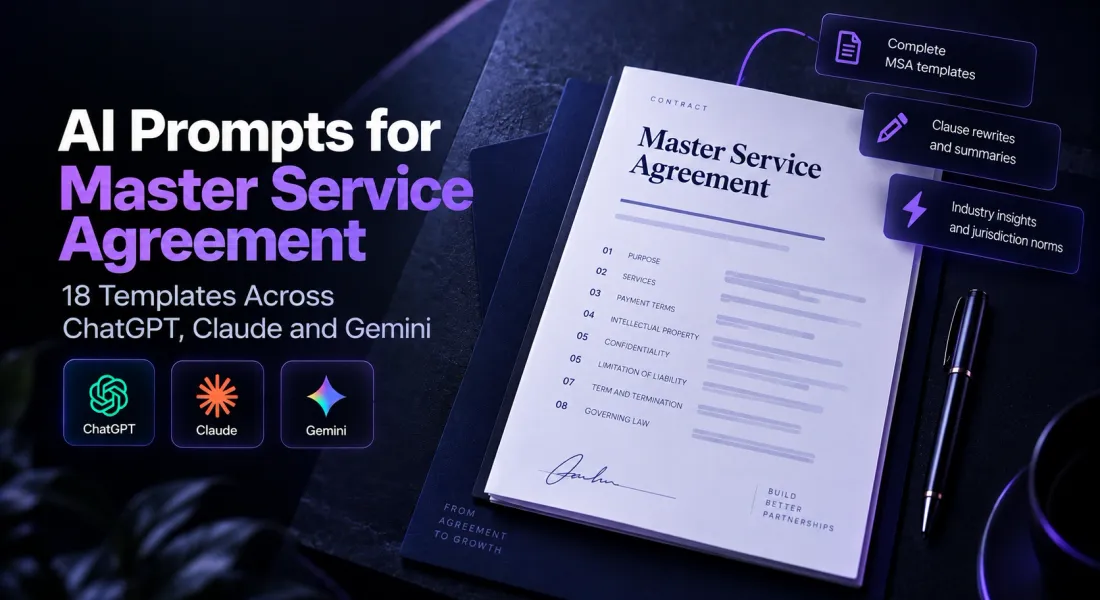
AI Prompts for Master Service Agreement: 18 Templates Across ChatGPT, Claude And Gemini
A master service agreement is the contract you write once so you do not have to renegotiate liability, IP and payment terms every time a new project starts. Get it right and every future statement of work is a short, simple document. Get it thin or generic and every SOW drags because the underlying terms were never actually settled. Most teams either adapt a template written for a completely different kind of engagement, or draft the MSA alongside a retainer agreement and end up with terms scattered across both.
The 18 templates here, divided across ChatGPT, Claude and Gemini, treat the MSA as the framework it is meant to be: the document that makes every future SOW fast. The ChatGPT prompts cover full drafts, plain-language summaries and quick clause rewrites. The Claude prompts handle the clauses that need to be exact, liability caps, IP ownership, termination, and comparing a client’s own draft against yours. The Gemini prompts research jurisdiction norms, industry-standard liability benchmarks and the regulatory context that shapes IP and data clauses. As with any contract, none of this replaces legal review before signature.
Why AI Works Well For Master Service Agreements
An MSA is a long, structured document with a small number of clauses that carry disproportionate risk. AI handles that combination well when the brief is specific about the relationship, not just the industry, since this is the framework the rest of your contracts will sit under.
Each Model Has A Different Edge
ChatGPT is the most flexible for a first full draft and quick summaries. Claude is strongest on the clauses that need to be precise, liability, IP and termination. Gemini is the right choice when jurisdiction norms or industry benchmarks should shape the terms.
The MSA Should Make SOWs Boring
The entire point of a master agreement is that liability, payment terms, IP ownership and dispute resolution are settled once. Every SOW under it should be a short document listing scope, deliverables and price, nothing else.
Liability Caps Deserve Real Thought
A liability cap set too low invites a client to walk away from the negotiation, set too high it exposes the business unreasonably. Ask the model to tie the cap to something specific, typically fees paid under the applicable SOW, rather than an arbitrary figure.
This Is A Drafting Starting Point, Not Legal Advice
Every template below produces a strong first draft. Have a qualified lawyer review any MSA before it goes to a client, particularly the liability, indemnification and IP sections.
ChatGPT Prompts For Master Service Agreements
ChatGPT is the flexible workhorse for a first MSA draft. It handles full frameworks, plain-language summaries and quick clause rewrites. These six ChatGPT prompts for master service agreement writing cover the situations consulting firms, agencies and IT service providers face when setting up a new client relationship. Each ChatGPT prompt for master service agreement below is built around a specific scenario, so you can pick the right ChatGPT prompt for master service agreement for the job rather than starting from a blank page.
1. Full MSA From Scratch (Framework)
Act as a commercial lawyer's drafting assistant producing
a standard master service agreement.
Context:
- Our company: [name and what we provide]
- Client: [name]
- Type of services: [consulting, IT, marketing, etc.]
- Engagement model: individual SOWs executed under this MSA
- Jurisdiction: [state/country]
- Payment terms: [e.g. net 30, milestone-based]
Write a complete MSA.
Sections:
1. Purpose and structure (MSA sets general terms, SOWs define
specific services)
2. Services performed as described in each SOW
3. Statements of work: form, content requirements, execution
4. Fees and payment terms, late fee, disputed invoice process
5. Change orders: written approval required
6. Acceptance: review period, deemed acceptance, remedy for
deficient work
7. Intellectual property: work-for-hire, client owns deliverables,
company retains tools and methodologies
8. Confidentiality, mutual, with survival period
9. Limitation of liability: mutual cap tied to fees paid, mutual
exclusion of consequential damages
10. Indemnification
11. Term and termination
12. Dispute resolution
13. Governing law
14. Order of precedence (MSA > SOW > change order)
15. Signature blocks
Rules: formal, balanced language, favouring neither party
unreasonably. Flag as a drafting starting point requiring legal
review.
Where it works best: ChatGPT produces a complete, correctly ordered MSA framework in one pass, with the full clause set most templates forget at least one of. This is the ChatGPT prompt for master service agreement most teams reach for first.
Best for: Setting up the first formal agreement with a new client before any SOW is signed.
Turn the signed MSA into your first branded SOW in 60 seconds
Paste your website URL and Proposal.biz pulls your brand, services and case studies into a Smart Content Library, so every SOW issued under this MSA looks like yours automatically.
Try for free
2. MSA Built For Future Statements Of Work
Act as a contracts specialist drafting an MSA explicitly
designed to make future SOWs short and simple.
Context:
Our company: [name]
Client: [name]
Type of services: [what will be delivered under future SOWs]
How often new SOWs are expected: [e.g. quarterly, per project]
Write an MSA where the SOW template referenced within it needs
only five fields to be complete: scope, deliverables, timeline,
price and any SOW-specific assumptions.
Requirements:
- State explicitly that all standard terms, liability, IP,
payment, confidentiality, live in the MSA, not in individual
SOWs.
- Include a short-form SOW template as an exhibit, with only the
five fields above as open variables.
- Order of precedence: MSA governs unless a SOW explicitly states
otherwise for that specific engagement.
Standard MSA sections also required: fees, IP, confidentiality,
liability, termination, governing law, signatures.
Where it works best: ChatGPT is good at keeping the SOW exhibit genuinely minimal, which is the detail that determines whether this MSA actually saves time later or not.
Best for: Ongoing relationships where multiple SOWs are expected and speed on each new one matters.
3. Plain-Language Summary Of An MSA
You are explaining a draft or signed MSA to someone
without a legal background.
MSA text:
[paste the MSA, or the sections in question]
Task:
Write a plain-language summary of what this MSA actually commits
each party to.
Output:
- What services are covered and how future SOWs work under it
- Payment terms, in plain language
- Who owns what gets built
- What happens if something goes wrong (liability cap, remedy)
- How either party can exit the agreement
- Anything unusual compared to a standard MSA
Rules: no legal jargon. This is a plain-language summary, not
legal advice.
Where it works best: ChatGPT translates dense clause language into something a founder or department head can actually act on before signing.
Best for: Getting internal sign-off from a stakeholder who needs to understand the commitment but will not read the legal text closely.
4. MSA Cover Email To A New Client
You are writing the short email that sends a new MSA to
a client for signature.
Context:
Client: [name]
Relationship so far: [first engagement, existing informal work,
referral]
What happens after signature: [e.g. "we can then issue the first
SOW"]
Write a short, professional cover email.
Rules:
- Confirm what is attached and why it matters as a framework
document, not a one-off contract.
- One sentence on what happens next once it is signed.
- Under 90 words.
- Confident and warm, not overly formal or intimidating.
Where it works best: ChatGPT writes a tone that avoids making a long framework document feel more adversarial than it needs to, which matters for a first-contract relationship.
Best for: The message that actually gets a new client’s legal or ops team to prioritise reviewing the MSA.
5. Rewrite A One-Sided Liability Clause
You are a contracts specialist negotiating a liability
clause that currently favours only one side.
Clause in question:
[paste the clause, ours or the counterparty's]
What concerns us: [e.g. uncapped liability, cap too low relative
to the engagement size, one-sided exclusions]
Task:
Rewrite this clause to be balanced and commercially reasonable.
Rules:
- Cap liability at a defined, specific amount (commonly fees paid
under the applicable SOW in the prior 12 months).
- Make consequential damages exclusions mutual, not one-sided.
- Carve out the standard exceptions: IP infringement, confidentiality
breach, gross negligence.
- Explain in one sentence why the rewrite is more balanced.
- Flag that any client-facing change should go through legal
review first.
Where it works best: ChatGPT is quick at identifying exactly why a liability clause reads as one-sided and proposing standard, defensible middle ground.
Best for: Negotiating a client’s own MSA draft rather than starting from your template.
6. IT/Consulting-Specific MSA (Bonus)
Act as a contracts specialist drafting an MSA tailored
to an IT services or consulting engagement specifically.
Context:
Our company: [name, what kind of IT/consulting work]
Client: [name and industry]
Whether we will access client systems or data: [yes/no, detail]
Whether subcontractors may be used: [yes/no]
Write an MSA with IT/consulting-specific provisions layered onto
the standard framework.
Additional sections beyond the standard MSA structure:
- Data access and security obligations if systems or data will
be touched
- Subcontractor flow-down clause if relevant
- Service levels or escalation process reference, if applicable
- Change management process specific to technical scope changes
Standard sections also required: fees, IP, confidentiality,
liability, termination, governing law, signatures.
Where it works best: ChatGPT adapts the standard framework cleanly to the specifics of IT and consulting work, including the data access and subcontractor details that generic templates often skip.
Best for: IT services and consulting firms whose engagements routinely involve system or data access.
Claude Prompts For Master Service Agreements
Claude is the right model when a specific clause needs to be exact rather than approximate, or when a client’s own MSA draft needs a careful comparison against yours before anyone reaches for e-signature. These six Claude prompts for master service agreement writing handle the situations where precision carries the most risk. Each Claude prompt for master service agreement below is built around a specific scenario, so you can pick the right Claude prompt for master service agreement for the job rather than starting from a blank page.
1. Full MSA From A Messy Internal Request
You are a contracts specialist turning a rough internal
request into a precise MSA.
[paste the internal request, email thread, or notes asking for
an MSA, however unstructured]
Our standard terms, if any: [your company's usual position on
liability, payment, IP]
Task:
Turn this request into a complete, correctly structured MSA.
Instructions:
- Pull out the actual services, payment expectations and any
constraints mentioned.
- Where the request is vague about liability caps, payment terms
or IP treatment, propose our standard default and label it
clearly as something to confirm.
- Produce the full MSA: purpose, services, SOW process, fees,
IP, confidentiality, liability, indemnification, term,
dispute resolution, governing law, signatures.
Flag as a drafting starting point requiring legal review before
it goes to any client.
Where it works best: Claude reads unstructured internal requests faithfully and makes sound, clearly labelled default decisions where the request left gaps. This is the Claude prompt for master service agreement most teams reach for first.
Best for: The common real-world case: someone asks for “an MSA for this client” with minimal detail attached.
Know exactly when the client opens each new SOW
Send every SOW under the MSA as a trackable link instead of a flat PDF attachment, and see opens, time spent and which sections got read before you ever have to chase a reply.
Try for free
2. Limitation Of Liability Clause
You are a contracts specialist writing the clause most
likely to be negotiated line by line: limitation of liability.
Context:
Type of engagement: [what is being delivered]
Typical engagement value: [rough fee range under a single SOW]
Risk profile: [anything unusually high-risk about this kind of
work, or standard]
Task:
Write a limitation of liability clause.
Requirements:
- Cap total liability at a specific, defensible amount, commonly
fees paid under the applicable SOW in a defined period.
- Make the cap and the consequential damages exclusion mutual.
- Carve out the standard exceptions: IP infringement,
confidentiality breach, gross negligence, wilful misconduct.
- Write one paragraph explaining the reasoning behind the specific
cap chosen, so this can be defended in negotiation.
Where it works best: Claude reasons carefully about tying the cap to a specific, defensible figure rather than an arbitrary number, and explains the logic clearly enough to use in negotiation.
Best for: The single clause every MSA negotiation spends the most time on.
3. Intellectual Property / Work-For-Hire Clause
You are a contracts specialist writing the IP ownership
clause of an MSA.
Context:
What is being delivered: [software, content, designs, strategy
documents, etc.]
Whether we want to retain reusable tools or methodologies: [yes/no]
Whether a licence-back for our own portfolio use matters to us:
[yes/no]
Task:
Write an intellectual property clause.
Requirements:
- State clearly that client owns deliverables created specifically
for them (work-for-hire), once paid in full.
- Carve out our pre-existing tools, methodologies and general
know-how as retained by us.
- If a portfolio licence-back matters, include a narrow clause
allowing us to reference the work, with client's reasonable
consent where confidential.
- Address what happens to IP if the engagement ends before
completion.
Explain in one paragraph how this balances client ownership
against our need to reuse our own methods on future work.
Where it works best: Claude keeps the ownership-versus-reuse distinction precise, which is the part of this clause most templates blur together.
Best for: Service providers who build reusable frameworks or tools and need to keep using them across clients.
4. Termination And Wind-Down Clause
You are a contracts specialist writing the termination
clause of an MSA.
Context:
Typical notice period expected: [e.g. 30, 60, 90 days]
Whether active SOWs should be allowed to complete after MSA
termination: [your preference]
Payment treatment for work in progress at termination: [your
preference]
Task:
Write a termination and wind-down clause.
Requirements:
- Termination for convenience with a defined notice period.
- Termination for cause with a cure period.
- State clearly what happens to any active SOW when the MSA is
terminated (complete, wind down, or terminate immediately).
- Address payment for work performed up to the termination date.
- Address confidentiality and IP obligations surviving termination.
Explain briefly why the wind-down approach chosen is fair to
both sides.
Where it works best: Claude is precise about what survives termination versus what ends immediately, which is the detail most disputes trace back to.
Best for: Any MSA where multiple SOWs might be active at different stages when the relationship eventually ends.
5. MSA Redline Against A Client’s Draft
You are a contracts specialist comparing a client's own
MSA draft against our standard position.
Our standard MSA terms: [paste key terms or the full template]
Client's draft: [paste their draft]
Task:
Compare the two and produce a redline summary.
Output:
- A list of every material difference: liability cap, IP
treatment, payment terms, termination notice, governing law
- For each, a one-line note on whether it favours us, them, or
is neutral
- A recommended negotiating position for each material difference
Rules: be precise about what actually changed. Flag anything
unusual compared to standard market MSA terms.
Where it works best: Claude compares two dense legal documents accurately and holds the comparison structure cleanly across a long agreement.
Best for: Reviewing a client’s own MSA draft instead of sending your standard template.
6. Tighten An Existing MSA Draft
You are a careful editor of legal drafting, working on
an MSA.
Draft:
[paste the full MSA draft]
Task:
Tighten this draft without changing its legal substance.
Instructions:
- Simplify overly dense sentences without losing precision.
- Flag any clause that is genuinely ambiguous, since that is a
substantive issue, not a style one.
- Note anything missing compared to a standard MSA (e.g. no
order of precedence clause, no dispute resolution mechanism).
- Do not change obligations, caps, or terms, only clarity.
Output:
1. The tightened draft.
2. A list of anything flagged as ambiguous or missing, for legal
review before this goes any further.
Where it works best: Claude separates genuine clarity edits from substantive legal changes and is explicit about the difference rather than quietly altering meaning.
Best for: A legally sound draft that reads as dense or was assembled from mismatched clause sources.
Gemini Prompts For Master Service Agreements
Gemini’s live web grounding is the right tool when jurisdiction norms, industry-standard liability benchmarks or recent regulatory context should inform the MSA before it is finalised, including confirming who actually has signatory authority on the client side. These six Gemini prompts for master service agreement writing turn a generic framework into one grounded in current context. Each Gemini prompt for master service agreement below is built around a specific scenario, so you can pick the right Gemini prompt for master service agreement for the job rather than starting from a blank page.
1. Research-Backed Jurisdiction-Appropriate MSA
You are a contracts specialist who checks jurisdiction
norms before finalising an MSA.
Step 1: Research standard MSA practice in [jurisdiction] for
[type of services]. Look for:
- Common liability cap structures considered reasonable
- Statutory limits on what liability can or cannot be excluded
- Common governing law and dispute resolution choices for this
kind of agreement
Step 2: Write an MSA informed by what you find, for [our company]
and [client] under [jurisdiction] law.
Requirements: cite the source for any jurisdiction-specific claim.
If you cannot verify something, say so rather than guessing. Flag
as a drafting starting point requiring local legal review.
This turns a generic AI prompt for master service agreement
writing into one grounded in the actual jurisdiction's norms.
Where it works best: Gemini’s live web grounding surfaces jurisdiction-specific norms, including statutory limits on liability exclusions, that a generic template would miss entirely. This is the Gemini prompt for master service agreement most teams reach for first.
Best for: Cross-border engagements, or any MSA governed by a jurisdiction you do not draft in every day.
Draft, brand, send and get every SOW signed in one window
Keep the whole framework-to-engagement lifecycle in one place: AI-assisted drafting, automatic branding, a trackable link to send, and e-signature so each new SOW under the MSA closes fast.
Try for free
2. Industry-Standard Liability Cap Benchmark
You are an analyst researching typical liability cap
structures in a specific industry, so ours does not look unusual
to a client's procurement team.
Step 1: Research typical MSA liability terms for [industry, e.g.
IT services, management consulting, marketing agencies]. Find:
- Common cap structures (fees paid, fixed amount, multiple of fees)
- Common exclusions and carve-outs
- Any patterns in how caps scale with engagement size
Step 2: Write a short benchmark summary, then flag anything in
our current draft that is unusually broad or narrow compared to
the norm.
Our current draft or key terms: [paste them]
Output: a paragraph on the industry norm with sources, then a
short list of anything in our draft worth reconsidering.
Where it works best: Gemini’s web grounding produces a credible industry benchmark that is hard for older models to source reliably.
Best for: Checking whether your standard liability position has drifted from what is normal in your specific industry.
3. Recent Regulatory Context For Data/IP Clauses
You are a research lead checking recent developments
that might affect an MSA's data or IP clauses.
Step 1: Research recent regulatory or legal developments in
[jurisdiction] in the last 12-24 months affecting [specific
concern, e.g. data processing obligations, AI-generated work IP
ownership]. Find:
- Relevant recent guidance or rulings
- What this means for standard MSA clauses in this area
- Any resulting best-practice recommendations
Step 2: Write a short summary and flag anything in our draft that
should be updated as a result.
Our current draft or key terms: [paste them]
Rules: cite sources. This is informational context, not legal
advice, and should be confirmed with counsel before relying on it.
Where it works best: Gemini’s web grounding catches recent regulatory developments that a static knowledge cutoff would simply not know about.
Best for: MSAs involving data processing or IP generated with AI tools, both fast-moving regulatory areas.
4. Comparable Company MSA Practices
You are a research lead benchmarking how comparable
companies structure their MSAs in a specific situation.
Step 1: Research how companies similar to ours (in size or
industry) typically structure [specific element, e.g. SOW
change-order processes, payment terms for milestone-based work].
Find:
- Publicly discussed norms or commentary
- Common mistakes flagged in this context
- Reasonable defaults commonly recommended
Step 2: Write a short recommendation for our situation based on
what you find.
Rules: cite sources. Distinguish between a documented norm and a
single opinion piece.
Where it works best: Gemini surfaces practical, real-world commentary that generic legal templates do not capture.
Best for: Growing firms without in-house legal counsel who want a sanity check on a specific clause approach.
5. Governing Law And Dispute Resolution Research
You are a contracts specialist researching the most
sensible governing law and dispute resolution choice for a new
client relationship.
Step 1: Research considerations for choosing governing law and
dispute resolution mechanism (litigation, mediation, arbitration)
for a [type of services] engagement between a company in
[our jurisdiction] and a client in [client's jurisdiction]. Find:
- Common practice for this kind of cross-jurisdiction engagement
- Practical considerations (cost, enforceability, speed) for each
dispute resolution option
Step 2: Write a short recommendation with reasoning.
Rules: cite sources. This is informational context to support a
decision, not legal advice, and should be confirmed with counsel.
Where it works best: Gemini can quickly surface the practical trade-offs between dispute resolution mechanisms with real sourcing, rather than defaulting to whatever was used last time.
Best for: Cross-jurisdiction engagements where the governing law choice is not obvious.
6. Client Public Standing Check Before Signing
You are a research lead doing basic public diligence
on a new client before we sign a master agreement.
Step 1: Research [client company name] using public information.
Find:
- Basic company standing (registration, ownership if publicly
known, any public litigation history)
- Recent public news relevant to reliability as a long-term
counterparty
- Financial signals that are publicly available, if any
Step 2: Write a short summary flagging anything worth confirming
before committing to a multi-engagement relationship.
Rules: only use publicly available information. Cite sources.
This is a basic public-information check, not a substitute for
formal due diligence.
Where it works best: Gemini can surface basic public-record context quickly, which is reasonable groundwork before committing to an ongoing, multi-SOW relationship.
Best for: New clients you expect to have a long relationship with under this single framework agreement.
How To Get More From Each Prompt
Treat The First Reply As A Draft
Ask for a tighter liability clause, push back on vague termination language, or request more specificity on the IP section. Each pass sharpens the framework before it goes to legal review.
Chain Your Prompts
Once the MSA is signed, the first statement of work under it should be short, since the heavy terms already live in the framework you just built.
Use the output of one prompt as the input to the next. A liability-benchmark research prompt can inform the liability clause prompt, which feeds the full-draft prompt.
Save What Works
When an MSA clause clears legal review cleanly and a client accepts it without much negotiation, keep it as your standard, with a note on why. Over time you build a reviewed framework that gets faster to deploy with every new client.
From Prompt To Branded Document
AI gives you the words. It does not give you a branded document your client actually reviews cleanly, or tell you when their legal team has opened it. That last stretch, formatting, sending, and tracking a document that might sit with a client’s legal department for weeks, is usually where the time stacks up.
This is where Proposal.biz fits in.
Paste Your Website URL – Proposal.biz pulls your brand assets into a Smart Content Library, so the MSA and every SOW that follows it look like yours automatically.
Generate From A Prompt – Describe what you need and it produces a fully branded document, ready to refine in the Proposal Builder.
Send, Sign And Track – Send a shareable, trackable link instead of a flat PDF, and use built-in e-signing so the framework agreement gets signed and returned inside the same workflow.
If you would rather start from a ready-made framework instead of a blank page, the framework master service agreement template gives you the full clause structure already in place, ready to adapt from any of the prompts above. Consulting and IT teams may prefer the
The simplest workflow: draft your MSA using whichever AI prompt for master service agreement writing fits the scenario, have it reviewed by counsel, then drop the final copy into Proposal.biz to brand, send and track every SOW issued under it. You keep the AI tool’s drafting speed and add the document layer that gets each engagement signed, then use any AI prompt to write a master service agreement you have saved alongside it.
Final Word
A master service agreement earns its keep the second time you use it, not the first. Get the liability cap, IP ownership and termination terms right once, keep the SOW template genuinely short, and every future engagement with that client becomes a five-minute document instead of a renegotiation. The discipline lives in the sections most rushed drafts skip: a liability cap tied to something specific, an IP clause that separates ownership from reuse rights, and a termination clause that says clearly what happens to work already in progress.
Proposal.biz makes the document side of that work simpler. Paste your website URL and your services, case studies and standard terms populate a Smart Content Library you draw from on the MSA and every SOW that follows it. The Proposal Builder turns your AI draft into a branded document, a shareable link replaces the PDF, and e-signature keeps the whole chain, MSA through to each signed SOW, inside one workflow.
For the individual engagements that follow, the prompts in AI prompts for Service Agreement cover the shorter-form documents most MSAs are actually built to support.
Frequently Asked Questions
What is the best AI prompt for master service agreement writing?
There is no single best prompt, and it depends on where you are in the process. For a first full framework draft, the ChatGPT prompt for master service agreement building works well. For the clauses that carry the most risk, liability, IP and termination, the Claude templates handle the precision that matters most. For an unfamiliar jurisdiction or industry benchmark, the Gemini template researches that context first.
Which AI tool is best for writing a master service agreement?
Each model has a different strength. ChatGPT is the most flexible for a first full draft and plain-language summaries. Claude is best when a specific clause, liability, IP or termination, needs to be exact rather than approximate. Gemini wins when jurisdiction norms or industry-standard benchmarks should shape the terms.
What is the difference between a master service agreement and a service agreement?
A master service agreement is the umbrella contract: it settles liability, IP, payment terms and dispute resolution once, for a relationship expected to include multiple engagements. A service agreement or statement of work sits underneath it and covers the specific scope, deliverables and price for one engagement. If you expect only a single project with a client, a standalone service agreement is usually simpler than setting up an MSA.
Should an AI-drafted MSA be reviewed by a lawyer before it is signed?
Yes, always. These templates produce a strong, well-structured first draft, but an MSA governs every future engagement under it, and the liability, indemnification and IP sections genuinely need a qualified lawyer’s review before anything goes to a client for signature.
How do I turn the AI output into a branded, signed document?
AI gives you the words, not a branded document or a way to know whether the client’s legal team has opened it. Tools like Proposal.biz close that gap: paste your website URL to pull your brand into a Smart Content Library, generate a fully branded document from a prompt, then send a shareable, trackable link and get it e-signed inside the same workflow.

Ronak Surti
 Ronak Surti