
Table of Contents
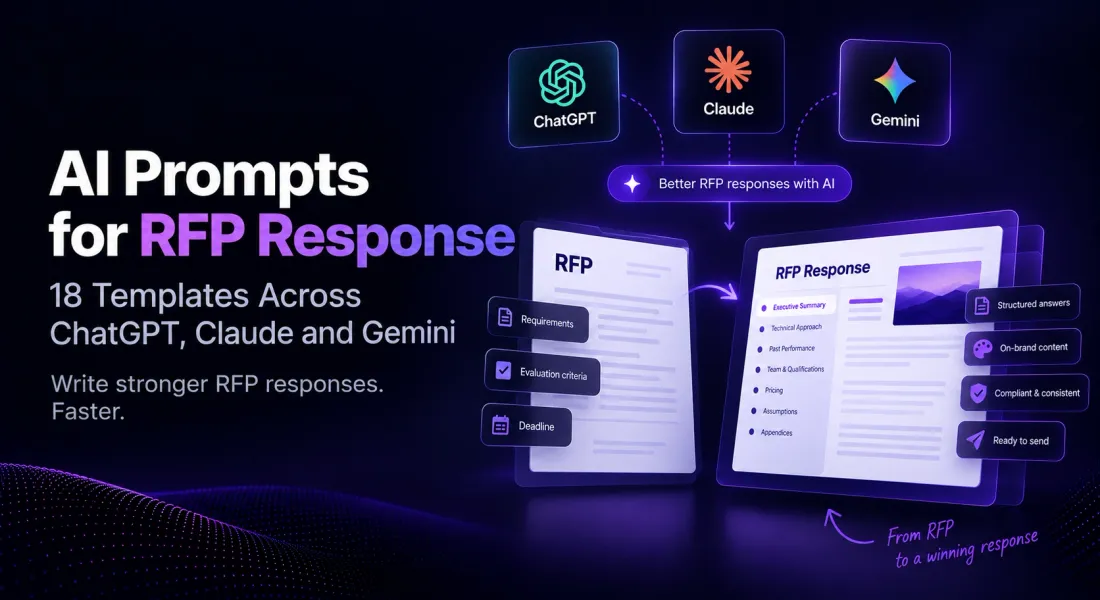
AI Prompts for RFP Response: 18 Templates Across ChatGPT, Claude And Gemini
An RFP response is graded, not read. Somewhere behind the document is a scorecard, and the response that wins is the one that answers every requirement in the order it was asked, not the one with the nicest cover page. Most response teams either compress weeks of research and drafting into the final 48 hours, or reuse last quarter’s answer in a section it does not quite fit, and evaluators notice both.
The 18 templates here, divided across ChatGPT, Claude and Gemini, treat compliance and consistency as the job, not an afterthought. The ChatGPT prompts cover full responses, executive summaries and quick rewrites of weak sections. The Claude prompts handle long RFP documents, requirement-by-requirement answer tables and pricing narratives that hold together under scrutiny. The Gemini prompts research the buyer, the competitive field and the regulatory context before a word gets written. Used well, these prompts turn the entire RFP response process from a scramble into a repeatable system.
Why AI Works Well For RFP Responses
An RFP is a structured document responding to a structured request. AI handles that pairing well once the brief includes the actual requirements, not a paraphrase of them. A documented RFP process makes that brief far easier to write in the first place.
Each Model Has A Different Edge
ChatGPT is the most flexible for general drafting and fast rewrites. Claude handles long, structured RFP documents and detailed compliance tables best. Gemini is the strongest choice when you need to research the buyer or the competitive field before writing.
Compliance Beats Persuasion
Score sheets reward the response that answers exactly what was asked, in the order it was asked. A brilliant answer to a question nobody asked scores zero. Every template below is built around the requirement, not around what sounds impressive.
Boilerplate Reads As Boilerplate
Evaluators read dozens of responses in one sitting. A paragraph copied from a different RFP, with the client name barely changed, is the fastest way to lose credibility. Ask the model to tie every answer to the specific requirement in front of it, and keep proof points in a reusable content library rather than copy-pasted from the last RFP.
A Consistent Win Theme Compounds
The proposals that score highest usually repeat two or three central arguments across multiple sections rather than raising a new point every time. Decide the win theme early and ask every prompt below to reinforce it.
ChatGPT Prompts For RFP Responses
ChatGPT is the flexible workhorse for RFP response drafting. It handles full responses, executive summaries and quick section rewrites under deadline pressure. These six ChatGPT prompts for RFP response writing cover the situations proposal teams and consultants face when trying to respond to an RFP faster than the deadline allows. Each ChatGPT prompt for RFP response below is built around a specific scenario, so you can pick the right ChatGPT prompt for RFP response for the job rather than starting from a blank page.
1. Full RFP Response From Requirements List
Act as an experienced proposal manager responding to a formal RFP on a tight deadline.
Context:
- Our company: [name and core capability]
- Buyer: [name and industry]
- RFP requirements: [paste the numbered requirements list]
- Our win theme: [the one argument we want to repeat]
- Relevant proof: [a comparable engagement or result]
- Page or word limit (if any): [limit]
Write a complete RFP response that addresses every requirement in order.
Structure:
1. Executive summary, tying our win theme to their stated goal
2. A response to each requirement, numbered to match the RFP
3. For each response: our approach, our proof, our differentiator
4. Team and qualifications
5. Pricing summary (narrative, not the full pricing table)
6. Assumptions and clarifications requested
Rules:
- Address every requirement, in the order it appears in the RFP.
- Reuse our win theme at least three times across sections.
- Do not invent capabilities we do not have.
- Plain, confident language, no filler.
Where it works best: ChatGPT produces a complete, requirement-mapped first draft fast enough to leave real time for review before the deadline. This is the ChatGPT prompt for RFP response most teams reach for first.
Best for: A first full draft once the requirements list is in hand and the clock is already running.
Turn this draft into a branded submission in 60 seconds
Paste your website URL and Proposal.biz pulls your brand, services and case studies into a Smart Content Library, so every RFP response looks like yours automatically, not like a Word template.
Try for free
2. Executive Summary For An RFP Response
Act as a proposal writer whose only job is the executive summary evaluators read before anything else.
Context:
- Buyer's stated goal: [from the RFP]
- Our win theme: [the one argument we want to repeat]
- The single most compelling proof point: [a result or credential]
- Why us over the likely competition: [one honest reason]
Write only the executive summary for this RFP response.
Rules:
- Open with their goal, not our company.
- State our win theme clearly in the first two sentences.
- Reference the proof point once, specifically.
- Under 250 words.
- No hedging language, no filler adjectives.
Additional output: one alternative opening sentence, bolder than the first, so I can choose between them.
Where it works best: ChatGPT compresses a scattered set of proof points into a tight, confident opening fast, and offers a second option to react to.
Best for: Tightening the one section evaluators are guaranteed to read in full.
3. Compliance Matrix Answer-By-Answer
Act as a proposal coordinator building a compliance matrix response for an RFP.
Context:
- RFP requirements: [paste the numbered list, or a subset]
- Our capability notes for each: [rough notes, bullet points are fine]
Task:
Turn these into a compliance matrix response.
Format, for each requirement:
- Requirement number
- Compliance status: Comply / Comply With Exception / Does Not Comply
- Response (2-4 sentences, specific, tied directly to the requirement)
Rules:
- Never mark "Comply" unless the notes actually support it.
- Where notes are thin, write "Comply With Exception" and flag it
for review rather than guessing.
- No generic language. Every response must reference the specific requirement wording.
Where it works best: ChatGPT holds a repetitive tabular structure cleanly across dozens of requirements without the answers blurring into each other.
Best for: Long RFPs with 20 or more numbered requirements that need an honest compliance status against each one.
4. Rewrite A Weak Answer To Score Higher
Act as an RFP reviewer who has scored hundreds of responses and knows exactly why weak answers lose points.
Requirement:
[paste the specific requirement]
Our current answer:
[paste the current draft answer]
Task:
Rewrite this answer to score higher against a typical evaluator scorecard.
Instructions:
- Point out, briefly, what the current answer is missing before the rewrite.
- The rewrite must answer the requirement directly in the first sentence.
- Add one specific, verifiable detail (a number, a name, a result) if one is available in the current draft; if not, flag where one is needed.
- Cut generic claims that could apply to any vendor.
- Keep length within 10% of the original.
Where it works best: ChatGPT is fast at diagnosing why a specific answer reads as generic and producing a sharper version in the same pass.
Best for: The final review pass, section by section, once a full draft already exists.
5. Win Themes Section
Act as a capture strategist defining the win themes for
an RFP response.
Context:
- Buyer's stated priorities: [from the RFP]
- Our genuine strengths relevant to this bid: [list them]
- Known or likely competitors: [if known]
- What we believe the buyer actually cares about beyond the stated requirements: [your read]
Task:
Define 2-3 win themes for this response and show how to weave each one through the document.
Output:
- Each win theme in one sentence
- Why it matters to this specific buyer
- Three sections of the response where it should reappear
- One sentence of proof to attach to it each time
Rules: win themes must be genuinely differentiating, not generic claims like "quality" or "experience" on their own.
Where it works best: ChatGPT is useful for structuring a repeatable theme across a long document once the strategic direction is already clear.
Best for: Early in the response process, before sections get assigned to different writers.
6. RFP Response Cover Letter (Bonus)
You are writing the cover letter that accompanies a submitted RFP response.
Context:
- Buyer: [name]
- RFP reference number or title: [if applicable]
- Submission deadline: [date]
- One line summarising our response's core commitment: [your line]
- Contact for questions: [name and role]
Write a short, formal cover letter.
Rules:
- Confirm what is being submitted and in response to which RFP.
- State our core commitment in one confident sentence.
- Confirm compliance with submission requirements (format, deadline).
- Under 200 words.
- Formal but not stiff.
Where it works best: ChatGPT writes a clean, compliant cover letter quickly, which matters when it is often the last thing written before submission.
Best for: The final document that wraps the whole response package before it goes out.
Claude Prompts For RFP Responses
Claude is the right model when the RFP is long, the requirements are dense, and every answer needs to hold up if an evaluator checks it against the original wording, particularly for consulting firms managing RFP-heavy pipelines. These six Claude prompts for RFP response writing handle the situations where precision matters most. Each Claude prompt for RFP response below is built around a specific scenario, so you can pick the right Claude prompt for RFP response for the job rather than starting from a blank page.
1. Full RFP Response From The Raw Document
You are a senior proposal manager who reads a full RFP document faithfully before writing a word of response.
RFP document:
[paste the full RFP, or the requirements and evaluation criteria sections at minimum]
Our capabilities: [what we offer, relevant to this bid]
Our win theme: [the one argument we want to repeat]
Task:
Write a complete RFP response addressing every requirement in the document, in the order it appears.
Instructions:
- Open with a short executive summary signalling we have read the entire document, including the evaluation criteria.
- Address every numbered or lettered requirement, in order.
- For each: our approach, our proof, our responsible role.
- Where a requirement is ambiguous, state a specific interpretation and label it as an assumption to confirm.
- Include a "Clarifications Requested" section at the end for anything genuinely unclear.
Rules: do not invent capabilities we do not have. If we cannot meet a requirement, say so plainly and offer the closest honest alternative.
Where it works best: Claude reads long, structured RFP documents faithfully and produces a response that holds up under a line-by-line comparison against the original. This is the Claude prompt for RFP response most teams reach for first.
Best for: Formal, lengthy RFPs, especially in regulated or procurement-heavy industries.
Track exactly when evaluators review your response
Send your RFP response as a trackable link instead of a flat PDF attachment, and see opens, time spent and which sections got read closely before you ever hear back.
Try for free
2. Requirement-By-Requirement Response Table
You are a proposal specialist who never lets a requirement go unanswered.
Requirements:
[paste the numbered requirements list]
Our capability notes: [notes against each, however rough]
Task:
Build a requirement-by-requirement response table.
For each requirement:
- Requirement number and a one-line restatement in our own words
- Our response, 2-4 sentences, specific and evidence-backed where possible
- Cross-reference to any full section elsewhere in the response that covers this in more depth
Rules:
- Every requirement gets a row. None are skipped or merged.
- Flag any requirement our notes do not clearly support, rather than writing around the gap.
- Consistent tone and format across every row.
Where it works best: Claude holds structure and consistency across dozens of rows better than models that start drifting in tone by row thirty.
Best for: Large, formal RFPs where the evaluator is visibly working from a compliance checklist.
3. Past Performance / Case Study Section
You are a proposal writer building the past performance section of an RFP response.
Context:
Relevant past engagements: [list 2-3, with client type, scope, and result]
This bid's requirements they should map to: [which requirements these examples prove we can meet]
Task:
Write a past performance section using these examples.
For each example:
- Client type and scope, kept generic if confidentiality requires
- The challenge and what we delivered
- The measurable result
- Which specific requirement in this RFP this example proves we can meet
Rules:
- Every example must map explicitly to a stated requirement.
- Use real, specific detail. Vague claims read as unverifiable.
- Close with one sentence connecting the pattern across examples to this buyer's situation.
Where it works best: Claude is careful about keeping factual claims grounded in the examples provided rather than inflating them, which matters in a section evaluators often fact-check.
Best for: RFPs that explicitly score past performance or require named references.
4. Risk And Mitigation Section For An RFP
You are a delivery lead who addresses risk honestly in an RFP response, because buyers trust vendors who do.
Context:
Project or service type: [what is being bid on]
Realistic risks for this kind of engagement: [list them honestly]
Our standard mitigations: [what we actually do]
Task:
Write a risk and mitigation section for the RFP response.
Structure:
Short intro paragraph on our approach to risk. Then for each risk:
- The risk, one sentence
- Likelihood and impact (low / medium / high)
- Our mitigation, specific and credible
- How we monitor for it during delivery
Rules: no vague risks like "scope creep" without specifics. No mitigation that is just a promise with no mechanism behind it.
Where it works best: Claude writes risk sections that read as genuinely credible rather than defensive boilerplate, which is exactly what evaluators are trained to spot.
Best for: RFPs from procurement-mature buyers who explicitly score risk management.
5. Pricing Narrative That Justifies The Number
You are a proposal writer explaining pricing in a way that survives scrutiny, not just a number on a page.
Context:
Pricing structure: [fixed, milestone-based, tiered, etc.]
The number or range: [your pricing]
What is included: [scope covered by this price]
Why the number is what it is: [genuine cost drivers or value justification]
Task:
Write a pricing narrative section to accompany the pricing table.
Structure:
- One paragraph framing value before cost
- What is included, in plain terms
- What drives the number, briefly and honestly
- Payment terms in one line
- A closing line connecting price back to the win theme
Rules: no false discounting language, no artificial urgency. Confident, not apologetic, about the number.
Where it works best: Claude writes value-framed pricing narratives that stay factual and avoid the over-selling tone that undermines pricing credibility.
Best for: Bids where the number needs defending against a lower competitor, not just stating.
6. Tighten An Existing Draft Response
You are a ruthless but careful editor of RFP responses.
Draft:
[paste the full draft response, or one section of it]
Word or page limit: [the constraint, if any]
Task:
Tighten this draft without losing any factual information or unaddressed requirement.
Instructions:
- Cut filler, hedging, and repeated claims.
- Replace vague statements with specific ones where the source material supports it.
- Confirm every requirement referenced is still addressed after cuts.
- Flag anything that could be cut entirely.
Output:
1. The tightened draft.
2. A short list of the most important changes and why.
3. Confirmation that no requirement coverage was lost.
Where it works best: Claude edits with restraint, explains its reasoning, and is careful about the specific risk in RFP editing: cutting a sentence that happened to be the only answer to a requirement.
Best for: A draft that answers everything but reads long, soft, or padded against a strict page limit.
Gemini Prompts For RFP Responses
Gemini’s live web grounding is the right tool when the RFP response needs current information about the buyer, the competitive field or the regulatory environment. These six Gemini prompts for RFP response writing turn a generic response into one that reads as genuinely informed, especially when paired with the right RFP response tools. Each Gemini prompt for RFP response below is built around a specific scenario, so you can pick the right Gemini prompt for RFP response for the job rather than starting from a blank page.
1. Research-Backed RFP Response
You are a capture strategist who researches the buyer before writing a word of the response.
Step 1: Research [buyer organisation] using current web information.
Look for:
- Their stated strategic priorities or public initiatives
- Recent news that suggests why this RFP was issued now
- Their current vendor or approach in this area, if public
- Industry benchmarks relevant to what is being procured
Step 2: Write an RFP response opening section informed by what you find.
Requirements:
- Open with two or three specific observations drawn from research.
- Tie our win theme to a stated priority of theirs.
- Cite any specific fact with its source.
- If something cannot be verified, say so rather than guessing.
This turns a generic AI prompt for RFP response writing into a response that feels genuinely informed about the buyer.
Where it works best: Gemini’s live web grounding is essential for a response that references the buyer’s actual current priorities rather than generic sector language. This is the Gemini prompt for RFP response most teams reach for first.
Best for: High-value bids where a generic response would read as one of a dozen identical submissions.
Draft, brand, send and get your RFP signed in one window
Keep the whole RFP response lifecycle in one place: AI-assisted drafting, automatic branding from your Smart Content Library, a trackable link to send, and e-signature when it is time to close.
Try for free
2. Competitor Landscape Section
You are an analyst researching who else is likely bidding on this RFP, so our differentiation is grounded in reality rather than assumption.
Step 1: Research the likely competitive field for [type of procurement] in [buyer's sector].
Find:
- Vendors commonly cited as leaders in this space
- Their typical positioning and known weaknesses
- Recent wins or losses reported publicly
Step 2: Write a short internal briefing (not for the RFP itself) on how to differentiate against this field.
Output:
- A paragraph on the likely competitive field
- 2-3 differentiation angles specific to this buyer's stated priorities
- One angle to avoid, because a likely competitor already owns it
Rules: cite sources. Do not name competitors in the response document itself unless the RFP explicitly asks for a competitive comparison.
Where it works best: Gemini can surface real competitive intelligence from public sources that shapes strategy before drafting starts.
Best for: Competitive bids where differentiation, not just compliance, decides the outcome.
3. Industry Compliance And Regulation Context
You are a research lead building the compliance context for an RFP response in a regulated sector.
Step 1: Research [buyer's industry] for regulatory or compliance requirements relevant to [what is being procured] in the last 12 months.
Find:
- Relevant regulations or standards
- Recent enforcement actions or guidance affecting this category
- Anticipated changes in the near term
Step 2: Write a compliance context section for the response.
Output:
- Opening paragraph framing the regulatory environment
- Bullet list of specific, cited requirements or standards
- A paragraph showing how our approach accommodates them
Rules: cite every regulation by name and source. Do not exaggerate our compliance posture.
Where it works best: Gemini’s web grounding catches recent regulatory changes that an older knowledge cutoff would miss entirely.
Best for: Government, healthcare, financial services, or other heavily regulated RFPs.
4. Buyer Priorities From Public Sources
You are a strategist reading between the lines of what a buyer actually wants, beyond the literal RFP text.
Step 1: Research [buyer organisation] using public sources.
Find:
- Recent public statements from leadership
- Strategic plans, annual reports, or press coverage
- Any stated pain point or initiative this procurement might connect to
Step 2: Write a short section connecting our response to what the buyer appears to actually be optimising for.
Output:
- A framing paragraph on the buyer's apparent priorities
- A bullet list connecting 2-3 of our capabilities to those priorities
- A sentence suggesting where in the response to reinforce this
Rules: cite specific sources. Do not overstate certainty about an organisation's internal priorities from public information alone.
Where it works best: Gemini surfaces context that turns a compliant-but-generic response into one that speaks to what the buyer is actually optimising for.
Best for: RFPs where the stated requirements feel like the floor, not the whole story.
5. Benchmark Pricing Context
You are an analyst researching what buyers typically pay for this category of work, so our pricing narrative has outside validation.
Step 1: Research typical pricing ranges for [type of engagement] in [buyer's sector or region].
Find:
- Reported price ranges from public sources
- Common pricing models used in this category
- Factors that typically move price up or down
Step 2: Write a short "market context" paragraph to accompany the pricing section.
Output:
- One paragraph framing the typical range, with sources
- A sentence positioning where our pricing sits and why
Rules: cite every figure. Use ranges, not false precision. Do not overclaim certainty about competitors' actual pricing.
Where it works best: Gemini’s web grounding produces credible third-party pricing context that is hard for older models to source reliably.
Best for: Bids where the buyer is price-sensitive and needs external validation that a number is reasonable.
6. Evaluation Criteria Reverse-Engineering
You are a capture strategist inferring how an RFP will actually be scored, beyond what the evaluation criteria section states outright.
Step 1: Research [buyer organisation or sector] procurement patterns.
Find:
- Any public procurement scoring guidance from this buyer or similar public-sector buyers, if applicable
- Common weighting patterns for this type of procurement
- Anything publicly known about what this buyer has valued in past awards
Step 2: Write a short internal scoring-alignment note (not for the RFP itself).
Output:
- A restatement of the stated evaluation criteria
- Where the real weight likely sits, based on research
- Which sections of our response deserve the most attention as a result
Rules: cite sources where they exist. Where this is inference rather than confirmed fact, label it clearly as inference.
Where it works best: Gemini’s research grounds an educated guess about scoring weight in something more than internal opinion, which shapes where the writing team spends their time.
Best for: High-value or recurring bids where understanding the real scoring weight changes the response strategy.
How To Get More From Each Prompt
Treat The First Reply As A Draft
Ask for a tighter version, push back on a generic-sounding answer, or request more specificity against one requirement. Each pass sharpens the response.
Chain Your Prompts
Before you invest hours answering every requirement, confirm the bid is genuinely winnable. Learn how to qualify serious prospects before writing so every RFP you respond to is one worth the hours it takes.
Use the output of one prompt as the input to the next. A research prompt can feed the executive summary prompt, which can feed the win-themes prompt.
Save What Works
When a prompt produces a response that scores well, keep it with a note on why. Over time you build a personal library of proven answers that beats writing from scratch on every new bid.
From Prompt To Branded Document
AI gives you the words. It does not give you a branded RFP response your evaluator actually opens easily, or tell you when they read it. That last stretch, formatting to the buyer’s expectations, submitting cleanly, and following up at the right moment, is usually where the time stacks up.
This is where Proposal.biz fits in.
Paste Your Website URL – Proposal.biz pulls your brand assets, services and case studies into a Smart Content Library, so every response looks like yours automatically.
Generate From A Prompt – Describe what you need and it produces a fully branded RFP response, ready to refine in the Proposal Builder.
Send A Shareable, Trackable Link – Instead of a flat PDF, you send a live link and see views, time spent and section-level engagement, so you know exactly when to follow up.
If you would rather start from a structured bid document instead of a blank page, the RFP-compliant bid proposal template gives you the section structure already built, ready to fill from any of the prompts above.
The simplest workflow: draft your response using whichever AI prompt for RFP response writing fits the scenario, then drop the copy into Proposal.biz to brand, send and track. You keep the AI tool’s drafting speed and add the document layer that closes the loop with the evaluator, then use any AI prompt to write an RFP response you have saved alongside it.
Final Word
An RFP response is judged against a checklist before anyone judges it on style. Answer every requirement in the order it was asked, back every claim with something specific, and repeat the same two or three win themes until they sound inevitable. The discipline lives in the sections most weak responses skip: an honest risk section, a pricing narrative that explains itself, and a compliance matrix that never marks “comply” without proof.
Proposal.biz makes the document side of that work simpler. Paste your website URL and your services, past performance and case studies populate a Smart Content Library you draw from on every bid. The Proposal Builder turns your AI draft into a branded submission, a shareable link replaces the PDF attachment, and view tracking shows you which sections the evaluator actually spent time on.
If your RFPs are consistently project-based rather than service-based, the prompts in AI prompts for Project Proposal cover the deeper scope-and-milestone detail a project-style RFP often needs.
Frequently Asked Questions
What is the best AI prompt for RFP response writing?
There is no single best prompt. The strongest output depends on where you are in the process and how long the RFP is. For a first full draft under deadline pressure, the ChatGPT prompt for RFP response building works well. For a long, formal RFP that needs line-by-line fidelity, the Claude templates handle it most faithfully. For a competitive or high-value bid where the buyer’s actual priorities matter, the Gemini template researches that context first.
Which AI tool is best for writing an RFP response?
Each model has a different strength. ChatGPT is the most flexible for general drafting and fast section rewrites. Claude is best when the RFP is long and every answer needs to hold up against the original requirement wording. Gemini wins when you need to research the buyer, the competitive field or the regulatory context before writing.
How do I make sure I answer every requirement in the RFP, not just the easy ones?
Paste the full, numbered requirements list into the prompt rather than a summary, and ask explicitly for a response mapped to each number in order. The compliance matrix and requirement-by-requirement templates in this guide are built for exactly this. If a draft ever skips a requirement, that is the prompt to catch it before submission.
Can I reuse the same RFP response prompts across industries?
Yes. The structure, requirement mapping, risk framing and pricing narrative patterns hold across industries. What changes is the context you feed in: the buyer’s sector, the regulations that apply, and the proof points you have available. Swap those details and the same 18 templates work for a government bid or a private-sector RFP alike.
How do I turn the AI output into a branded RFP response document?
AI gives you the words, not a branded submission or a way to know whether the evaluator opened it. Tools like Proposal.biz close that gap: paste your website URL to pull your brand into a Smart Content Library, generate a fully branded RFP response from a prompt, then send a shareable link and track views, time spent and section-level engagement.

Ronak Surti

 Ronak Surti