
Table of Contents
How to Write a Sales Proposal?
Quick answer: To write a sales proposal, open with a short summary of the client’s problem, restate their goals in their words, lay out your proposed solution and scope, present clear pricing, add proof such as case studies, and close with a single obvious next step. A strong sales proposal is built around the client’s outcome, not your feature list.
Most sales proposals lose deals for the same reasons: they talk about the seller instead of the buyer, bury the price, and end without a clear action. This guide walks through the format that works, the exact steps to write one, and what to include.
What Is a Sales Proposal?
A sales proposal is a document that lays out how you will solve a specific prospect’s problem, what it will cost, and why you are the right choice. It usually comes after a discovery conversation, once you understand the prospect’s situation well enough to tailor a solution.
It is not a brochure and not a price list. The job of a sales proposal is to make saying yes easy by connecting the prospect’s goals to your solution and removing any reason to hesitate.
Sales Proposal Format: The Standard Structure
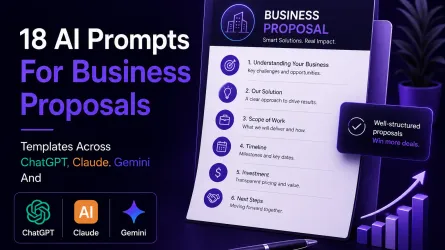
Almost every effective sales proposal follows the same skeleton. You can adjust the order, but these are the sections buyers expect:
- Title page. Your company, the client’s name, and the date. Clean and branded.
- Executive summary. A short paragraph framing the client’s problem and your solution. This is the most important section, because some readers only read this.
- Understanding of the problem. Proof that you listened, written in the client’s own language.
- Proposed solution. What you will deliver and how it solves the problem.
- Scope and deliverables. Specifics: what is included, what is not, and the timeline.
- Pricing. Clear, itemized, and easy to compare.
- Proof. Case studies, results, testimonials, or relevant experience.
- Terms and next step. What happens after they say yes, and one clear call to action.
Keep it as short as it can be while still answering every question the buyer would ask.
How to Write a Sales Proposal: Step by Step
Step 1: Start From the Discovery Call, Not a Template
The best proposals are written after a real conversation. Before you write a word, you should know the prospect’s main problem, what success looks like to them, their timeline, and their budget range. If you do not have those, you are guessing, and guessing shows.
Step 2: Write the Executive Summary First
Lead with the client’s problem and the outcome you will deliver, in two or three sentences. Resist the urge to introduce your company first. The buyer cares about their situation, not your founding story. Write this section so well that someone could approve the deal from it alone.
Step 3: Mirror the Client’s Goals in Their Words
Restate the problem using the language the prospect used on the call. When a buyer reads their own words back, they trust that you understood them. This single move separates tailored proposals from generic ones.
Step 4: Present the Solution as Outcomes
Describe what you will do, then immediately connect it to the result the client wants. Not “we will run a six-week content sprint,” but “we will run a six-week content sprint to fill your pipeline before Q4.” Every deliverable should map to a goal.
Step 5: Make Pricing Clear and Confident
Do not bury the price or apologize for it. Present pricing in a clean table, itemized so the buyer can see what they are paying for. If you offer tiers, make the recommended option obvious. Confusing pricing creates hesitation, and hesitation kills deals.
Step 6: Add Proof
Back your claims with evidence: a relevant case study, a measurable result, or a short testimonial from a similar client. Proof reduces the perceived risk of choosing you.
Step 7: End With One Clear Next Step
Close with a single, specific action: book a call, approve the scope, or sign. Multiple options create decision paralysis. Give the buyer one obvious thing to do next.
What to Include in a Sales Proposal: The Checklist
Use this as a final pass before you send:
- A branded title page with the client’s name
- An executive summary the buyer could approve on its own
- The client’s problem stated in their language
- A solution framed around outcomes, not features
- Clear scope, deliverables, and timeline
- Itemized, easy-to-read pricing
- At least one piece of proof
- A single, specific call to action
- No typos, no placeholder text, and consistent branding throughout
If any item is missing, the proposal is not ready to send.
Common Sales Proposal Mistakes to Avoid
- Leading with yourself. The buyer’s problem comes first, every time.
- Sending a generic template. Untailored proposals read as untailored, and buyers can tell.
- Hiding the price. Clarity builds confidence; vagueness breeds doubt.
- Writing a novel. Length is not value. Cut anything that does not move the deal.
- Ending weakly. “Let me know your thoughts” is not a call to action.
Writing Sales Proposals Faster With Proposal.biz
The hardest part of writing a sales proposal is starting from a blank page for every deal. Proposal.biz removes that step. Here is how it speeds up the process:
- Set up once. Paste your website URL and the Smart Content Library pulls your brand, services, and case studies into one place.
- Generate the first draft from a prompt. Describe the deal and the AI produces a branded draft, with pricing blocks built in.
- Refine instead of rewrite. Adjust any section in the editor or by chat, rather than building from scratch.
- Send as a trackable link. See which sections the prospect reads and how long they spend, so you know when to follow up and what to address.
- Close in the same place. Get the proposal signed without switching tools.
The result is less time assembling documents and more time selling.
Top 5 Sales Proposal Writing Tools
If you want software to help you write and send sales proposals, these five are the strongest options in 2026.
| Tool | Best for | Starting price (2026) |
|---|---|---|
| Proposal.biz | Generating a full branded proposal from a prompt | $15 per month |
| PandaDoc | All-round document automation and e-signatures | Free plan, paid from $19 per user per month |
| Proposify | Structured, repeatable proposal templates | $19 per user per month |
| Qwilr | Interactive, web-based proposals | $35 per user per month |
| Better Proposals | Simple, fast proposals at a low entry price | $13 per user per month |
1. Proposal.biz
The only tool here that writes the proposal for you. You connect your website, describe the deal in a prompt, and the AI generates a complete, branded draft, pricing blocks included. You then refine it, share it as a trackable link, watch engagement section by section, and get it signed. It is the fastest path from a blank page to a finished proposal, and it covers the full document lifecycle in one place.
2. PandaDoc
A widely used document automation platform with templates, e-signatures, payments, and CRM integrations. It has a free plan for basic e-signing, with paid plans from $19 per user per month and a Business tier at $49 per seat per month aimed specifically at sales proposals. Strong and well-supported, though you still build each proposal inside a template rather than generating it.
3. Proposify
Proposal-focused software built for sales teams that send similar proposals repeatedly. It offers a drag-and-drop editor, a reusable content library, an AI writing assist, e-signatures, and per-section analytics, starting at $19 per user per month. Best when your value is consistency and repeatability rather than speed of first draft.
4. Qwilr
Turns proposals into interactive web pages instead of static PDFs, with embedded media, interactive quotes, and payments. It is the standout for a polished client-facing experience, starting at $35 per user per month on the Business plan. The trade-off is a higher price and manual page building.
5. Better Proposals
The simplest and lowest-cost entry point, aimed at freelancers and small teams who want a clean, professional proposal without a learning curve. It starts at $13 per user per month and includes legally binding signatures, pricing tables, payment integrations, and tracking. Lighter on automation, but quick to learn.
Conclusion
A great sales proposal is not about you. It is about showing the prospect that you understand their problem, can solve it, and have done it before, then making the next step obvious. Follow the format, lead with outcomes, keep pricing clear, and close with one clear action.
Do that consistently and your proposals stop being documents you send and start being deals you close.
Generate a branded sales proposal from a single prompt with Proposal.biz.
FAQs
How long should a sales proposal be?
As short as it can be while answering every question the buyer has. For most deals that is two to six pages. Length signals nothing; clarity does.
What is the most important part of a sales proposal?
The executive summary. Many decision-makers skim, and some approve from the summary alone, so it should frame the problem and the outcome clearly enough to stand on its own.
What is the difference between a sales proposal and a quote?
A quote is mostly pricing. A sales proposal includes the context, solution, scope, and proof around the pricing, making the case for why the buyer should choose you, not just what it costs.
How do I write a sales proposal quickly?
Start from a real discovery call so you are not guessing, work from a repeatable structure, and reuse proven content like case studies and pricing blocks. AI tools that generate a branded first draft from a prompt cut the time further.
Should I include pricing in the sales proposal?
Yes. Clear, itemized pricing builds confidence and reduces back-and-forth. Hiding the price creates friction and gives the buyer a reason to stall.

Ronak Surti

 Ronak Surti