Table of contentsAverage Sales Cycle Length at a Glance
How long is a B2B sales cycle? Ask ten sales leaders and you will hear anything from two weeks to two years. Both answers are right, because they measure different things. The average sales cycle length depends on where you start the clock, how big the deal is and whether the buyer already knows you.
This guide brings together the most reliable recent benchmarks. Buyer-side data from 6sense covers more than 4,000 B2B buyers. Seller-side data comes from Ebsta’s analysis of $48 billion in pipeline and Optifai’s CRM study of 939 B2B SaaS companies. We have added Proposify’s benchmark of 742,137 proposals for the final stretch from proposal to signature.
Alongside the numbers, you will find which stages slow deals down and where better documents take days out of the cycle. Much of that time sits between the conversation and the paperwork, which is why teams use a drag-and-drop document builder to close the gap.
Average Sales Cycle Length at a Glance
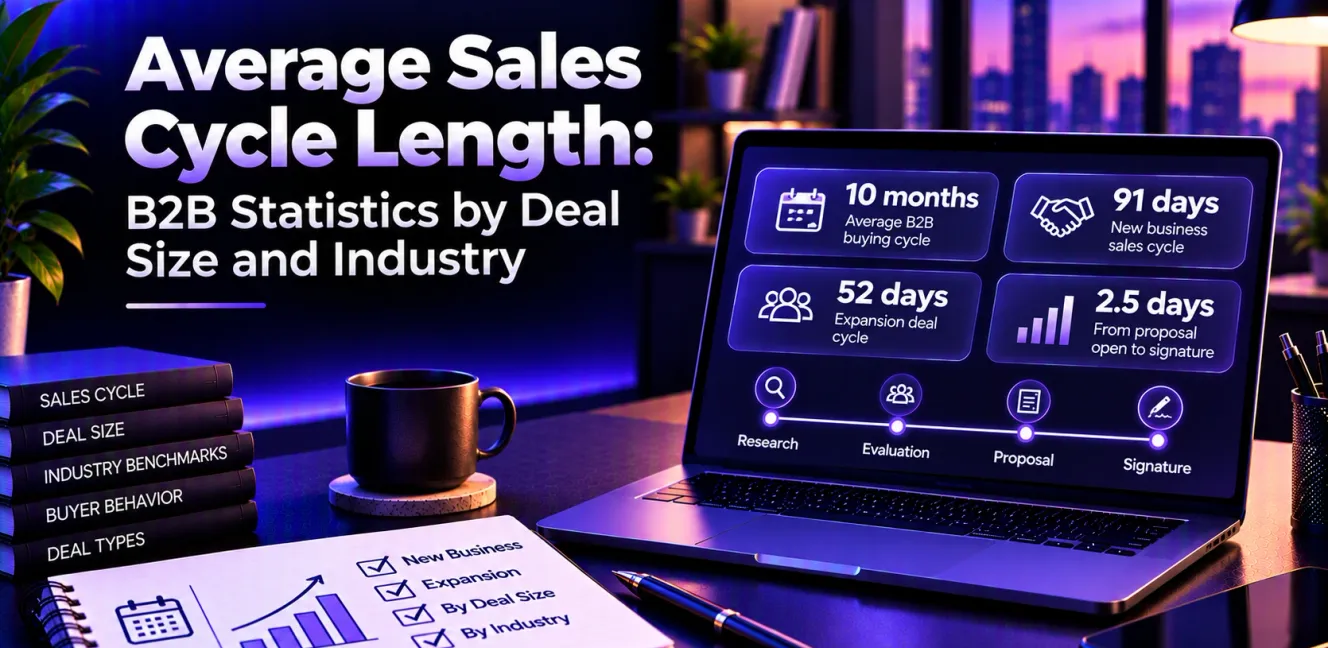
- 10 months is the average B2B buying cycle measured from the buyer’s side (6sense, 2025).
- 91 days is the average sales cycle for new business, measured from the seller’s side (Ebsta, 2025).
- 52 days is the average cycle for expansion deals with existing customers (Ebsta, 2025).
- 84 days is the median B2B SaaS sales cycle (Optifai, 2026).
- 14 to 30 days is typical for deals under $15,000 in annual contract value (Optifai, 2026).
- 90 to 180+ days is typical for deals above $100,000 (Optifai, 2026).
- 36% of deals slipped past their expected close date in the latest benchmark year (Ebsta, 2025).
- 2.5 days is the average time from first opening a proposal to signing it (Proposify, 2026).
Buyer-Side vs Seller-Side: Two Ways to Measure the Cycle
Before answering “how long is a B2B sales cycle”, check which clock each benchmark uses. Most confusion about B2B sales cycle length comes from mixing the two.
The Buyer’s Clock Starts at the First Search
Buyer-side research measures from the moment a buyer starts looking for a solution to the moment they sign. 6sense’s 2025 Buyer Experience Report put that journey at about 10 months, down from 11 months in 2024.
Most of that time happens before you know the buyer exists. The balance between independent research and seller engagement shifted from 70/30 to 60/40, and 94% of buying groups had ranked preferred vendors before first contact (6sense, 2025).
The Seller’s Clock Starts at the Opportunity
Seller-side data measures from when an opportunity is created in the CRM to when it closes. This is the number most sales leaders track, and it is far shorter. Ebsta’s benchmark puts it at 91 days for new business.
Why the Difference Matters
If your seller-side cycle is three months, your buyer has usually spent several months researching before that clock even started. The documents you send early, including anything a champion forwards internally, are working on that hidden part of the cycle.
B2B Sales Cycle Length by Deal Type
The fastest way to shorten your average cycle is to sell more to people who already buy from you.
New Business Takes 91 Days on Average
Ebsta’s 2025 GTM Benchmarks, built on $48 billion of pipeline from UK and US technology companies, found an average cycle of 91 days for new deals. New business deals involved eight decision-makers on average.
Expansion Deals Close in 52 Days
Expansion deals with existing customers closed in 52 days, with five decision-makers instead of eight (Ebsta, 2025). They also won 45% of the time, against 18% for new business.
Existing customers skip most of the trust-building stage. A renewal or upsell proposal that lands quickly can close in under two months.
Cycles Swung by 16% and 9% in Two Years
Ebsta found that sales cycles ran 16% longer in 2023 as buyers extended evaluations during economic uncertainty. In 2024 they shortened by 9%. Optifai’s data shows median B2B SaaS cycles are 22% longer than in 2022.
Financial Pressure Is Pushing Buyers to Move Faster
6sense found that 49% of buyers said financial pressure shortened their buying cycles, and 62% engaged sellers earlier as a result. When buyers move early, the seller who responds first with a credible document sets the terms of the conversation.
Sales Cycle by Deal Size
Deal size is the strongest predictor of B2B sales cycle length. Optifai’s 2026 Pipeline Study measured won deals across 939 B2B SaaS companies between Q2 2025 and Q1 2026, using CRM timestamps. The ranges below are the middle 50% of deals in each band.
Deals Under $15,000: 14 to 30 Days
Small deals close in two to four weeks. One or two decision-makers, a standard contract and a clear price keep things moving.
Deals of $15,000 to $50,000: 30 to 60 Days
Mid-market deals add stakeholders and usually a procurement review. One to two months is typical.
Deals of $50,000 to $100,000: 60 to 90 Days
Upper mid-market deals bring more scrutiny of scope and pricing. Expect two to three months.
Deals Over $100,000: 90 to 180+ Days
Enterprise deals routinely run three to six months or more. The median across all bands was 84 days (Optifai, 2026).
Which Stages Slow Deals Down
Knowing the sales cycle by deal size is useful. Knowing where the time goes is what lets you shorten it. Optifai broke won deals into four stages:
| Stage | Small deals | Mid-market | Enterprise |
|---|---|---|---|
| Discovery to demo | 3 to 5 days | 5 to 10 days | 10 to 20 days |
| Demo to proposal | 1 to 3 days | 5 to 15 days | 15 to 30 days |
| Proposal to negotiation | 3 to 7 days | 10 to 20 days | 20 to 40 days |
| Negotiation to close | 2 to 5 days | 10 to 20 days | 30 to 60 days |
The Gap Between Demo and Proposal
In enterprise deals, the time between the demo and the proposal ran 15 to 30 days (Optifai, 2026). That is waiting time, not buying time. The buyer has already seen the product and is ready to evaluate the offer.
Optifai found that deals with a proposal sent within 24 hours of the demo closed 35% faster. Closing this gap is the cheapest speed gain in the entire cycle. A same-day draft depends on having your content ready, which is where a tool to create and send quotes in minutes pays for itself.
Negotiation Is the Longest Stage in Enterprise Deals
Negotiation to close accounted for 35% to 40% of total enterprise cycle time (Optifai, 2026). Redlines, pricing pushback and legal review all happen here, and each round trip adds days.
Want your next proposal out the same day as the demo? Start free and generate a branded draft from your website URL and a single prompt.
Procurement and Trials Add Their Own Time
Forrester’s 2026 research found that procurement is a decision-maker in 53% of business buying cycles and engages from the start. More than 60% of buyers now use a trial, rising to 78% for purchases over $10 million. Both add stages that a clear scope and defined pilot terms help shorten.
Slipped Deals Are Still Common
In 2023, 44% of deals slipped past their expected close date. In 2024, 36% slipped, according to Ebsta. Slippage often happens late, while the buyer waits for a revised quote, an updated scope or a signature.
Our guide to the enterprise sales cycle breaks down the late stages of large deals in more detail.
Time to Close After the Proposal
Once the proposal is sent, the clock speeds up sharply. These figures come from Proposify’s State of Proposals 2026, a benchmark of 742,137 proposals sent in 2025.
Buyers Open Proposals Within 34 Minutes
On average, buyers opened a proposal 34 minutes after it was sent (Proposify, 2026). They are waiting for it.
Winning Proposals Close 2.5 Days After the First Open
The average time from first open to closed-won was 2.5 days (Proposify, 2026). Deals that drift well past that point are usually stuck on an unanswered question.
Time to Close Varies by Industry
Industry changes the final stretch dramatically (Proposify, 2026):
- Telecommunications: 0.98 days
- Hotel and venue: 1.05 days
- Legal services: 1.20 days
- Human resources services: 1.73 days
- Property management: 8.93 days
- Installation: 9.0 days
- Event management: 12.16 days
- Wholesale distribution: 14.91 days
E-Signatures Remove Days From the End
In Proposify’s benchmark, proposals with e-signatures closed 60% faster than those without. Removing the print, sign and scan step takes days out of the stage where deals most often slip.
What Shortens the Sales Cycle
The data points to a handful of moves that consistently take time out of a deal.
Qualify Before You Write
Ebsta’s 2025 Sales Qualification Report found that well-qualified deals closed 21.6% faster and were 6.3 times more likely to close. Qualified buyers do not need weeks of convincing after the proposal.
Multi-Thread the Deal
Optifai found that deals with three or more engaged contacts closed 2.4 times faster than single-threaded deals. When more of the buying group sees the proposal early, there are fewer surprises at approval.
Make the Document Easy to Share Internally
A champion who shares material internally speeds things up. Ebsta’s report highlights that when a champion shares a sales room internally at least twice, the cycle shortens by 15% on average. A proposal sent as one link that anyone in the buying group can open does the same job.
Live editing helps here too. When your team can collaborate on documents in real time, revisions turn around in hours rather than days.
Agree the Scope Early
For project work, a clear statement of work stops scope questions from reopening negotiation. A project milestone statement of work template sets out deliverables and payments by stage.
For quick-turnaround deals, a simple quote template gets the price in front of the buyer the same day.
Follow the Demo With the Document
A strong demo creates momentum that fades within days. A product demo presentation template and a proposal ready to send straight after it keep that momentum intact.
The covering message matters too. Our guide to writing a proposal email covers what to say when the proposal goes out.
Cut the waiting from your cycle. Send your next proposal as a trackable link and let your client sign inside it.
The Final Word on Average Sales Cycle Length
So, how long is a B2B sales cycle? The average sales cycle length depends on what you measure. From the buyer’s side, it is about 10 months. From the seller’s side, it is around 91 days for new business, 52 days for expansion and, measured as a sales cycle by deal size, anywhere from two weeks to six months.
Across every dataset, the same stages waste the most time: the gap between demo and proposal, and the back-and-forth of negotiation and signing. Both are document problems as much as sales problems. Our guide to strategies to shorten the B2B sales cycle walks through the fixes in order.
For large or staged deals, a multi-phase proposal strategy breaks a long commitment into smaller decisions that close faster.
Frequently Asked Questions
What is the average sales cycle length for B2B companies?
Seller-side benchmarks put the average sales cycle length at around 91 days for new business and 52 days for expansion deals. The median B2B SaaS cycle is 84 days. Measured from the buyer’s first search, the full buying journey averages about 10 months.
How long is a B2B sales cycle by deal size?
Deals under $15,000 in annual contract value typically close in 14 to 30 days. Deals of $15,000 to $50,000 take 30 to 60 days, $50,000 to $100,000 take 60 to 90 days and deals above $100,000 take 90 to 180 days or more.
Which stage of the sales cycle takes longest?
In enterprise deals, negotiation to close accounts for 35% to 40% of total cycle time. The gap between demo and proposal is also significant, running 15 to 30 days in enterprise deals, even though the buyer is ready to see an offer.
How can I shorten my sales cycle?
Qualify before writing a proposal, send the proposal within 24 hours of the demo, involve three or more contacts in the buying group and let the client sign inside the document. Each of these is linked to faster closes in the benchmark data.
Why do B2B sales cycles vary so much?
Deal size, the number of decision-makers, procurement involvement, trials and whether the buyer is a new or existing customer all change B2B sales cycle length. Industry matters too: some industries sign proposals within a day, others take two weeks.