
Table of Contents
Tiered Pricing Strategy: How to Build 3-Tier Pricing That Sells
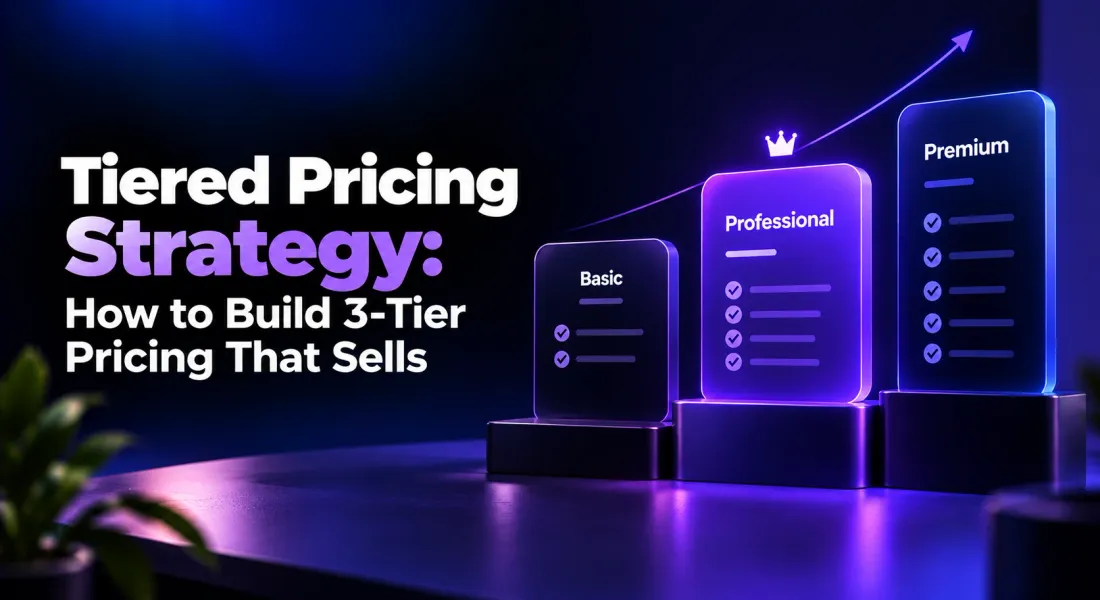
A 3 tier pricing strategy offers the same product or service at three levels, usually a basic, a recommended and a premium option, each with a clear difference in what the customer gets. Done well, it lets buyers choose how to say yes instead of whether to say yes, and steers most of them to the option that fits them best.
It is everywhere for a reason. Software companies use it on pricing pages, agencies and consultants use it in proposals, and service businesses use it for packages. But it also has a reputation problem: buyers have learned to spot a “decoy” tier that exists only to make another option look good, and they resent it.
This guide covers the tiered pricing definition, why three tiers work, how to build them step by step, tiered pricing examples across different businesses, and the mistakes that make tiers backfire.
Tiered Pricing Definition: What Is Tier Price?
Tiered pricing is a pricing approach where you offer several distinct packages or price levels, each giving the customer a different amount of value. A tier price is simply the price attached to one of those levels.
So what is tier price in practice? It depends on which of two common models you use.
Package Tiers
The customer chooses one of several bundles, such as Starter, Professional and Business, each including different features, service levels or deliverables. This is what most people mean by 3 tier pricing, and it is the focus of this guide.
Package tiers work well for services and software, where the value delivered can be scaled up or down without changing the core product.
Volume Tiers
The price per unit changes with the quantity bought. For example, the first 100 units cost $10 each, units 101 to 500 cost $8 and anything above 500 costs $6. This model is common for physical products, data and usage-based services.
Present pricing options in a branded proposal clients can sign. Create your first proposal free.
Why Three Tiers Work
Three is not a magic number, but it solves several problems at once.
One Price Forces a Yes-or-No Decision
With a single price, the buyer’s only options are to accept or walk away. With three, the question changes to which option suits them, which is a much easier conversation.
It also gives buyers a way to stay in the conversation when budget is tight. A smaller option keeps the relationship alive where a single high price would have ended it.
The Middle Option Feels Safe
Many buyers avoid the cheapest option because they worry it will not be enough, and the most expensive because it feels excessive. The middle feels like the sensible choice, which is why it is usually where you place the option you most want to sell.
The Top Tier Anchors Expectations
A premium option sets a reference point. Next to it, the middle tier looks reasonable. This is the effect that people call decoy pricing, and it only works ethically when the top tier is genuinely valuable to some customers.
Some buyers will choose the premium option outright, especially larger organisations, so build it as a real offer with real delivery behind it.
More Than Three Overwhelms
Four or five options can work for large software catalogues, but for most proposals and service packages, extra tiers slow decisions. If two tiers are hard to tell apart, merge them.
If you genuinely serve very different customer types, consider separate offers for each segment rather than adding more tiers to one table.
How to Build a 3-Tier Pricing Strategy in 6 Steps
1. Start From Your Customer Segments
Tiers work when each one matches a real type of customer. Look at your existing clients and group them by size, needs or ambition: those who want the essentials, those who want the full solution and those who want everything done for them.
If you cannot describe the customer each tier is for, the tier probably should not exist.
2. Define the Core Outcome Every Tier Delivers
Every tier should solve the customer’s main problem. The entry tier is not a broken version of the product; it is the simplest version that still works.
Tiers then differ in how much of the outcome they deliver, how fast, with how much support or across how much of the business.
3. Build the Middle Tier First
Design the option you expect most customers to choose, and price it using your normal method, whether that is cost-plus, value-based or market-led. This is your anchor for everything else.
Starting in the middle keeps the whole structure grounded in what most customers actually need, rather than stretching outward from a stripped-down product.
4. Strip Back for the Entry Tier
Remove the elements that matter most to larger or more demanding customers, such as extra users, faster turnaround, strategy time or advanced features. Keep enough that the tier is genuinely useful.
The entry tier should create a natural reason to upgrade later, not a frustrating gap on day one.
5. Add Real Value for the Premium Tier
The premium tier should include things some customers truly want: dedicated support, priority delivery, more scope, strategic input or guarantees. If nobody would ever choose it, buyers will see it as a decoy.
Talk to your best existing customers about what they would pay more for. Their answers usually define the premium tier better than internal brainstorming.
6. Set the Price Gaps and Name the Tiers
Price gaps should match the difference in value. A common pattern is for the premium tier to cost noticeably more than the middle tier, with the entry tier a meaningful step below it.
Name tiers by who they are for or what they achieve (“Launch”, “Growth”, “Scale”) rather than by size alone. Good names help buyers picture themselves in a tier.
Tiered Pricing Examples
These tiered pricing examples use illustrative figures to show how three tiers flex for different businesses.
SaaS Subscription
| Starter | Professional (recommended) | Business | |
|---|---|---|---|
| Price | $29 a month | $79 a month | $199 a month |
| Users | 1 | Up to 5 | Up to 20 |
| Core features | Yes | Yes | Yes |
| Integrations | Limited | All | All plus API |
| Support | Chat and email | Priority with onboarding |
Each tier serves a different customer: the solo user, the small team and the growing company. Upgrades follow naturally as a team grows.
See how SaaS companies use proposals alongside self-serve pricing on our page for SaaS teams.
Marketing Agency Retainer
| Foundation | Growth (recommended) | Accelerate | |
|---|---|---|---|
| Monthly fee | $3,000 | $6,000 | $11,000 |
| Channels managed | 1 | 3 | 5 |
| Content pieces | 4 a month | 8 a month | 16 a month |
| Strategy sessions | Quarterly | Monthly | Fortnightly |
| Reporting | Monthly report | Monthly report and call | Live dashboard and weekly call |
The difference between tiers is the amount of the outcome delivered, not whether the agency does a good job. Every tier gets competent work.
Consulting Project
| Diagnose | Diagnose and Plan (recommended) | Diagnose, Plan and Implement | |
|---|---|---|---|
| Price | $8,000 | $18,000 | $45,000 |
| Scope | Assessment and findings | Findings plus a prioritised roadmap | Roadmap plus hands-on implementation support |
| Duration | 3 weeks | 6 weeks | 4 months |
Consulting tiers often follow the stages of the work. Clients can start small and continue, which also reduces their risk.
Freelance Website Project
| Essentials | Growth (recommended) | Complete | |
|---|---|---|---|
| Price | $4,500 | $8,000 | $14,000 |
| Pages | Up to 6 | Up to 12 | Up to 25 |
| Copywriting | Client supplies | Key pages written | All pages written |
| Revisions | 1 round | 2 rounds | 3 rounds |
| Launch support | 2 weeks | 30 days | 90 days |
Volume Tiered Pricing for a Product
| Quantity | Price per unit |
|---|---|
| 1 to 100 | $10.00 |
| 101 to 500 | $8.50 |
| 501 and above | $7.00 |
Volume tiers reward larger orders and help buyers plan budgets. Make clear whether the lower price applies to all units or only to the units within each band, because customers will ask.
5 Tiered Pricing Mistakes That Backfire
A Decoy Tier Nobody Would Buy
Online discussions about pricing are full of people pointing out “sacrificial” top tiers, priced absurdly to make the middle look reasonable. Buyers increasingly recognise the tactic and trust the seller less for it.
Make every tier a real option. If the top tier exists only for anchoring, redesign it until some customers would genuinely choose it.
Tiers That Differ Only in Quantity
“5 hours, 10 hours, 20 hours” gives buyers no reason to choose anything but the cheapest that fits. Differences in outcome, speed or support are more persuasive than differences in volume alone.
Quantity can still be one difference, but pair it with something qualitative, such as faster response times, strategic input or a dedicated contact.
Putting Everything in the Entry Tier
If the cheapest tier includes almost everything, few customers upgrade. Keep the features that matter most to larger customers in the higher tiers.
The opposite mistake, a bare entry tier that barely works, is just as damaging. The aim is a tier that is genuinely useful for its intended customer and clearly limited for larger ones.
Confusing Names and Comparisons
Tier names like “Plus”, “Pro” and “Premium” tell buyers nothing about which suits them. Clear names and a simple comparison table make the choice faster.
Test your tier names with a few customers. If they cannot tell which tier is meant for them from the name and one line of description, rename it.
No Recommendation
Leaving buyers to choose without guidance slows decisions. Mark the option you recommend and explain why in one sentence.
Build tiered pricing tables in a branded proposal and send it as a link. Start free.
A recommendation is not pressure; it is advice. Buyers expect an expert to tell them which option fits, and most appreciate it.
How to Present Three Tiers in a Proposal
Pricing pages and proposals present tiers differently. On a website, tiers are generic; in a proposal, they should be built around one client’s situation.
Lead With the Client’s Goal
Before the table, restate what the client wants to achieve. Each tier then becomes a different way of reaching that goal, rather than a list of features.
This framing also changes how clients compare tiers. Instead of asking which is cheapest, they ask which gets them to their goal in the way they prefer.
Use a Comparison Table With Outcome Rows
Rows such as “Expected result”, “Time to first result” and “Your involvement” help clients compare tiers in terms they care about. Feature rows can follow underneath.
The drag-and-drop proposal builder in Proposal.biz includes pricing tables designed for exactly this kind of comparison.
Recommend One Tier and Explain Why
Label your recommendation clearly and tie it to something the client said: “We recommend Growth because you want results within the quarter.”
The same principle sits behind value-based selling in proposals: connect the price to the outcome, not the effort.
Make It Easy to Choose and Sign
The client should be able to pick an option and accept it in the same place. In Proposal.biz, the client signs inside the proposal; signing records the signed status and date, and both parties receive a confirmation email.
Every extra step between choosing an option and accepting it, such as printing, emailing back or waiting for a separate contract, is a chance for the decision to stall.
When Not to Use Tiered Pricing
Tiered pricing is not right for every deal. A single price can work better when the client has asked for something very specific, when the scope is already fully agreed, or when you are responding to a formal tender with a fixed specification.
Complex deals with many variables sometimes need a phased approach instead of tiers. Our guide to a multi-phase proposal strategy explains when that works better.
And for large product catalogues with many options and discounts, a configure, price, quote system can do the job more reliably than hand-built tiers.
This explainer on what CPQ software is covers when that becomes worth it.
Final Word on Building a 3-Tier Pricing Strategy
A strong 3 tier pricing strategy gives every type of customer a real option, recommends the one that fits most, and makes the differences between tiers about outcomes rather than quantity. Build the middle tier first, strip back for the entry tier, add genuine value at the top, and present it all around the client’s goal.
Proposal.biz lets you create and send proposals with tiered pricing tables built from your own services and prices, shared as one link the client can sign.
FAQs About Tiered Pricing
What Is Tiered Pricing?
Tiered pricing offers several distinct price levels or packages, each with a different amount of value. It can mean package tiers, such as Starter, Professional and Business, or volume tiers, where the unit price changes with quantity.
Why Do Companies Use Three Pricing Tiers?
Three tiers turn a yes-or-no decision into a choice, make the middle option feel safe and sensible, and give larger customers a premium option without overwhelming smaller ones.
How Should I Price the Three Tiers?
Price the middle tier first using your normal method, then set the entry tier a meaningful step below and the premium tier noticeably above, with each gap matching a real difference in value.
Is Decoy Pricing a Good Idea?
Only if every tier is a genuine option. Buyers increasingly recognise tiers that exist only to make another look good, and it can damage trust.
Should a Proposal Always Include Three Pricing Options?
Not always. Three options work well when the client’s needs can be met at different levels. For fully defined scopes or formal tenders with fixed specifications, a single price is often clearer.

Prabir Chaudhary
 Prabir Chaudhary
 Ronak Surti

 Dimple Maru