
Table of Contents
When we first brought up writing a blog on “Enterprise Sales Cycle & How to Close a Fortune 500 Client” our CEO laughed and said, “If you know how to do this, why aren’t you doing it for us?”
Fair point. It got us thinking: many people talk about winning big, enterprise deals, but few actually know how to navigate that maze effectively.
Now, if you’re already making excuses in your head, thinking, “Our company’s too small to sell to the big leagues,” or “We don’t have the resources for this,” then maybe stop reading now. Also, if you think closing a Fortune 500 deal is just about connections or luck, this might not be the blog for you either.
But here’s why you should keep reading: Fortune 500 deals aren’t won by chance. They come from a structured, thoughtful approach and knowing exactly how to handle each stage of a complicated sales cycle.
In this guide to enterprise sales, we’ll unpack the enterprise sales cycle together, share real problems you’ll face, and provide some honest insights on how to actually navigate them.
What is the Enterprise Sales Cycle?
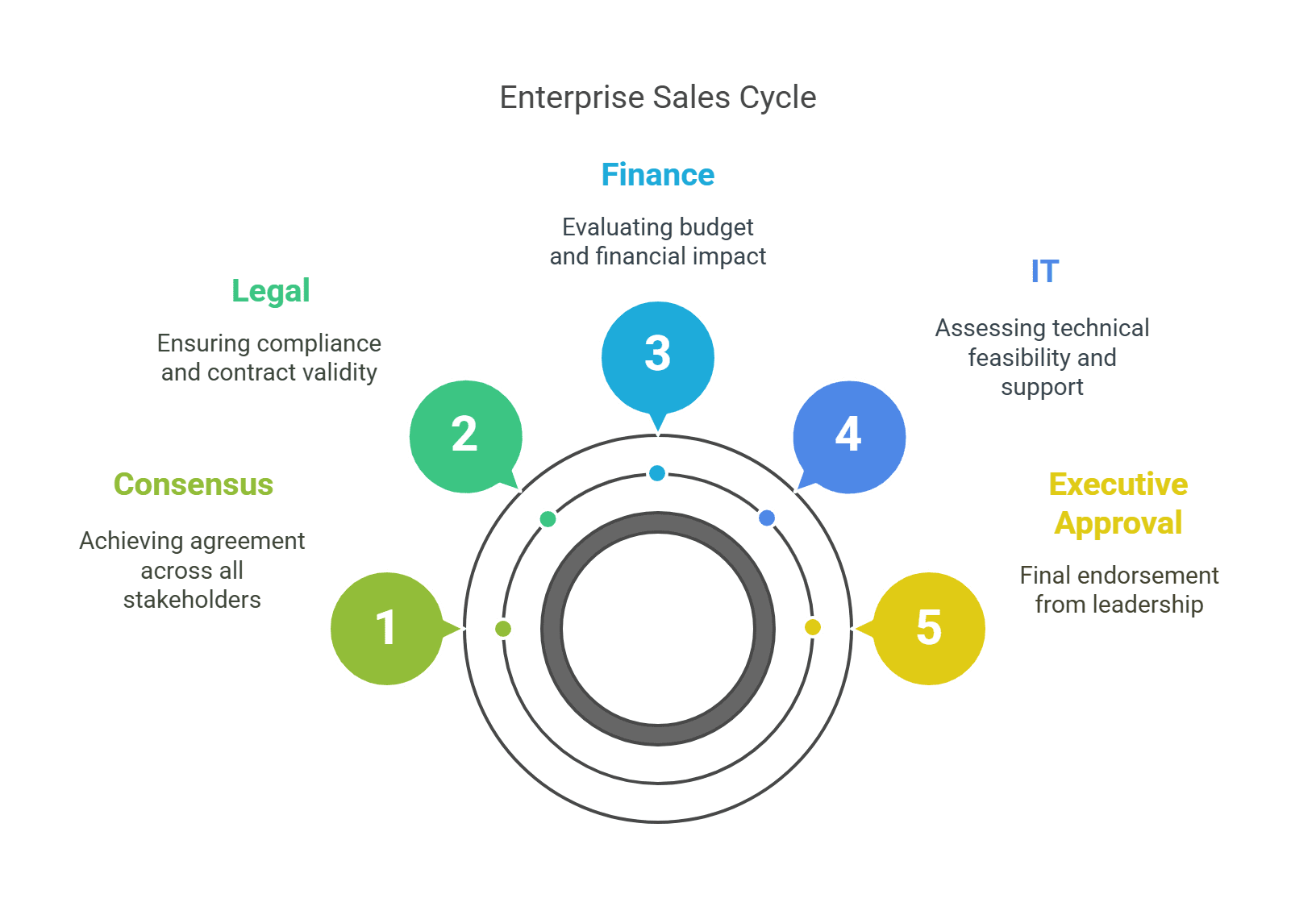
Enterprise sales cycles are long, but not just because of timelines. They’re long because you’re not selling to a person. You’re selling to an entire ecosystem. One that includes legal, finance, IT, someone’s boss’s boss, and a few people who got looped in just to be safe.
It’s not just about getting a “yes.” It’s about building layered consensus, across departments, shifting priorities, and internal politics you’ll never see on a spreadsheet. Every step matters. Every touchpoint counts. And if it feels slow, that’s because it is. But when done right, this kind of sale opens doors you don’t have to knock on again.
Enterprise Sales Process and Methodology
Enterprise sales only work when your process works harder than you do. And by process, we don’t mean a checklist. We mean a system that helps you qualify early, sell collaboratively, and move the deal forward without losing context every time someone new joins the call.
Think of methodologies like MEDDIC or Challenger as scaffolding. They help you ask the right questions, map the right players, and guide the conversation toward momentum and not confusion. Great sellers use process as a way to bring clarity, both to themselves and to the buyer.
When done well, your methodology becomes invisible. The buyer doesn’t feel “sold to.” They feel supported. And in enterprise sales, that’s the difference between chasing signatures and closing them.
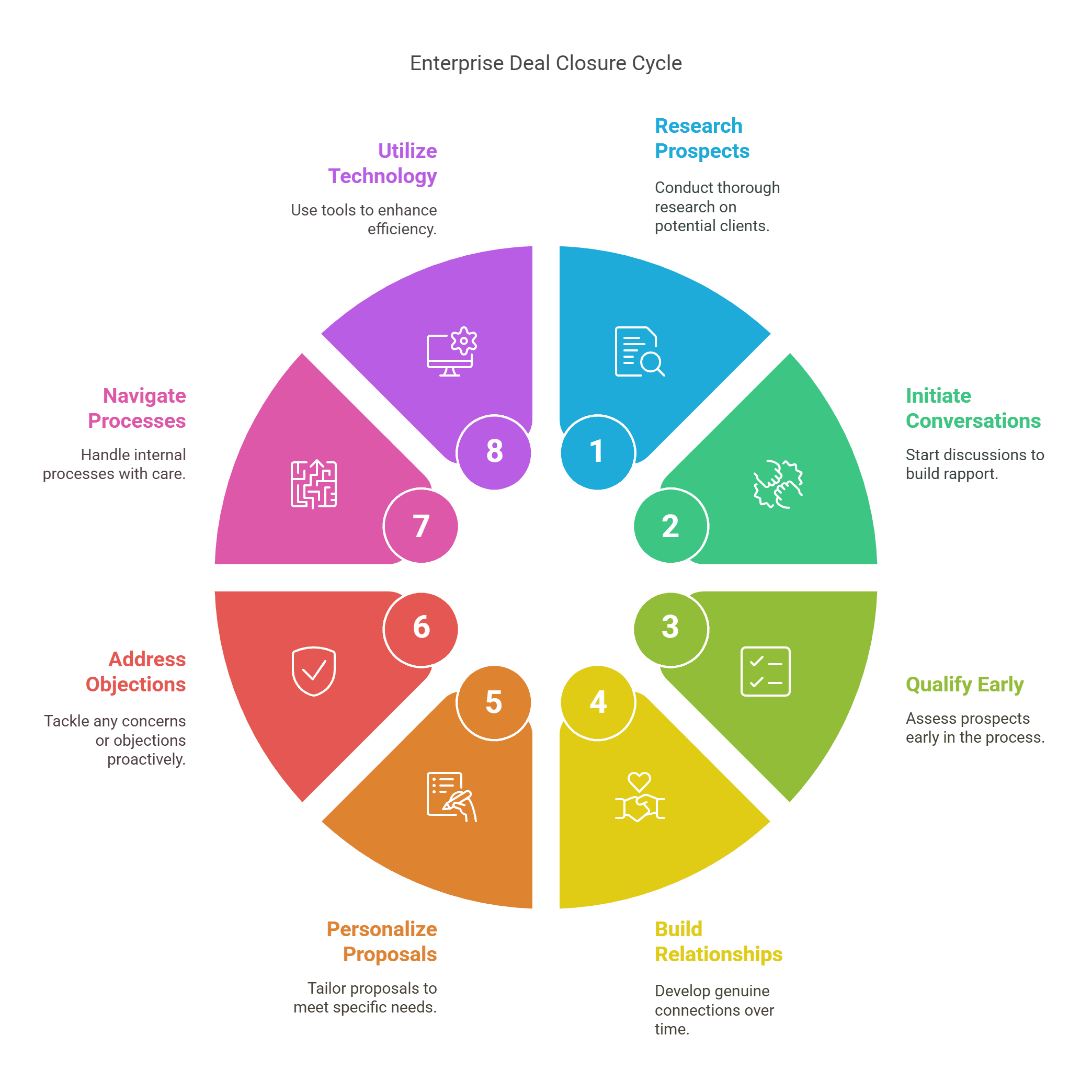
7 Stages of the Enterprise Sales Cycle (And What You Should Actually Be Doing in Each**)**
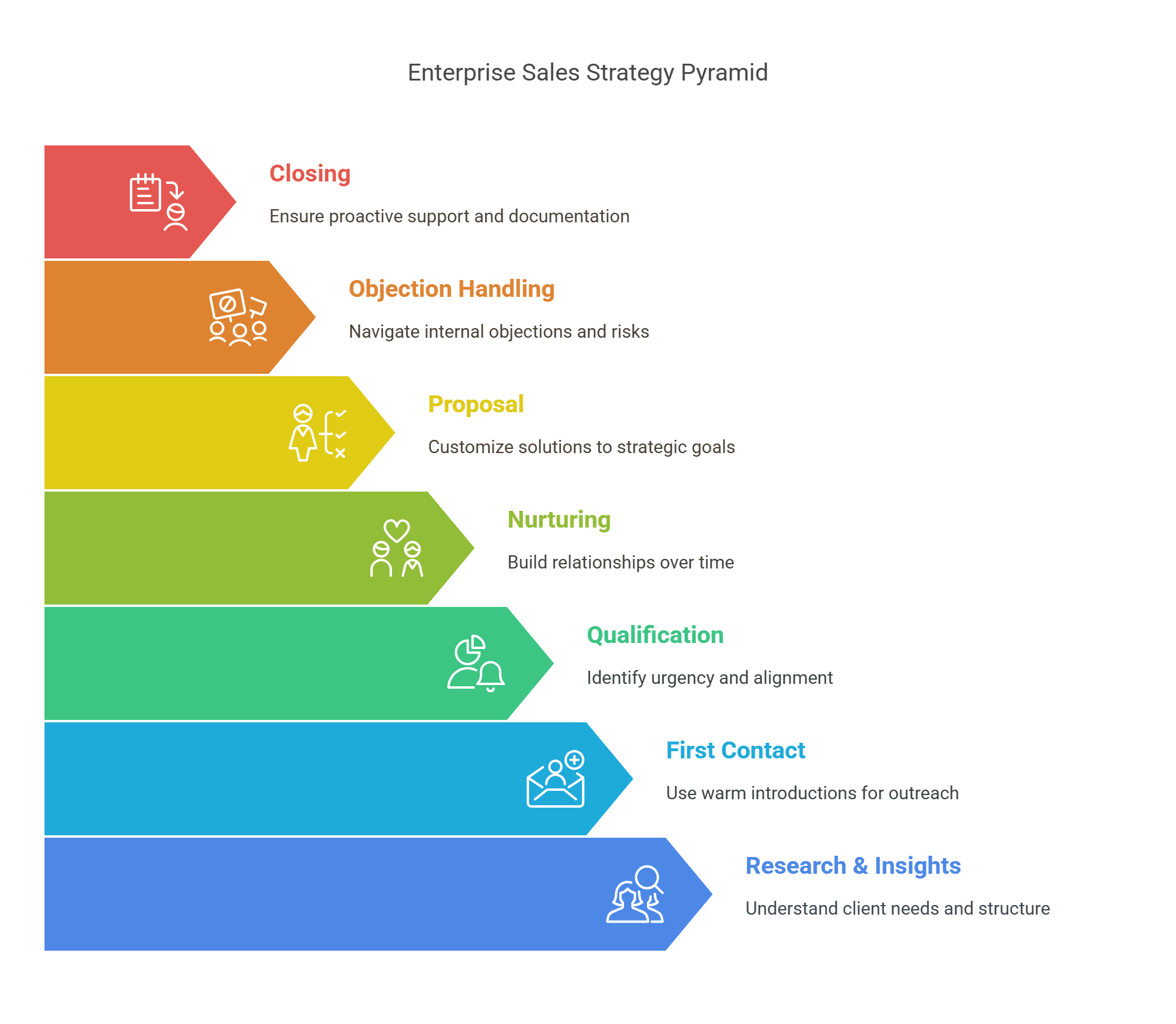
Now that we’ve talked about what enterprise sales really looks like, let’s get into the part no one wants to admit they’re winging: the actual sales cycle. Honestly, to call it a ‘7-step process of enterprise sales cycle” would be minimizing its importance. These are moments where deals either move forward or quietly fall apart. In this guide, we’ll show you how to make each stage of the enterprise sales process count and keep your deals on track.
Stage 1: Prospecting (Finding Your Fortune 500 Fit)
Real Problem: You don’t know who to approach or how to get their attention. Fortune 500 clients often feel unreachable.
Real Insight: Fortune 500 selling begins long before the first email or call. It’s about understanding your target client’s genuine needs, organizational structure, and strategic goals. Without doing your homework, your message will be lost in a sea of generic pitches.
Actionable Tips:
-
Focus on specific business units, departments, or divisions that align best with your solution.
-
Look into recent financial reports, press releases, and LinkedIn posts to discover real pain points.
-
Create a detailed Ideal Customer Profile specifically for enterprise prospects.
Stage 2: First Contact (The Cold Outreach Challenge)
Real Problem: Decision-makers in large enterprises rarely reply to cold outreach.
Real Insight: Closing big deals often relies on warm introductions or genuine value-based outreach, not cold, templated emails.
Actionable Tips:
-
Leverage mutual connections on LinkedIn or attend events where decision-makers speak.
-
Reference a specific piece of company news, financial insight, or recent initiative to personalize your outreach.
-
Don’t ask for a meeting outright; instead, offer relevant, valuable insights first.
Stage 3: Qualification (Why Most Enterprise Deals Die Here)
Real Problem: You’re wasting resources chasing opportunities that are never going to close.
Real Insight: Qualification isn’t just about budget and authority; it’s about identifying urgency and internal alignment within your prospect’s organization.
Actionable Tips:
-
Use structured frameworks like MEDDIC (Metrics, Economic Buyer, Decision criteria, Decision process, Identify pain, Champion) for clear qualification.
-
Politely but firmly ask about internal stakeholders and decision-making processes early.
-
Know when to walk away, no matter how big the name is.
Stage 4: Nurturing (Playing the Long Game)
Real Problem: Large deals can stall or fade away because internal priorities change or stakeholders shift.
Real Insight: Enterprise deals take patience. Selling is really relationship-building over weeks or months, not just sending follow-up emails.
Actionable Tips:
-
Regularly share relevant insights and market trends, not sales pitches, to remain a trusted advisor.
-
Connect stakeholders with other industry peers or existing clients who faced similar challenges.
-
Organize exclusive webinars or roundtables that genuinely educate or inform prospects.
Stage 5: Proposal & Presentation (Standing Out)
Real Problem: You have one shot at making an impression. Most proposals look alike.
Real Insight: Large clients aren’t interested in generic solutions; they buy custom-fitted solutions addressing their exact, strategic pain points.
Actionable Tips:
-
Always tie your proposal clearly to your prospect’s strategic goals and KPIs.
-
Use stories or references from similar-sized clients to build credibility.
-
Keep it simple, but deeply relevant: complexity rarely impresses, clarity always does.
Stage 6: Objection Handling (Navigating Internal Politics)
Real Problem: Enterprise sales involve multiple stakeholders, each with different objections, agendas, and concerns.
Real Insight: Most objections at this stage aren’t about your product or price. They’re about internal risk management or fears of disruption.
Actionable Tips:
-
Map stakeholders and proactively uncover their potential objections early in the process.
-
Provide clear ROI analysis and straightforward case studies from other Fortune 500 successes.
-
Use internal champions to navigate objections from within.
Stage 7: Closing (The Final Mile)
Real Problem: Your deal seems “done,” but procurement or legal delays stall everything.
Real Insight: The deal isn’t done until it’s signed. Enterprise contracts often require patience and proactive internal support from your champion.
Actionable Tips:
-
Summarize all key points, agreed terms, and clear next steps immediately after meetings.
-
Maintain direct, frequent, and empathetic communication with your internal champions.
-
Prepare legal and procurement-ready documentation in advance to reduce friction.
Listen, Technology & Tools Matter
One underrated way to improve your chances in large deal sales is leveraging technology. Using AI-driven proposal tools, CRM integrations, and real-time tracking can simplify and streamline the complex enterprise sales process.
Invest in tools that:
-
Track proposal engagement (to know when and how your prospect interacts)
-
Automate document generation for speed and accuracy
-
Predict deal risks early based on historical sales data
Closing Big Deals Isn’t a Big Deal (It’s Methodology)
Our CEO’s challenge, “If you know how to do this, why aren’t you doing it for us?” was a wake-up call. The reality is, knowing how to close enterprise deals and actually doing it involves consistent execution, discipline, and patience.
To quickly recap:
-
Do your homework on prospects.
-
Warm up conversations before reaching out.
-
Qualify carefully and early.
-
Build real relationships over time.
-
Personalize your proposals.
-
Address objections proactively.
-
Navigate internal processes with empathy and patience.
-
And yes, use technology to help you do all of this faster and better.
As we see it. Selling to Fortune 500 clients isn’t reserved for giants or insiders. It’s for anyone willing to adopt the mindset and strategies required to navigate the enterprise sales cycle effectively. So, if you stopped making excuses and kept reading, well, you’re already on your way.
Besides, you don’t have to figure it all out alone.
At Proposal Biz, we’re currently building a smarter way to handle proposals. We’re tapping into insights from some incredibly experienced sales and enterprise veterans… and we’d love your voice in the mix too.
Interested in shaping the future of proposal-building? Join our community of insiders today and be part of creating a platform that helps everyone close bigger, better deals.

Dimple Maru
 Prabir Chaudhary
 Ronak Surti
 Dimple Maru