
Table of Contents
Miller Heiman Blue Sheet Explained: How to Use It on Complex Deals
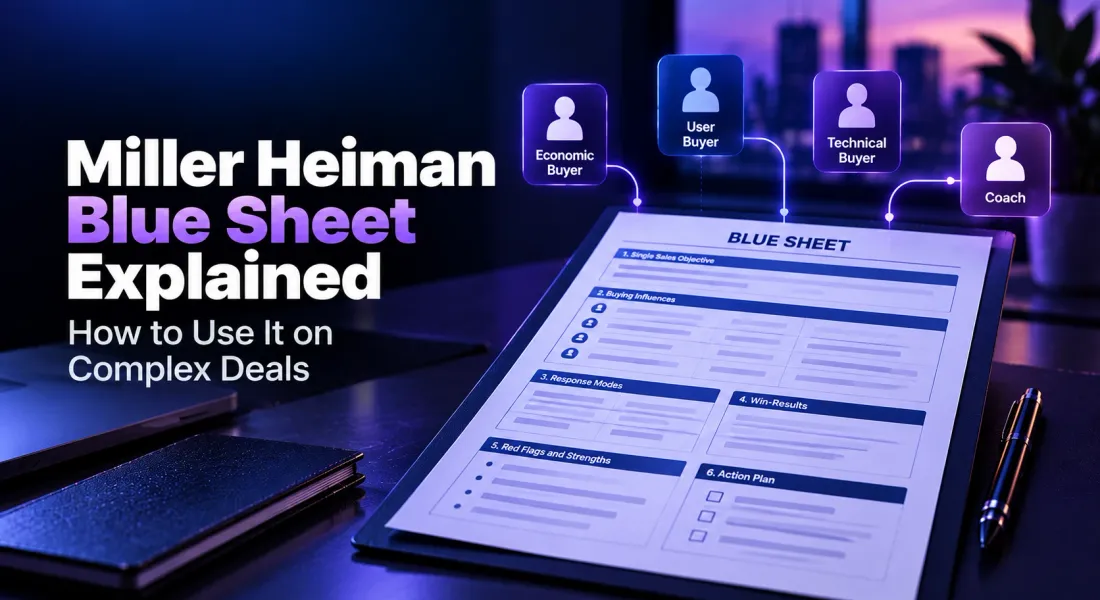
The Miller Heiman Blue Sheet is a one-page plan for a single complex deal. It maps every buying influence (the Economic, User and Technical buyers and your Coach), records how each one sees the change you are proposing, lists the red flags and strengths, and ends with an action plan. Its core idea is that big deals are decided by groups, not by one friendly contact.
The Blue Sheet comes from Strategic Selling, the methodology Robert Miller and Stephen Heiman published in 1985. Decades later, its ideas are everywhere: the “economic buyer” and “champion” in modern qualification frameworks are close relatives of the Blue Sheet’s Economic Buyer and Coach.
Ask working salespeople about it, though, and you hear a consistent criticism: the Blue Sheet gets filled in once to satisfy a manager, then never updated, so it describes a deal that no longer exists. This guide explains each section of the blue sheet Miller Heiman designed, how it differs from the Green Sheet, and how to keep it useful instead of decorative.
What Is the Miller Heiman Blue Sheet?
The Blue Sheet is the planning worksheet at the centre of Strategic Selling. You complete one per opportunity, not per account, and you revisit it as the deal moves.
It forces a seller to answer uncomfortable questions on paper: who actually signs, who can block this, who have I not met, and what does each of these people personally want from the decision? A deal that looks healthy in a forecast often looks very different once those blanks are visible.
The methodology outlived the company that created it. Korn Ferry completed its acquisition of Miller Heiman Group in November 2019, and the programmes are now part of Korn Ferry’s offering. The ideas, though, are now standard practice in complex B2B selling well beyond the brand.
Turn your deal plan into a proposal that speaks to every buying influence. Create your first proposal free.
The 6 Sections of a Blue Sheet
Versions vary slightly, but most blue sheet sales templates cover the same six areas. Each one answers a specific question about the deal.
1. Single Sales Objective
A precise statement of what you are trying to sell, to whom, by when and for how much. “Close a deal with Acme” is not an objective; “Acme signs a 12-month contract for the analytics package for 40 users by 30 November” is.
The precision matters because buying influences differ by objective. The same account can have a different Economic Buyer for a small add-on than for a company-wide rollout.
2. Buying Influences
Every person who can affect the decision, grouped into four roles. One person can hold more than one role, and one role can be held by several people.
For each person, you record their name, title, how much influence they have on this decision and how well you have covered them. Blank names are not a formality to fill later; they are the most important information on the sheet.
3. Response Modes
How each buying influence perceives the change you are proposing. People in different modes need completely different conversations, which is why this section changes how you sell, not just how you report.
Record a mode for every buying influence, not just your main contact. It is common for the User Buyers to be in Growth mode while the Economic Buyer sits in Even Keel, and that mismatch explains why a popular deal can still stall.
4. Win-Results
For each buying influence, the organisational result they want and the personal win that result delivers for them. This is the part of the Blue Sheet most teams skip, and arguably the most valuable.
Write each win-result in the buyer’s words where you can. If you cannot state what a person gains personally from the decision, that gap belongs in the red flags section.
5. Red Flags and Strengths
Red flags are gaps and risks: a buying influence you have not met, information you do not have, a reorganisation in progress, an incumbent supplier with a strong relationship. Strengths are the advantages you can build on.
In the Miller Heiman approach, missing information is itself a red flag. If you cannot say how a key person feels about the deal, you treat that uncertainty as a risk, not as neutral.
6. Action Plan
Specific actions to remove red flags and use strengths, each with an owner and a date. A Blue Sheet without an action plan is analysis; with one, it becomes a plan to win.
Keep actions small and specific: “Coach to introduce us to the COO by Friday” rather than “build executive relationship”. Actions that can be completed and checked keep the sheet alive between reviews.
The 4 Buying Influences
Economic Buyer
The person who gives final approval and can release the money. There is usually only one for a given objective, and they often appear late in the deal.
Economic Buyers care about business outcomes such as return, risk and strategic fit. If you have never spoken to yours, your deal depends on someone else presenting your case for you, which is a red flag in itself.
User Buyer
The people who will use what you sell day to day and judge whether it works for their job. There are often several.
User Buyers rarely approve budgets, but a User Buyer who dislikes your solution can slow a decision or undermine adoption after signing. Their concerns are practical: ease of use, impact on workload and support.
Technical Buyer
The gatekeepers who screen your offer against specifications: IT, legal, procurement or finance teams. Their defining trait is that they can say no but cannot say yes on their own.
Technical Buyers kill more deals quietly than any competitor does. Find out early who they are and what criteria they will apply, rather than discovering them in a procurement review a week before the expected close.
Coach
Someone who wants you to win and will guide you through the organisation: who matters, what they care about and how decisions really get made. A Coach can be inside the buying company, inside your own, or a third party.
A good Coach has credibility with the other buying influences and a personal reason to want your solution. A friendly contact who simply answers your emails is not automatically a Coach.
| Buying influence | Role in the decision | What they usually care about | Typical risk if ignored |
|---|---|---|---|
| Economic Buyer | Final approval and budget | Return, risk, strategic fit | Deal stalls at sign-off |
| User Buyer | Judges day-to-day fit | Ease of use, workload, support | Resistance during or after rollout |
| Technical Buyer | Screens against criteria | Specifications, terms, internal policies | Late veto in procurement or legal |
| Coach | Guides you through the organisation | Seeing the right solution chosen | Selling blind to internal politics |
The 4 Response Modes
Response modes describe how each buying influence sees the gap between where they are and where they want to be. Selling the same message to all four is one of the most common reasons complex deals stall.
Growth Mode
The person sees a gap between current results and what they want, and believes change can close it. They are receptive and open to new ideas.
Talk about what becomes possible: more output, faster growth, new capabilities.
Buyers in Growth mode can still hesitate if the change looks risky, so pair the upside with evidence that it has worked for similar companies.
Trouble Mode
Something is going wrong and they need it fixed. Urgency is high, but so is caution, because they cannot afford a solution that creates new problems.
Focus on how quickly and safely you remove the problem. A long strategic pitch frustrates someone in trouble mode.
Even Keel Mode
They see no gap. Things are fine as they are, so they have no reason to change and little interest in your proposal.
Pushing harder rarely works. Your job is to help them see a gap they had not noticed, often through someone in Growth or Trouble mode elsewhere in the organisation.
Overconfident Mode
They believe things are going better than they really are. They are the hardest to move, because any suggestion of a problem feels like criticism.
Direct challenge usually backfires. Peer comparisons, third-party evidence or a change in circumstances tend to shift this mode more effectively.
Win-Results: The Part Most Teams Skip
Miller and Heiman separated two ideas that most sellers merge. A result is an organisational outcome, such as lower costs or faster onboarding. A win is a personal outcome, such as recognition, an easier job or a strong position in the next restructuring.
People commit to decisions that deliver both. A buyer who agrees with every business argument you make but still will not move often has no personal win in the deal, or sees a personal risk you have not addressed.
Capturing win-results does not mean manipulating people. It means understanding that a finance director who championed a failed project last year will weigh risk very differently from one who did not.
Carry those win-results into your proposal. Our guide to value-based selling in proposals shows how to connect each stakeholder’s outcome to the price.
Blue Sheet vs Green Sheet: What Is the Difference?
People often search for blue sheet green sheet together because the two documents work as a pair, but they plan different things.
The Blue Sheet plans the whole opportunity. The Miller Heiman Green Sheet plans a single customer meeting, and comes from Conceptual Selling, Miller Heiman’s companion methodology focused on the conversations within a deal.
| Blue Sheet | Green Sheet | |
|---|---|---|
| Methodology | Strategic Selling | Conceptual Selling |
| Plans | The entire opportunity | One sales call or meeting |
| Key questions | Who decides, how they see the change, what can derail it | Why this meeting matters, what you need to learn, what commitment you want |
| Updated | Throughout the deal | Before and after each meeting |
What the Miller Heiman Green Sheet Covers
The Green Sheet works as a Miller Heiman sales call planner. It typically sets out the reason the customer has to meet, the information you need to get and give, and the commitment you want by the end of the meeting.
Two ideas from it are especially practical. The Best Action Commitment is the most you can realistically expect from the customer as a result of the meeting. The Minimum Acceptable Action is the least you will settle for. Writing both down before a call stops meetings from ending with a vague “let’s keep in touch”.
The same discipline applies to the meetings before a proposal is written. Our pre-sales proposal strategies cover how to use those early conversations to qualify the deal.
How to Fill In a Blue Sheet: A Worked Example
Imagine you sell a sales analytics platform to a 300-person distribution company. Here is how the key sections can look early in the deal.
| Section | Example entry |
|---|---|
| Single sales objective | Northline Distribution signs a 12-month contract for 40 sales users by 30 November |
| Economic Buyer | COO, response mode unknown (red flag: not yet met) |
| User Buyers | Regional sales managers, Growth mode: want visibility into rep activity |
| Technical Buyers | IT manager (data integration), procurement lead (terms), Even Keel |
| Coach | Head of Sales Operations, wants to replace manual spreadsheets |
| Win-results | Head of Sales Ops: result is accurate forecasts; win is no more weekend spreadsheet work |
| Red flags | COO not met; IT has a preferred vendor; budget cycle starts in January |
| Strengths | Strong user demo; Coach has the COO’s trust |
| Action plan | Coach to arrange a 20-minute COO meeting by 15 October; IT technical review on 22 October |
Notice what the sheet reveals that a pipeline report would hide: the deal looks promising, but the person who decides has never been met, and IT has a preference. The next actions are obvious.
Why Blue Sheets Fail in Practice
In sales communities, Miller Heiman, MEDDIC and similar frameworks are often criticised as “CRM exercises”: reps fill in fields to satisfy managers rather than to win deals. The criticism is fair when the sheet is treated as paperwork.
It Is Completed Once and Never Updated
Deals change. The Economic Buyer leaves, the Coach changes jobs, a User Buyer’s mode shifts from Growth to Trouble. A Blue Sheet from six weeks ago can confidently describe a deal that no longer exists.
Review it after every significant meeting and in every deal review. A short, current sheet beats a detailed, stale one.
Reps Guess Instead of Admitting Gaps
Under pressure to look in control, reps fill in response modes and win-results they have never confirmed. The sheet then reflects optimism, not reality.
Managers can fix this by rewarding honest red flags rather than punishing them. “I don’t know how the COO sees this” is the most useful sentence on a Blue Sheet.
It Is Used for Small, Simple Deals
The Blue Sheet earns its time on complex deals with several decision-makers. For a quick, single-buyer purchase, it is overkill, and teams that force it on every deal soon stop taking it seriously.
Save it for the deals where several people decide over several months. Our guide to the enterprise sales cycle covers how those deals differ.
See which stakeholders open your proposal and how far they read. Start free.
Using the Blue Sheet Alongside Your Proposal
A Blue Sheet tells you who needs to be convinced of what. Your proposal is where that convincing happens, often without you in the room.
Structure the proposal so each buying influence finds their section quickly: the business case and return for the Economic Buyer, implementation and support for User Buyers, specifications and terms for Technical Buyers. A proposal that only speaks to your Coach will stall when it reaches everyone else.
Engagement data also feeds back into the sheet. With document analytics and engagement tracking, you can see when the proposal is opened and how far it is read. If it goes quiet after reaching a new reader, that is often a Technical Buyer you have not yet mapped.
When the deal reaches its decision, you can create the proposal, share it as one link and collect the signature in the same place, so the final steps do not create new red flags of their own.
Proposal.biz lets you create and send proposals built from your own content library, so every section is accurate for every reader.
Final Word on the Miller Heiman Blue Sheet
The blue sheet Miller Heiman designed is simple on paper and demanding in practice. Map every buying influence, record how each sees the change, capture their personal wins, be honest about red flags, and turn the gaps into dated actions. Then keep it current, because a Blue Sheet is only as good as its last update.
For sales teams running long, multi-stakeholder deals, see how Proposal.biz supports sales teams.
FAQs About the Miller Heiman Blue Sheet
What Is a Blue Sheet in Miller Heiman?
It is a one-page plan for a single complex opportunity. It records the single sales objective, every buying influence, their response modes and win-results, red flags and strengths, and an action plan.
What Are the Four Buying Influences?
The Economic Buyer, who gives final approval; User Buyers, who judge day-to-day fit; Technical Buyers, who screen against criteria and can say no; and the Coach, who guides you through the organisation.
What Is the Difference Between the Blue Sheet and the Green Sheet?
The Blue Sheet plans a whole opportunity and comes from Strategic Selling. The Green Sheet plans an individual sales meeting and comes from Conceptual Selling.
Who Owns Miller Heiman Now?
Korn Ferry acquired Miller Heiman Group in 2019, and the methodology is now part of Korn Ferry’s sales training offering.
Is the Blue Sheet Still Relevant Today?
Yes, for complex deals with several decision-makers. Buying groups have grown, which makes mapping every influence more important. It only works if the sheet is kept current.

Prabir Chaudhary
 Prabir Chaudhary
 Ronak Surti


 Dimple Maru