
Table of Contents
Last quarter, we spoke to twelve mid-sized agencies that had strong leads lined up. Referrals were warm. Discovery calls were productive. Teams were confident. Yet six out of those twelve didn’t convert a single client from that pipeline.
The reason? Their proposals were unclear, uninspiring, and in a few cases, actually confusing.
That’s the thing with bad business proposals. They don’t just “lose you the deal.” They leave a trail of lost opportunity, wasted time, and team-wide misalignment. And most businesses don’t even realize the damage until it compounds.
According to a 2024 report by Hubspot, on average, the proposal-to-close (win) rate remains near 20%–22%, meaning only about 1 in 5–6 proposals result in a closed deal.. That means more than two-thirds of your warmest prospects vanish, and not because of price, not because of competition, but because your proposal didn’t make them feel confident.
Let’s break down why this happens, how to spot it early, and what you can do to fix it.
What Really Counts as a “Bad Business Proposal”?
It’s tempting to think a bad proposal is just about typos or outdated pricing. In reality, what turns off modern buyers is a lack of clarity, relevance, and emotional connection. A proposal might be technically accurate, but if it doesn’t make the client feel understood and confident, it quietly kills the deal before it even begins.
Today, a bad business proposal is one that:
-
Doesn’t speak to the client’s actual problem
-
Lacks structure or skimmability
-
Feels templated or cold
-
Fails to clearly outline next steps
-
Doesn’t look or feel trustworthy
Most decision-makers read proposals in few minutes, according to 2025 research from Proposify. If they can’t “get it” in that time, they mentally move on, even if they don’t tell you outright.
The scary part? They won’t tell you it was your proposal. They’ll just ghost you.
The Real Hidden Cost of Bad Proposals
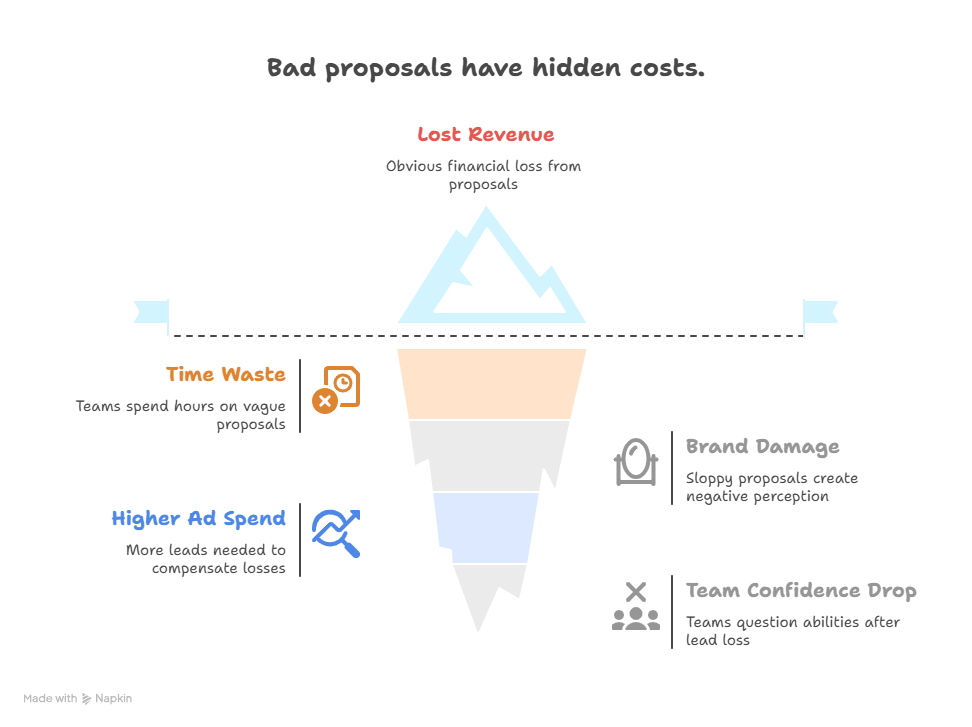
The hidden cost isn’t just lost revenue. It’s everything that leaks quietly behind the scenes:
1. Time Waste Across Teams
Sales teams prep for hours. Operations scopes timelines. Designers tweak mockups. Then, a vague proposal goes out, and the prospect disappears. Multiply that across 10 pitches a month, and you’re looking at hundreds of hours spent chasing dead air.
2. Brand Perception Damage
A poorly presented proposal creates doubt. If your offer looks sloppy, your work might feel sloppy too. One misplaced table or mismatched heading can raise silent red flags.
3. Lower Win Rates, Higher Ad Spend
You start needing more leads to hit the same revenue. That means more money spent on ads, outreach, and pipeline-building. All this done just to compensate for what a strong proposal could have fixed.
4. Confidence Drop in the Team
When great leads go nowhere, teams start questioning themselves. Confidence drops. Morale dips. No one wants to admit the proposal might be the weak link, though often, it is.
How Do Bad Business Proposals Affect B2B Sales Cycles?
In B2B, decisions don’t happen in a vacuum. Gartner’s 2024 report shows that the average B2B deal involves 6 decision-makers. A clunky or unclear proposal creates uncertainty for everyone involved.
Consider this: One tech consulting firm sent two nearly identical proposals to two similar-sized retail clients. The first proposal was a clean, outcome-oriented pitch with a visual summary on page one and next steps clearly outlined. It was signed in four days.
The second proposal had the same scope and pricing but was formatted as a long document with scattered bullet points, vague deliverables, and no summary. That client never responded beyond the first review call.
What follows with bad proposals is more back-and-forth, more internal approvals, and longer lead times. In short: bad business proposals slow down sales cycles, create decision paralysis, and increase the risk of deals stalling out entirely.
If your competitors present cleaner, simpler, more outcome-driven proposals, you’ll often lose the deal even if your solution is better. Teams looking to accelerate deal flow should also explore effective strategies to shorten the B2B sales cycle, which tie closely to how proposals are structured and delivered.
Common Red Flags Clients Notice in Proposals (That You Might Miss)
Buyers are trained to notice small things, and those details shape their perception of your credibility.
Let’s run you through some red flags that they spot immediately:
-
Proposals start with your achievements instead of the client’s needs: This signals that you’re more focused on your own story than theirs.
-
Cluttered layout with poor hierarchy: It makes your proposal feel disorganized, which subtly implies that your work might be the same.
-
Confusing pricing or unclear deliverables: Clients get anxious when they don’t fully understand what they’re paying for.
-
Repetitive content reused across industries: Generic proposals feel impersonal, and buyers may assume your service will be too.
-
Weak or generic introductions: Starting with vague mission statements or lengthy bios misses the chance to hook the reader.
One SaaS buyer told us after declining a pitch, “I couldn’t tell which parts were for us and which were just recycled. If they can’t invest time here, how will they handle our account?”
EyeQuant’s research consistently emphasizes the first 3–5 seconds as the crucial window for initial visual attention on a page.
The tendency is for readers to focus heavily on the first section, then quickly scan or skip the remainder unless their interest is captured immediately. Using a clean, consistent business proposal visual template can eliminate many of these friction points and help build immediate trust before they cost you the lead.
What High-Performing Proposals Always Get Right
Winning proposals tend to:
-
Lead with the client’s problem (not your pitch)
-
Use visual elements like infographics or progress bars to break up text
-
Include proof of success (results, testimonials, micro case studies)
-
Offer clear pricing with outcome alignment
-
Strong and effective introductions.
For example, one fintech company redesigned its pitch deck to include a side-by-side before-and-after dashboard for cost savings. The visual helped the client team quickly justify the investment, and the proposal closed in three days. Another agency used a short video embed from their creative director, along with a clean proposal layout, and reported a 30% increase in callback rate in the same quarter.
Statistics show that 92% of B2B buyers are more likely to make a purchase after reading trusted reviews, and adding testimonials to landing pages can increase conversions by up to 34%.
It’s not about being flashy. It’s about removing friction and building trust through clarity and relevance. Before you even begin crafting a proposal, make sure you’re asking the right questions. This can help qualify leads and tailor your pitch with more accuracy.
When Should You Audit Your Proposal Process?
Most teams don’t realize their proposals are holding them back until results start dipping. But there are clear signs it’s time to step back and reassess.
Here are key triggers to look out for:
-
Your close rate is below 30%
-
You’re consistently being undercut by lower bids
-
Clients ask questions your proposal should have already answered
-
You spend more time formatting proposals than crafting value
-
You’ve been reusing the same template across very different client types
If any of these sound familiar, it’s time to evaluate how your proposals are structured, presented, and received. Even strong sales pitches can lose momentum if the proposal itself introduces friction.
If you’re relying on manual formatting or older decks, explore the benefits of a proposal builder tool to modernize your process. A smart builder helps you stay consistent, remove layout guesswork, and focus your team’s energy where it matters most.
What’s At Stake? Let’s Run the Math
Let’s say you close 4 out of every 10 qualified leads today.
You spend $250 USD per lead (between marketing and sales hours), and each project is worth $3500 USD.
That means 6 of your 10 warm leads are lost, i.e., $20,000 USD in missed opportunity and $1400 USD in sunk lead costs.
If your proposal is the reason 4 of those walked away, you’ve spent over a lakh to lose business.
How Proposal Presentation Impacts Conversions
When you send out a clear, skimmable, visually aligned proposal, clients:
-
Feel seen and understood
-
Share it more easily with decision-makers
-
Ask fewer clarification questions
-
See your expertise before they even speak to you
A recent study by Qwilr found that proposals with interactive visual elements had 52% higher approval rates than traditional static PDFs.
The Fix: A Better Proposal Framework
Improving your proposals isn’t about flashy design or clever headlines. It’s about intentional structure and measurable results. A good proposal should do three things: engage the reader, answer their questions, and lead them to a decision. Here’s how to get there:
-
Start with a personalized insight. Show that you understand their pain point better than anyone else. Use their language. Reference something from your last conversation. Make the opening line about them, not you.
-
Use a modular structure. Break down your offer into clear, named sections: the problem, the opportunity, the roadmap, the proof, the investment, and the next step. Each section should stand on its own and guide the reader forward.
-
Visualize the journey. Insert a process flow or milestone graphic to replace long explanations. Clients process visuals 60,000 times faster than text. Even a simple timeline can lift engagement.
-
Anchor value to outcomes. Don’t list deliverables. Tie each one to a metric or impact. For example, instead of “Weekly reporting,” write “Weekly reporting to reduce churn by 12%.”
-
Give them one clear action. Whether it’s booking a follow-up call or clicking to sign, make the next step feel natural and urgent. Use a CTA block with visual contrast and directional text.
Bonus: Track open rates and engagement using a proposal platform. Smart proposal teams are now leaning on AI to handle structure and formatting, freeing up time to focus on message and personalization.
How Proposal.biz Helps You Never Send a Bad Proposal Again
At Proposal.biz, we’re building a platform that eliminates all the classic proposal traps:
-
Auto-structured business proposal visual templates
-
Integrated layout logic and skimmable formatting
-
Visual guidance for every stage of the proposal
-
Support for testimonials, milestones, and rich content
It’s not just about writing faster. It’s about presenting smarter.
Frequently Asked Questions
**1. Are bad proposals always the reason we lose leads?**Not always, but when good-fit leads go cold without feedback, it’s often due to how your proposal was perceived.
**2. What’s the difference between a bad proposal and an average one?**Bad proposals confuse or overwhelm. Average ones explain but don’t persuade. Great ones make action feel obvious.
**3. How do I know if my proposals need redesigning?**If you’re not closing at least 30–40% of qualified leads consistently, it’s worth reviewing your proposal format.
**4. Can a proposal tool reduce errors?**Yes. A good proposal builder automates structure and formatting so you can focus on message and value.
**5. Should I customize each proposal?**Not from scratch. Use modular templates that adapt, like those we’re designing at Proposal.biz.
Don’t Let Good Leads Slip Through a Bad Window
The biggest mistake you can make is assuming your proposal is “just a formality.” In truth, it’s the final pitch. The document that either reinforces your value or weakens it.
Every bad business proposal costs more than one deal. It costs trust, momentum, and months of effort spent building that opportunity.
At Proposal.biz, we’re building a tool to make sure that never happens. So you don’t lose the lead right when you were closest to winning it.

Dimple Maru
 Prabir Chaudhary
 Ronak Surti
 Dimple Maru