Table of contentsWhat Exactly Is a Visual Proposal?
Key takeaways
- Use visual proposals to show instead of tell, because a wall of text is the first thing a client sees in a text-heavy proposal.
- Design for how clients actually read, since most scan proposals instead of working through long PDFs or dense documents.
- Treat a proposal as a narrative, because every narrative lands better with visuals and infographics.
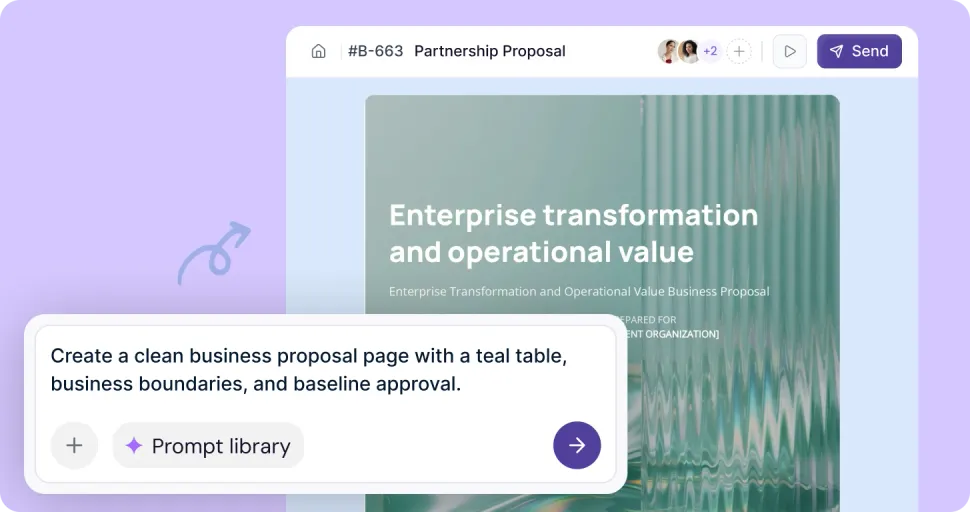
- Proposal.biz designs your proposal from a prompt in your brand style, with charts and visuals built in, so you do not need a design degree to send a visual proposal.
- Aim for a proposal that feels like a conversation with the client, not like homework to get through.
- Remember that clients rarely decide on information alone: they act on how something makes them feel, which is why presentation is often underrated.
- Use visual proposals beyond creative companies, since law firms, IT service providers and finance companies use them too.
It was a regular Tuesday. You opened your inbox and clicked on a proposal from a potential agency. What appeared first was a wall of text. Bullet points, industry terms, a long description of the services. Nothing wrong, but nothing memorable either.
Now picture a different experience. The email opens with your brand name in bold. Right below it, there’s a visual summary of your pain point and a timeline of how the agency plans to solve it. A projected ROI shown through a clean graph. This visual proposal feels like it was made for you and then specifically sent to you.
That’s the difference between “telling” and “showing.”
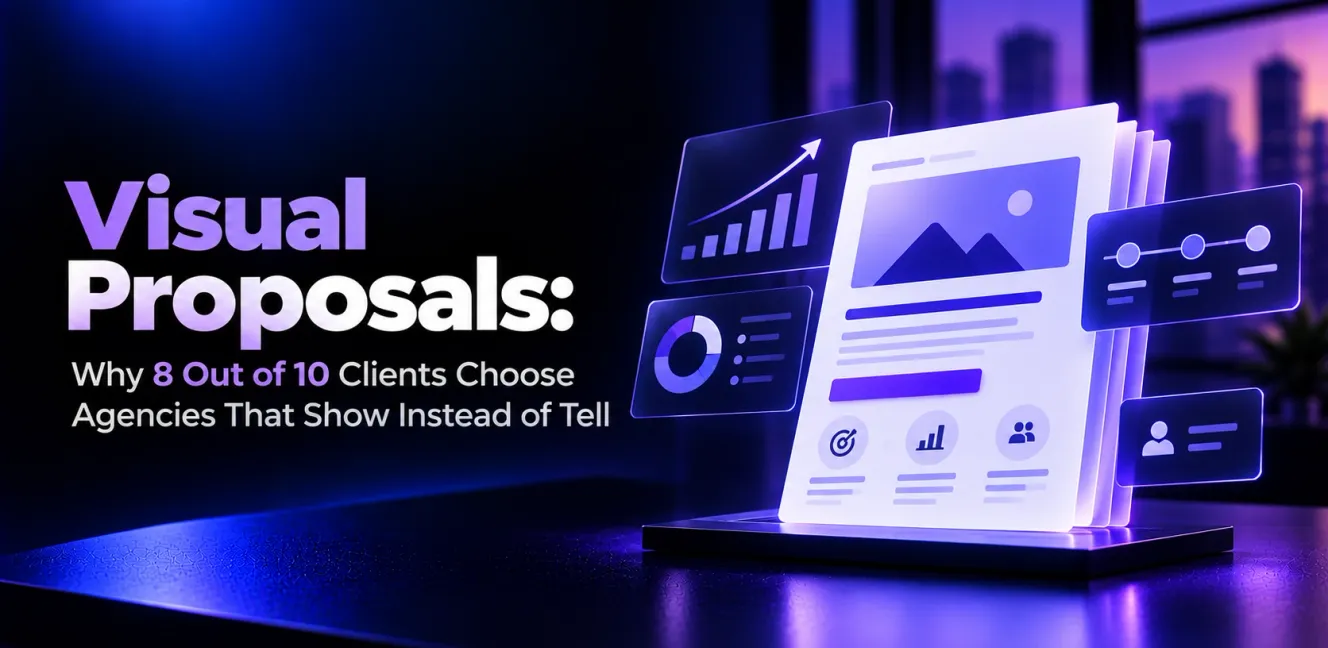
A 2023 study said that 8 out of 10 clients say they’re more likely to go with a provider that presents their proposal visually. The number reflects more than just preference. It signals trust, clarity, and engagement. At Proposal.biz, we’ve built our entire vision around this shift.
What Exactly Is a Visual Proposal?
Most people still imagine proposals as long PDFs or dense Word docs. But that format simply doesn’t match how clients make decisions today.
A visual proposal is built for the way people actually absorb information now… fast, visually, and emotionally. It combines structure, storytelling, and design to simplify complex offerings. Instead of long paragraphs, you use clean sections, icons, timelines, and visuals that help your message land in seconds.
It’s not just about appearances. Visual proposals reduce cognitive friction. They’re easier to scan, easier to share across teams, and easier to say yes to. Whether you’re sending a one-page visual proposal or a more detailed pitch, the approach prioritizes flow, not filler.
If you’ve ever explored different types of business proposals, you’ll see that visual formats are quietly reshaping client expectations, especially in industries where clarity, speed, and emotional connection give you an edge.
What Are the Three Types of Proposals?
Proposals aren’t one-size-fits-all. Most fall into one of three categories.
First, you have formal proposals. These are structured documents often required by corporates or government clients. They follow a defined format and go deep into technical and contractual details.
Second, there are informal proposals. These are usually quick decks, presentations, or writeups shared over email or messaging platforms. While convenient, they often lack consistency and clarity.
Finally, we have visual proposals. These are built to be fast, engaging, and intuitive. They use visual storytelling to guide the reader through the offer. These are often one-page visual proposals that sum up the who, what, how, and why in a way that makes clients feel informed and respected.
And this third kind is what more and more decision-makers are now expecting as default.
The Role of Visuals and Infographics in Proposal Writing
A proposal is not just a document. It’s a narrative. And every narrative lands better when it’s easy to follow.
Visual storytelling in proposals taps into something most people forget: humans don’t read first, they look. That initial impression your proposal creates sets the tone for how seriously you’ll be considered. Infographics in proposal documents create fast connections. They help the reader understand your process and potential impact in a single glance.
Studies on learning and memory demonstrate that prospects are far more likely to remember our key messages when presented with compelling visuals alongside concise text, improving retention from as low as 10% with text alone to upwards of 80% when multiple senses are engaged (Dale, 1969). That’s because visuals are easier for the brain to process. They remove the effort from reading and replace it with recognition.
Instead of hoping your words land, visuals make them stick.
According to HubSpot-related sales enablement reports in 2025, companies leveraging visual storytelling in their approach showed 36% better client engagement, underscoring the impact of using enriched, engaging sales content, including visuals, to drive decision-making and revenue growth. Another study by Proposify noted that 85% of winning proposals include images.
This aligns with what we’ve seen during our research at Proposal.biz. Through our conversation with hundreds of potential customers, we have validation that most aren’t reading proposals; they’re scanning them. And the ones that win are the ones designed for that behavior.
Why Visuals in Business Proposals Work Better
Clients rarely make decisions based on information alone. They act based on how something makes them feel. That’s why visuals are more than just design elements. They help create that emotional connection and also the quiet confidence that the person on the other side “gets it.”
Most people don’t remember numbers or paragraphs. They remember how you made them feel. A clean, well-structured business proposal layout tells the client you value their time, that you understand their pain point, and that you’ve thought about the solution clearly.
The benefits of visuals in business proposals go beyond aesthetics. They create:
Clarity: by showing, not just saying
Confidence: by giving them something they can scan and understand
Speed: by reducing time spent on back-and-forth questions
Momentum: by making it easier to present your proposal internally
And in competitive environments, clarity, confidence, and speed are often what separates a winning bid from the rest.
What Sets a Visual Proposal Apart?

Some proposals feel like homework. Others feel like a conversation. Visual proposals fall into the second category.
What makes them different isn’t just their appearance, it’s how they think on behalf of the reader. They prioritize what’s important. They group information into patterns people already recognize. They feel like they belong in the modern decision-making process.
Visual proposals do a few things better than traditional formats:
-They show structure at a glance
-They reduce overwhelm by spacing and flow
-They replace dense text with design-led clarity
-They keep the reader oriented from start to finish
If you’re already using a tool to streamline your process, the benefits of a proposal builder tool only amplify this. Visual-first tools not only save time, but they also help you present ideas the way clients want to receive them.
When a proposal feels tailored, easy to digest, and respectful of the client’s time, it becomes more than a pitch. It becomes proof of how you work.
How to Use Visuals in Proposals Without Being a Designer
You don’t need a design degree to create a visually engaging proposal. What you need is the right approach.
- Start with a one-page visual proposal. These act as your pitch on a single screen. Focus on the pain point, your offer, expected results, and a visual roadmap of the steps involved.
- Have a reusable business proposal visual template. This helps your team maintain consistency across different clients while still allowing for customization.
- Bring in actual metrics when possible. A simple bar chart comparing “before and after” results from similar clients can replace an entire paragraph of text.
- Use visual icons, color-coded sections, and layout spacing to create breathing room. This keeps attention from drifting.
- Infographics work well in proposals when you want to show a process. If your service involves multiple steps, a linear or circular graphic is more engaging than a bullet list.
- Leverage AI to speed up design work. From generating branded proposal templates to auto-building charts based on your data, AI tools can help you skip repetitive formatting and focus on refining your message.
Even something as simple as a quote paired with a client photo can become a powerful emotional anchor when placed at the right moment in your proposal.
Why Presentation is Often Underrated
Many teams invest serious time in crafting their offering, defining scope, and refining copy. But the way they present it is often rushed.
What we’ve learned is that clients don’t separate the proposal from the brand. They see both as part of the same experience. A clunky, disjointed layout creates hesitation. A polished, easy-to-scan visual presentation invites dialogue.
When your proposal feels intuitive and intentional, it doesn’t just convey information. It builds momentum. It travels across departments with fewer edits. It becomes the artifact that sells, even in your absence.
The Psychology Behind Optics
People are driven by what they see. And what they see shapes how they feel. That’s not just a design truth, you know; that’s a behavioral one.
Clients often make a snap judgment within seconds of opening your proposal. Not because they’re shallow or impatient, but because that’s how the human brain works. Our eyes look for patterns. We trust what feels clear. We remember what resonates emotionally.
Optics are not decoration. They are signals. They tell the client you care about clarity. They reflect how you think. And they help the client imagine what working with you might feel like.
At Proposal.biz, our focus has always been to help agencies and businesses translate value into visual language because in today’s fast-paced world, that’s what drives action.
Frequently Asked Questions
**Are visual proposals only meant for creative companies?**No. We’ve seen law firms, IT service providers, finance companies, and even healthcare teams win with well-crafted visual proposals. It’s about making your offer easy to understand.
**How do I keep my visual proposals secure and compliant?**We’re building Proposal.biz with encryption, permission controls, and full GDPR compliance. The tool is being developed to meet the safety expectations of modern businesses.
**Do visuals replace detailed documentation?**Visuals simplify the journey. You can still provide detailed PDFs or appendices. But visuals help your main message land first.
**Can I create repeatable formats for my team?**Yes. Proposal.biz will let you save visual templates, reuse sections, and populate client data into proposals without starting from scratch each time.
**Will visuals work for multilingual or global clients?**Absolutely. Visuals reduce dependency on language. A good layout with clear visuals helps proposals travel better across teams and cultures.
Everyone’s Talking About AI. But What About Visual Proposals?
AI is everywhere right now. It’s writing emails, generating reports, building pitch decks. But here’s the real question: what happens when AI meets visual proposals?
Not just filling in text, but designing the structure. Picking the right flow. Suggesting the right visuals. Even selecting the best business proposal visual template based on your industry and client type. It automates a lot of the process.
That’s where it gets interesting.
Instead of you dragging boxes around or pasting screenshots, imagine AI building the bones of your proposal by laying out infographics in proposal sections where they belong, recommending formats that convert, and helping you move from “rough idea” to “client-ready” in minutes.
That’s what we’re creating at Proposal.biz, a platform where AI doesn’t just write. It designs, suggests, and simplifies the way you build proposals that win.
It’s Time to Rethink Your Business Proposal Visual Template Strategy
Clients don’t just want more information. They want to feel understood. They want to know that your solution fits, and they want to believe they’re making a smart decision.
Visual proposals help create that belief. They invite the client in, guide them through the story, and leave them with something they can share with confidence.
At Proposal.biz, we’re building a tool that makes it easier to create proposals like this. Not just pretty templates, but thoughtful visual frameworks that reflect what you stand for. The product isn’t live yet. But it’s coming. And when it does, it’ll be something that fits your workflow, your security needs, and your client’s expectations.
If you’ve ever wished your proposal could do the talking, we’re building the thing that makes that possible. We’d love for you to help us resolve some of the early bugs.