
Table of Contents
Cost-Plus Pricing: Examples and When to Use It
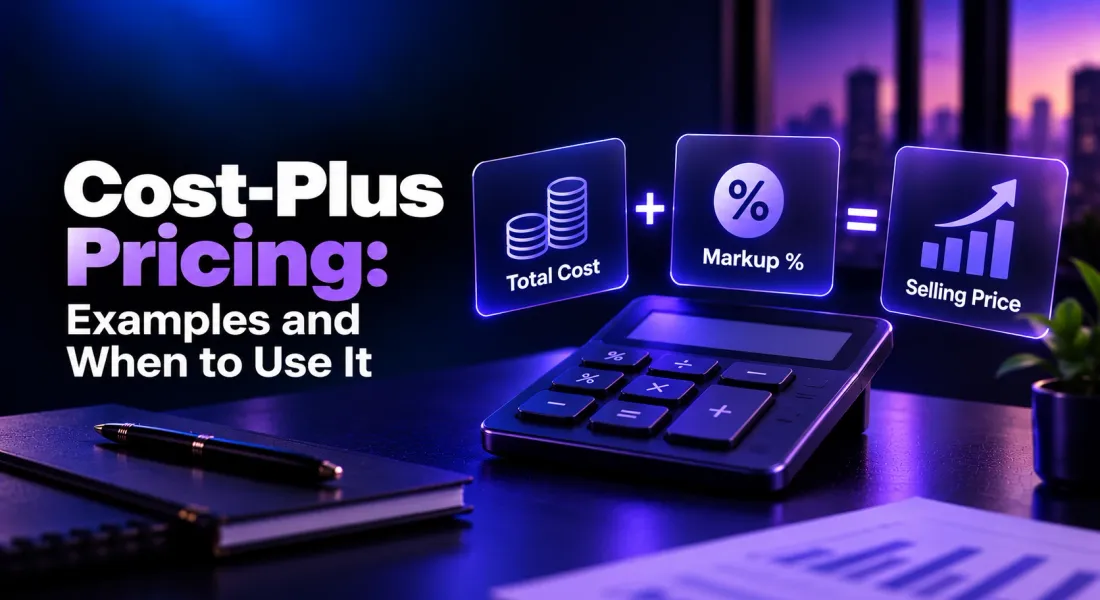
Cost-plus pricing sets a price by adding a fixed percentage markup to the total cost of producing a product or delivering a service. A simple cost plus pricing example: if a product costs $40 to make and you apply a 50% markup, the price is $60.
It is one of the oldest and most widely used pricing methods, especially in manufacturing, construction, distribution and government contracting. It is easy to calculate, easy to explain and almost guarantees a profit on every sale, as long as you know your costs.
That last condition is where people get caught out. Small business owners regularly describe two problems: confusing markup with margin, so the profit is lower than they think, and clients questioning the markup once they see the underlying costs. This guide covers the formula, seven worked examples of cost plus pricing, which companies use it, and how to present it so it holds up.
How Cost-Plus Pricing Works
The formula is simple: price equals total cost multiplied by one plus the markup percentage.
Price = Total cost × (1 + Markup %)
The hard part is not the maths. It is getting the total cost right, because any cost you forget comes straight out of your profit.
Step 1: Calculate the Full Cost
Add up the direct costs of the product or job, such as materials, components, direct labour and subcontractors. Then add a fair share of overheads: rent, equipment, software, insurance, management time and the hours you cannot bill.
Many businesses price only on direct costs and wonder why the year ends with less profit than expected. Overheads are real costs; they just do not appear on a single job.
Step 2: Choose a Markup
The markup should cover your profit target and reflect your market. Common markups vary hugely by industry, from single digits in high-volume distribution to well over 100% for some specialist products.
Look at what similar businesses achieve, what your customers expect to pay and how much risk the work carries. Riskier or more complex work justifies a higher markup.
Step 3: Calculate the Price and Sense-Check It
Apply the formula, then compare the result with the market. If your cost-plus price is far above competitors, your costs are probably too high. If it is far below what customers would happily pay, you are probably leaving money on the table.
Build clear, branded quotes with line items and totals. Create your first quote free.
Markup vs Margin: The Mistake That Costs Money
This is the single most common error with cost-plus pricing, and it comes up again and again in small business discussions. Markup and margin are both percentages, but they are calculated on different numbers.
Markup is profit as a percentage of cost. Margin is profit as a percentage of the selling price. The same deal always shows a lower margin than markup.
| Cost | Markup | Price | Profit | Margin |
|---|---|---|---|---|
| $100 | 25% | $125 | $25 | 20% |
| $100 | 50% | $150 | $50 | 33% |
| $100 | 100% | $200 | $100 | 50% |
If your business needs a 30% margin to cover its costs and you apply a 30% markup, you will fall short every time. To get a 30% margin, you need a markup of roughly 43%.
Decide which number you are targeting, write it down, and make sure everyone who prices work uses the same one.
7 Cost-Plus Pricing Examples
These cost plus pricing strategy examples use illustrative figures to show how the method works across different businesses.
1. Manufacturing a Product
A small manufacturer makes a metal bracket. Materials cost $6, direct labour $4 and allocated overheads $5, for a total of $15 per unit. With a 40% markup, the price is $21.
Manufacturing suits cost-plus pricing because costs are measurable and repeat with every unit. The risk is that overhead allocations drift out of date as volumes change.
2. Wholesale or Distribution
A distributor buys a product for $50 and applies a 20% markup, selling it to retailers for $60. Volume businesses often work on thin markups and make their profit through quantity.
Distributors in small business forums describe competitors who sell close to cost to win accounts. Cost-plus pricing gives you a clear floor: below it, you are paying to keep the customer.
3. A Restaurant Menu Item
A dish uses $4 of ingredients. Many restaurants think in terms of food cost as a share of the menu price, so a target of around 30% food cost puts the dish at roughly $13.
This is cost-plus pricing in a different form. The same logic applies, but the restaurant then adjusts prices dish by dish based on what customers will pay and what competitors charge.
4. A Construction or Contracting Job
A contractor estimates materials at $18,000, labour at $12,000 and subcontractors at $6,000, for $36,000 in direct costs. They add 10% for site overheads and 15% for profit, bringing the price to about $45,500.
In a cost-plus contract, the client agrees to pay the actual costs plus a fee, rather than a fixed price. That protects the contractor when costs are uncertain, but it requires transparent records the client can check.
5. Reselling Hardware or Media as a Service Provider
An IT services provider buys a laptop for $900 and resells it to a client for $1,050, a markup of about 17%. An agency buys media and charges the client the media cost plus a percentage fee.
This is where clients most often question the markup. A story shared in managed services communities describes a client discovering the provider’s hardware markup and starting to question every other charge. The lesson is to agree how resale is priced up front, rather than hoping nobody compares prices.
6. A Government Cost-Plus Contract
Some government and defence contracts reimburse the contractor’s allowable costs plus a fee, which can be fixed or linked to performance. They are used where the work is too uncertain to price in advance, such as research or first-of-a-kind projects.
These contracts come with strict rules on which costs are allowable and how they must be documented. For the contractor, the trade-off is lower risk in exchange for detailed scrutiny.
7. Freelance or Project-Based Services
A freelancer estimates 40 hours for a project. Their cost per hour, covering their target income, tools and overheads, is $60, so the cost is $2,400. A 30% markup for risk and profit gives a price of $3,120.
Service businesses often combine cost-plus pricing with value-based thinking: cost-plus sets the floor, and the value to the client decides how far above it the price can go.
Companies That Use Cost-Plus Pricing
Companies that use cost plus pricing tend to share one trait: their costs are measurable and closely tied to each sale. Common examples by industry include:
- Manufacturers of standard and custom parts, where unit costs are well understood
- Wholesalers and distributors, who apply markups to the cost of goods they buy and resell
- Construction firms and contractors, especially on cost-plus contracts where costs are uncertain
- Government and defence contractors, on cost-reimbursement contracts for research or complex projects
- Restaurants and food businesses, which price dishes from ingredient and food cost targets
- IT providers and agencies reselling hardware, software licences or media
Many of these businesses also adjust prices for competition and demand. Cost-plus pricing is often the starting point rather than the whole strategy.
Advantages of Cost-Plus Pricing
It Is Simple and Consistent
Anyone in the business can calculate a price with the same method. That makes quoting faster and reduces arguments about how a price was reached.
Consistency also matters when several people quote. A shared formula stops one salesperson discounting heavily while another prices high for the same work.
It Protects Your Margin
As long as costs are accurate, every sale covers its costs and contributes profit. It is a strong defence against underpricing, which is one of the most common reasons small businesses struggle.
That protection is only as good as your cost data, which is why reviewing costs regularly is part of using the method well.
It Is Easy to Justify
When costs rise, you can explain a price increase in plain terms. Clients understand “our materials went up 12%” more readily than an unexplained new price.
It also makes conversations about price rises calmer. Clients tend to accept increases tied to visible cost changes more readily than increases with no stated reason.
Disadvantages of Cost-Plus Pricing
It Ignores What Customers Will Pay
Cost-plus pricing looks inward. If customers value your product far more than it costs to make, you leave money on the table; if they value it less, no markup will make it sell.
The fix is to treat the cost-plus price as a floor and check it against the market and the value to the customer before you finalise it.
It Rewards Inefficiency
If price follows cost, higher costs mean higher prices. There is less pressure to work efficiently, and in cost-reimbursement contracts clients watch for this closely.
Internally, it can also hide waste. If every cost is passed on, there is little pressure to find better suppliers or faster ways of working.
It Depends on Accurate Costing
Forgotten overheads, outdated allocations and underestimated hours all erode profit. The method is only as reliable as your cost data.
Review your cost assumptions at least once a year, and whenever a major input such as materials, wages or rent changes significantly. Prices built on last year’s costs quietly erode this year’s profit.
When to Use Cost-Plus Pricing
Cost-plus pricing works well when costs are measurable and closely tied to each sale, when products are similar to competitors’ so value is hard to differentiate, when work is uncertain and the client accepts paying actual costs plus a fee, and when you need a reliable floor under every price.
It is a weaker fit for software, creative and advisory work, where the cost of delivery has little to do with the value the client receives. In those cases, use cost-plus to find your minimum, then price on value.
This guide to value-based selling in proposals explains how to build the case for pricing above cost.
Cost-Plus vs Value-Based vs Competitive Pricing
| Cost-plus | Value-based | Competitive | |
|---|---|---|---|
| Starts from | Your costs | The customer’s perceived value | Competitors’ prices |
| Best for | Measurable, repeatable costs | Differentiated, high-impact offers | Similar products in crowded markets |
| Main risk | Ignores willingness to pay | Needs solid customer insight | Races to the bottom |
| Easy to explain? | Yes | Harder | Yes |
In practice, many businesses blend all three. Cost-plus sets the floor, competitors set the range, and value decides where in the range you price. That blended approach is the most practical example of cost plus pricing strategy in action.
How to Present Cost-Plus Pricing in a Quote
How you present a cost-plus price affects how the client reacts to it. There are two main approaches, and the right one depends on the relationship and the contract.
The wording of the quote matters as much as the numbers. If you write quotes often, these AI prompts for quotation drafting speed up the first version.
Show the Costs and the Fee Separately
In cost-plus contracts and reselling arrangements, show the cost lines and your fee or markup openly. Clients who agreed to this structure expect to see it, and transparency builds trust.
Agree the markup or fee percentage in writing before work starts. The problems described in service provider forums almost always come from markups the client discovered rather than ones they agreed to.
Show a Single Price With a Clear Scope
For most product and fixed-price work, show the price and what it includes, not your internal costs. Clients buy outcomes, and exposing costs invites line-by-line negotiation of your margin.
Either way, make the quote clear about what is included, what is not and how long the price is valid. This guide to the difference between an estimate and a quote explains which to send when costs are still uncertain.
Send quotes clients can read, accept and sign from one link. Start free.
How to Build Cost-Plus Quotes Faster
Proposal.biz lets you create and send quotes from a content library that stores your services, prices and standard terms, so every quote uses current figures.
Clients open the quote as a link on any device, and when they accept, they sign inside the same document. Signing records the signed status and date, and both parties receive a confirmation email.
The drag-and-drop document editor includes pricing tables for line items, fees and totals, so cost breakdowns stay clear and consistent from one quote to the next.
Final Word on Cost-Plus Pricing
A good cost plus pricing example always starts with an accurate full cost, including overheads, and a markup chosen with the margin you actually need in mind. Use cost-plus pricing to guarantee a floor, combine it with market and value thinking to set the final price, and agree any visible markup with clients up front.
For engineering firms and contractors pricing complex work, see how Proposal.biz supports engineering teams.
FAQs About Cost-Plus Pricing
What Is a Simple Cost-plus Pricing Example?
If a product costs $40 to make, including a share of overheads, and you apply a 50% markup, the price is $60 and the profit is $20.
What Is the Formula for Cost-plus Pricing?
Price equals total cost multiplied by one plus the markup percentage. For a $100 cost and a 25% markup, the price is $125.
What Is the Difference Between Markup and Margin?
Markup is profit as a percentage of cost; margin is profit as a percentage of the selling price. A 50% markup produces a margin of about 33%.
Which Industries Use Cost-plus Pricing?
Manufacturing, wholesale and distribution, construction, government contracting, restaurants and service providers that resell hardware, licences or media are common users.
Is Cost-plus Pricing a Good Strategy for Services?
It is a good way to set a minimum price. For services where the value to the client is much higher than your delivery cost, combine it with value-based pricing.

Dimple Maru

 Prabir Chaudhary

 Ronak Surti



 Dimple Maru