
Table of Contents
BANT Criteria: How to Qualify Leads With Budget, Authority, Need and Timeline
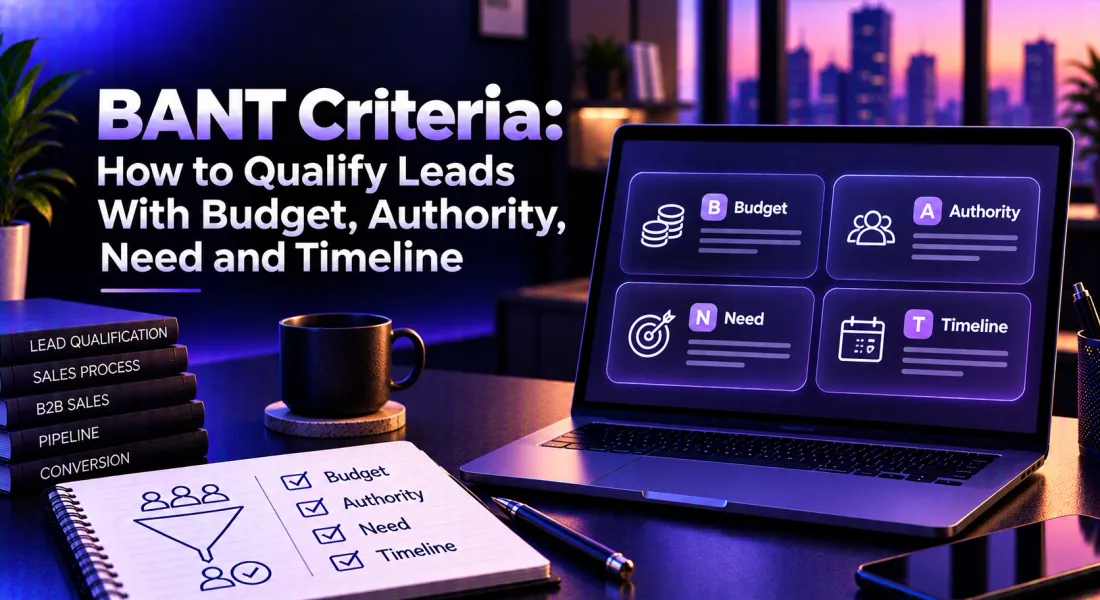
The BANT criteria are four questions sellers use to decide whether a lead is worth pursuing: does the prospect have the Budget, the Authority to buy, a genuine Need, and a Timeline for deciding? A lead that meets most of them is qualified; one that meets none is probably not a real opportunity yet.
BANT is one of the oldest sales qualification frameworks and is widely attributed to IBM in the mid-20th century. Sales BANT training is still standard for almost every new sales development rep, and the framework still turns up in sales job interviews.
It also attracts plenty of criticism in sales communities. Reps call it a box-ticking exercise, buyers dislike being interrogated, and budget is rarely fixed before a seller shows value. This guide explains each of the BANT criteria, the questions to ask, how to use BANT lead qualification without sounding scripted, and when another framework fits better.
What Are the BANT Criteria?
BANT stands for Budget, Authority, Need and Timeline. Together they answer a simple question: is there a realistic chance this prospect will buy, from anyone, within a time frame that matters?
The framework’s value is speed. In a short first conversation, a seller can find out whether to invest more time or politely move on, which matters when a team has more leads than hours.
Once a lead is qualified, send a branded proposal the same day. Create your first proposal free.
The 4 BANT Criteria Explained
Budget
Does the prospect have money available, or can they find it, for a solution like yours? The goal is not to learn an exact figure but to confirm that the cost is within reach.
In practice, many buyers have not set a budget before they speak to a seller, especially for a problem they have just started to explore. A missing budget is not always a disqualifier; it often means you need to help build the business case.
Red flag: the prospect has no idea how the purchase would be paid for, and nobody they know would be able to approve the spend.
Authority
Is the person you are speaking to able to approve the purchase, or do you know who can? In modern B2B buying, the answer is usually a group rather than one person.
The useful question is less “are you the decision-maker?”, which can feel blunt, and more “who else will be involved in a decision like this?”. It maps the buying group without putting your contact on the spot.
Red flag: your contact cannot name anyone else involved and has never bought anything similar for the company.
Need
Does the prospect have a problem your offer genuinely solves, and does it matter enough to act on? Need is the criterion that makes the others relevant; without it, budget and authority are irrelevant.
Listen for specifics: a cost, a delay, a missed target, a risk. Vague interest (“we’re always looking to improve”) is not a need.
Red flag: the prospect cannot describe a concrete problem, or the problem is real but low on their list of priorities.
Timeline
When does the prospect need to decide or have a solution in place, and what is driving that date? A real deadline, such as a contract ending or a launch date, is far more reliable than “sometime this year”.
Red flag: there is no event or reason driving the timing. Without one, decisions tend to slip quarter after quarter.
BANT Questions to Ask
The questions below are phrased to feel like a conversation rather than a checklist. Use them as a guide, not a script.
| Criterion | Questions that work |
|---|---|
| Budget | How are projects like this usually funded? Is there budget set aside, or would we need to build the case? What range were you expecting to invest? |
| Authority | Who else would be involved in a decision like this? How have you made similar decisions before? Who would need to sign off? |
| Need | What prompted you to look at this now? What is this problem costing you today? What happens if nothing changes? |
| Timeline | When would you want this in place? Is anything driving that date? What needs to happen between now and then? |
Notice that the need questions come first in a natural conversation, even though Need is third in the acronym. People share budget and authority details far more readily once they have explained their problem.
How BANT Fits Into the Sales Process
In most teams, BANT is applied early, often by a sales development rep, before a lead is handed to an account executive. It acts as a filter so that the people who run demos and write proposals spend their time on real opportunities.
What Counts as a BANT Qualified Lead
Few leads meet all four criteria in the first conversation. Many teams treat a lead as qualified when it meets three of the four, usually including Need, with a plan to confirm the missing one.
Agree the rule as a team and write it down. BANT qualified leads only mean something if sales and marketing use the same definition.
This guide to sales and marketing alignment covers how to agree lead definitions and handover rules.
Where BANT Sits in the BANT Sales Process
A typical BANT sales process runs from first contact, to a short qualification conversation, to a decision: hand over, nurture or disqualify. Leads that fail on timeline but pass on need are often worth nurturing rather than discarding.
The point is not to reject people. It is to put each lead on the right path, so nobody spends weeks writing a proposal for a prospect with no realistic way to buy.
What Sales Reps Say About BANT
BANT is debated constantly in sales communities. The criticisms are worth understanding, because they explain how to use it well.
It Turns Into a Box-Ticking Exercise
A blunt view shared often by experienced reps is that BANT, MEDDIC and similar frameworks become “CRM exercises”: fields filled in to keep managers happy rather than tools for understanding deals.
The fix is to treat the criteria as questions you genuinely need answered, not fields to complete. If the answer is unknown, write “unknown” and plan how to find out.
Buyers Dislike Being Interrogated
Prospects describe sellers firing qualification questions at them before showing any understanding of their problem. It feels like an interview the buyer did not agree to.
Lead with curiosity about their situation. The qualification answers come out naturally when the conversation is about them.
Budget Often Does Not Exist Yet
For new problems and new types of solution, buyers often have no budget until a seller helps them see the value. Disqualifying every lead without a budget means walking away from deals you can still create.
In those situations, treat budget as something to build with the buyer. Help them quantify the cost of the problem, and the budget conversation becomes far easier.
One Person Rarely Decides
BANT was designed when one person often made the buying decision. Today, B2B purchases usually involve several stakeholders, so “authority” needs to mean mapping the group, not finding one name.
Experienced reps still defend BANT for one reason: asking the hard questions early saves enormous amounts of wasted time. The answer is to ask them well, not to stop asking.
How to Use BANT Without Sounding Like a Checklist
Start With Need, Not Budget
Open with the prospect’s situation and problem. Once they have explained why it matters, asking about budget and timing feels like a natural next step rather than a test.
Starting with need also gives you the information you need to answer the budget question well, because you can frame the investment against the problem they described.
Earn the Budget Question
Asking about budget before showing any understanding of the problem feels presumptuous. Asking after a good discovery conversation feels practical: “Based on what you’ve described, projects like this usually land between X and Y. Is that in line with what you expected?”
Map the Group Instead of Asking for the Decision-Maker
Replace “are you the decision-maker?” with “who else will want a say in this?”. It is more respectful and more accurate in multi-stakeholder deals.
Follow up with “how have decisions like this been made before?”. Past behaviour is often the best guide to how this decision will be made.
Use BANT After the Call as Much as During It
Some of the best reps barely mention BANT on calls. They hold a natural conversation, then use the four criteria afterwards to judge what they learned and what they still need to find out.
Turn qualified opportunities into proposals your buyers can sign. Start free.
Write the four answers down straight after the call, including the unknowns. The gaps tell you exactly what to ask in the next conversation.
BANT vs Other Qualification Frameworks
BANT is not the only option. Several newer frameworks build on it for more complex deals.
| Framework | What it checks | Best for |
|---|---|---|
| BANT | Budget, Authority, Need, Timeline | Fast, early qualification of high lead volumes |
| MEDDIC | Metrics, Economic buyer, Decision criteria, Decision process, Identify pain, Champion | Complex enterprise deals |
| SPICED | Situation, Pain, Impact, Critical Event, Decision | Consultative selling and recurring revenue |
| CHAMP | Challenges, Authority, Money, Prioritisation | Need-first qualification |
Many teams use BANT for early qualification and a deeper framework such as MEDDIC or SPICED once a deal is in progress. That combination keeps first conversations quick without oversimplifying complex deals.
For deals that run for months with many stakeholders, read our guide to the enterprise sales cycle.
Example: Qualifying a Lead With BANT
A sales development rep speaks to the operations manager at a 120-person logistics company that downloaded a guide about route planning.
Need: routes are planned manually in spreadsheets, and late deliveries have triggered penalties from two major customers. The problem is costly and specific.
Timeline: a contract renewal with their largest customer is in four months, and they need to show improvement before then. There is a real deadline.
Authority: the operations manager will lead the evaluation, but the finance director signs off on software and the IT lead must approve integrations. The buying group is mapped.
Budget: no budget is set aside, but the finance director has approved similar tools before when the penalties saved outweighed the cost. Budget is unconfirmed but plausible.
Verdict: three of four criteria are clearly met and the fourth is plausible. The lead is qualified, handed to an account executive, with a note to build a cost-of-penalties business case for the finance director.
What Happens After a Lead Is Qualified
Qualification is only useful if what follows is fast and specific. The information you gathered through BANT should shape the proposal directly: the need becomes the problem statement, the timeline becomes the project plan, the authority map tells you who the proposal must persuade, and the budget conversation shapes the pricing options.
Our pre-sales proposal strategies cover how to use that early information to write proposals that win.
Speed matters too. A qualified lead with a real deadline will not wait a week for a proposal.
Proposal.biz lets you create and send proposals from your own content library within minutes of the call, shared as a link the whole buying group can open.
Once it is sent, you can see who opens it and how far they read, which tells you whether the people you mapped under Authority are actually engaging.
Final Word on the BANT Criteria
The BANT criteria remain one of the fastest ways to decide whether a lead deserves more time. Use them as questions you genuinely need answered rather than boxes to tick, start with need, map the buying group instead of hunting for one decision-maker, and do not discard every lead without a budget. Pair BANT with a deeper framework once deals become complex.
For sales teams building a consistent qualification process, see how Proposal.biz supports sales teams.
FAQs About BANT
What Does BANT Stand for?
BANT stands for Budget, Authority, Need and Timeline, the four criteria used to judge whether a lead is likely to buy.
Is BANT Still Relevant?
Yes, for fast early qualification. It works best when the questions are asked conversationally and combined with deeper frameworks for complex, multi-stakeholder deals.
Does a Lead Need to Meet All Four BANT Criteria?
Rarely in the first conversation. Many teams treat a lead as qualified when it clearly meets three of the four, including Need, with a plan to confirm the fourth.
In What Order Should I Ask BANT Questions?
Start with need. Once the prospect has explained their problem, questions about timeline, authority and budget feel natural rather than intrusive.
What Is the Difference Between BANT and MEDDIC?
BANT is a quick four-part check for early qualification. MEDDIC is a deeper framework for complex deals, covering metrics, the economic buyer, decision criteria and process, pain and a champion.

Prabir Chaudhary
 Prabir Chaudhary
 Ronak Surti


 Dimple Maru