
Table of Contents
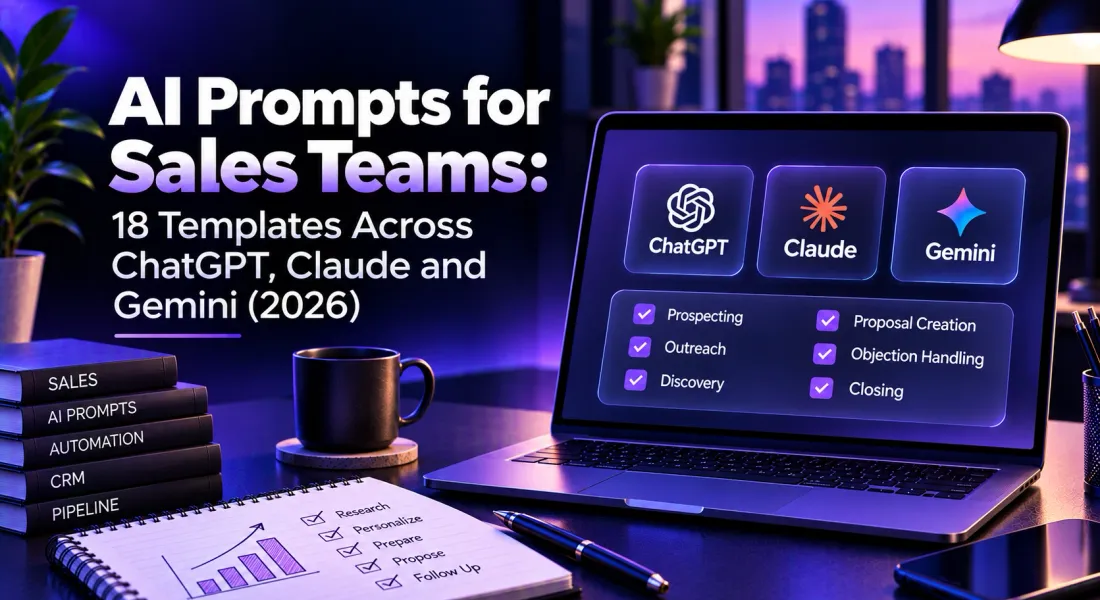
AI Prompts for Sales Teams: 18 Templates Across ChatGPT, Claude and Gemini (2026)
A sales rep has 40 prospects to research, 15 emails to personalize, three discovery calls to prepare for, and two proposals waiting to be sent.
The actual selling is only part of the job. Research, writing, meeting preparation, CRM updates, and follow-ups take up a significant amount of time.
AI can help with that work, but the quality depends on what you ask it to do.
A generic prompt like “write a cold email” produces generic sales copy. A prompt that includes the buyer’s role, company context, actual business problem, and a clear output format is far more useful.
These 18 AI prompts for sales teams cover six stages of the sales process: prospecting, outreach, discovery, proposal creation, objection handling, and closing.
You’ll find six prompts each for ChatGPT, Claude, and Gemini, with practical scenarios and instructions you can copy and adapt. They’re designed to work alongside your existing CRM and sales team workflows, not replace your judgment.
Why AI works well across the sales process
Sales involves a combination of research, communication, analysis, and document preparation. Many of these tasks follow repeatable patterns, making them useful applications for AI.
The key is knowing which tasks benefit from automation and which still need human decisions.
Each AI model brings something useful
ChatGPT, Claude, and Gemini can all help with most of the tasks in this guide. The suggested model for each prompt reflects a useful workflow, not an exclusive capability.
| AI model | Useful sales applications | Example tasks |
|---|---|---|
| ChatGPT | Drafting, rewriting, and structured planning | Cold emails, discovery agendas, proposals, follow-ups |
| Claude | Working through detailed notes and long documents | CRM summaries, proposal reviews, stakeholder analysis |
| Gemini | Research-assisted tasks when web access is available | Account research, industry context, competitor comparisons |
The results depend on the information provided, the model version, and whether the tool has access to current sources.
Context matters more than clever wording
A good AI sales prompt should include five things:
- Role: What perspective should the AI take?
- Context: Who is the buyer, and what do you know?
- Task: What exactly should the AI produce?
- Format: Should the output be an email, table, summary, or checklist?
- Rules: What must the AI avoid assuming or inventing?
Replace the bracketed placeholders in each prompt with your actual information. Use approved or anonymized customer data when necessary, and verify important claims before sharing them.
AI prompts for sales prospecting and research
Prospecting starts before the first message. You need to identify suitable companies, understand their businesses, and decide whether they are worth contacting.
These AI prompts for sales prospecting help with that preparation.
1. ChatGPT: Build an ideal customer profile
Use this prompt when your sales team needs a clearer definition of which companies to target.
Act as a B2B sales strategist helping us define our ideal customer profile.

Context:
* Our product or service: [description]
* Problems we solve: [specific business problems]
* Existing customer types: [verified examples]
* Target markets: [countries or regions]
* Typical deal size: [range, if known]

Task: Identify the customer segments most likely to benefit from our offering.

Create a table covering:
1. Industry and company size
2. Suitable buyer roles
3. Likely business problems
4. Buying triggers worth investigating
5. Potential disqualifiers
6. Why the segment may be a good fit

Rank the three strongest ICP hypotheses based on the information provided. Separate confirmed evidence from assumptions.

Finish with five questions our sales team should answer before beginning outreach.

Rules: Do not invent customer results, budgets, or market demand. Keep the recommendations practical.
Where it works best: When entering a new market, launching a product, or refining an existing account list.
Best for: Sales managers, founders, and SDR teams building their prospecting strategy.
2. Claude: Prioritize leads from an existing prospect list
A large lead list is useful only if your team knows where to focus.
You are a sales operations analyst responsible for prioritizing B2B prospects.

Our ideal customer profile:
[Paste your ICP criteria]

Prospect records:
[Paste approved or anonymized company information and research notes]

Task: Evaluate the available accounts against our ICP.

For each company, assess:
* Industry and company-size fit
* Evidence of a relevant business need
* Potential buyer roles
* Available buying signals
* Missing qualification information

Output: Create a table with company, fit score from 1–5, supporting evidence, missing information, and recommended next action.

Then identify the ten accounts that deserve manual research first.

Rules: Explain the scoring criteria. Treat missing information as unknown, not negative. Do not invent buying intent or claim an account is actively evaluating software without evidence.
Where it works best: When reviewing CRM exports, Apollo lists, or prospecting research that contains inconsistent information.
Best for: SDR managers and sales operations teams prioritizing account research.
3. Gemini: Research a prospect before outreach
Before contacting a company, find a credible reason to start the conversation.
Act as a B2B account research analyst.

Prospect company: [company name and website]
Target contact: [role]
Our offering: [product or service]

Task: If web research is available, investigate the company's publicly available business information.

Look for:
* What the company sells and whom it serves
* Recent product launches or expansions
* Published business priorities
* Relevant hiring or operational signals
* Potential connections to the problems we solve

Output: Provide a one-page account brief with verified observations, source links, possible sales conversation angles, and three questions worth asking the prospect.

Label every business-problem hypothesis as an assumption.

Rules: Cite sources with publication dates where available. Do not invent initiatives or describe ordinary hiring activity as proof of a software requirement. If web access is unavailable, analyze only the information supplied.
Where it works best: Account-based prospecting where researching a smaller number of relevant companies matters more than sending generic messages.
Best for: Account executives and outbound sales teams preparing personalized outreach.
Before investing time in customized proposals for these accounts, our guide to qualifying serious prospects before writing explains how to assess whether an opportunity deserves that investment.
AI prompts for cold emails and LinkedIn outreach
Once you’ve identified suitable accounts, the next challenge is getting a response.
Effective outreach doesn’t require exaggerated personalization or a complicated pitch. It needs a relevant reason to contact someone and a message that respects their time.
4. ChatGPT: Write a personalized cold email
Act as a B2B sales representative writing a first-touch cold email.

Prospect:
* Name: [first name]
* Role: [job title]
* Company: [company]
* Verified observation: [specific information]

Our offering: [description]
Relevant business problem: [problem we may help solve]

Task: Write three different cold email options.

Each email must include:
* A specific subject line
* A relevant opening based on the supplied observation
* A concise explanation of why we're reaching out
* One natural question at the end

Constraints: Keep each email under 100 words. Avoid generic compliments, exaggerated claims, manufactured urgency, and language that sounds mass-generated.

Do not imply that the prospect has a problem unless it has been confirmed. Write like a real person contacting another professional.
Where it works best: Personalized outbound email campaigns targeting a specific role or account.
Best for: SDRs, founders, and account executives preparing first-touch emails.
5. Claude: Write a LinkedIn connection note and first DM
You are a B2B founder writing a LinkedIn connection request and a message for after the person accepts.

Prospect: [name, role, company]
Relevant context: [post, comment, professional interest, or verified observation]
Our business: [short description]

Task: Write:
1. Three connection notes under 250 characters
2. One first DM under 75 words
3. One alternative DM for someone who has already replied to the original post

The connection notes should start from the actual reason for contacting the person.

The first DM should acknowledge the shared context and contribute something useful to the conversation.

Rules: No product pitch or links in the connection note. Avoid artificial familiarity, generic compliments, and forced qualification questions.

If the supplied context is too weak for personalized outreach, flag it instead of manufacturing a connection.
Where it works best: Founder-led LinkedIn outreach where the aim is to begin a genuine professional conversation.
Best for: Founders, account executives, and relationship-led B2B sales teams.
6. Gemini: Build a research-backed outreach sequence
Act as an outbound sales strategist preparing a three-touch email sequence for [prospect company].

Our offering: [description]
Target buyer: [role]
Known context: [verified observations]

Task: If browsing is available, identify a recent, credible company development that may be relevant to our offering.

Using only verified information, write:
1. An introductory email explaining the reason for contact
2. A second email adding useful context or insight
3. A final email offering a simple next step

Include subject lines and keep each email under 100 words.

Explain why each message is relevant to this buyer.

Rules: Do not repeat the same pitch across all three emails. Do not invent funding announcements, hiring plans, or business difficulties. Cite the sources used for personalization. If no meaningful trigger exists, write a role-relevant sequence instead.
Where it works best: Targeted outbound campaigns built around meaningful company developments rather than broad industry assumptions.
Best for: Account-based marketing and sales teams running personalized email sequences.
AI prompts for discovery calls and sales meetings
Discovery calls are where assumptions should become confirmed information.
AI can help prepare the conversation, organize notes, and identify what still needs clarification.
7. ChatGPT: Prepare a discovery call agenda
Act as a consultative B2B account executive preparing for a first discovery call.

Context:
* Prospect company: [company]
* Buyer role: [title]
* Our offering: [description]
* Known business context: [verified notes]
* Meeting duration: 30 minutes

Task: Create a discovery call agenda that helps us understand the buyer's situation before presenting a solution.

Structure the meeting around:
1. Introduction and meeting objective
2. Current workflow
3. Business problems and their impact
4. Desired outcomes
5. Decision process and stakeholders
6. Next steps

Provide eight open-ended questions and three useful follow-up questions.

Rules: Avoid leading questions or assuming that the prospect needs our product. Don't turn the meeting into a scripted product demonstration.
Where it works best: First discovery calls where the salesperson needs a structured conversation without sounding rehearsed.
Best for: SDRs, account executives, and consultants.
8. Claude: Turn discovery notes into CRM-ready insights
Act as a sales operations assistant reviewing a discovery call transcript.

Transcript or meeting notes:
[Paste approved or anonymized content]

Task: Extract the information needed to understand the opportunity and prepare the next sales action.

Return:
1. A concise CRM summary
2. Confirmed buyer problems
3. Business priorities and desired outcomes
4. Budget information, if discussed
5. Stakeholders and decision roles
6. Objections or concerns
7. Agreed next steps with owners and dates
8. Unanswered questions

Include a separate section called "What we should not assume."

Rules: Use only information in the transcript. Do not invent budgets, decision dates, or commitments. Preserve important distinctions between what the buyer confirmed and what the salesperson suggested.
Where it works best: Long discovery conversations where important details are buried in unstructured notes.
Best for: Account executives and sales operations teams updating CRM records.
9. Gemini: Generate industry-specific discovery questions
You are a B2B sales strategist preparing a discovery call with a [buyer role] at a company in [industry].

Our offering: [description]
Known prospect context: [verified company information]

Task: Research current, relevant business challenges in this industry if web access is available.

Create ten discovery questions organized into:
* Current processes
* Operational challenges
* Business impact
* Technology or service requirements
* Decision criteria

For each question, explain what we're trying to learn.

Include three industry-specific issues worth investigating and cite sources supporting their relevance.

Rules: Industry-wide problems are not proof that this particular company has them. Phrase potential issues as questions, not statements of fact. If research is unavailable, use only the supplied context.
Where it works best: Preparing for unfamiliar industries or meetings where the salesperson needs additional business context.
Best for: Sales representatives entering new verticals.
After discovery, some opportunities may benefit from a short presentation. Our AI prompts for sales deck creation cover presentation structure, executive messaging, and buyer-specific sales decks.
AI prompts for sales proposals and pricing
Once the buyer’s requirements are clear, the next challenge is turning those requirements into a specific, accurate offer.
AI can accelerate proposal preparation, but the team still needs to verify scope, pricing, and promises before sending.
10. ChatGPT: Draft a personalized sales proposal
Act as a senior B2B proposal writer preparing a client-facing proposal.

Client: [company and industry]
Confirmed business problem: [problem]
Desired outcome: [goal]
Our proposed solution: [solution]
Scope and deliverables: [details]
Timeline: [approved timeline]
Investment: [approved pricing]
Relevant experience: [verified case studies or proof]

Task: Write a professional sales proposal with these sections:
1. Executive summary
2. Client's objectives
3. Proposed solution
4. Scope and deliverables
5. Timeline
6. Investment
7. Assumptions and exclusions
8. Next steps

Rules: Write directly to the client, use plain language, and avoid generic sales claims. Do not invent pricing, capabilities, customer results, or implementation commitments. Highlight missing details for review.
Where it works best: Preparing a structured first draft after discovery has clarified the client’s requirements.
Best for: Sales representatives, consultants, agencies, and founders preparing custom proposals.
For more specialized proposal types, our AI prompts for business proposals provide additional document-focused templates.
11. Claude: Review a proposal against discovery requirements
You are a proposal quality reviewer checking whether a sales proposal accurately reflects the client's requirements.

Client requirements and discovery notes:
[Paste confirmed requirements]

Proposal draft:
[Paste draft]

Task: Audit the proposal against the information supplied.

Identify:
* Missing requirements
* Inaccurate or unsupported claims
* Ambiguous scope
* Inconsistent pricing
* Unrealistic or unverified timelines
* Missing exclusions and dependencies
* Questions the client may still have

Output: Create a table with issue, supporting evidence, severity, and recommended correction.

Then provide a revised version of only the sections that need improvement.

Rules: Do not silently modify approved commercial terms. Flag any change requiring confirmation from delivery, finance, or legal.
Where it works best: Reviewing detailed proposals before they reach clients, particularly when several departments have contributed.
Best for: Proposal managers, sales leads, and delivery teams.
12. Gemini: Build a credible pricing justification
Act as a B2B commercial analyst helping explain the investment in a proposed solution.

Our offering: [description]
Approved price: [amount]
Included deliverables: [scope]
Client priorities: [confirmed priorities]
Verified value evidence: [case studies, results, or operational benefits]

Task: Write a concise investment justification explaining how the proposed price relates to the deliverables and the client's objectives.

If browsing is available, find relevant published industry context or pricing benchmarks and provide dated sources. Explain whether those benchmarks are genuinely comparable to our offer.

Output: Provide a 150-word client-facing explanation, a table matching cost components to deliverables, and three questions the buyer may ask.

Rules: Do not invent ROI figures, customer savings, or market averages. If reliable benchmarks aren't available, base the explanation solely on our approved scope and pricing.
Where it works best: Proposals where the buyer needs a clear understanding of what is included in the investment.
Best for: Account executives and commercial teams preparing pricing discussions.
AI prompts for handling sales objections
Price concerns, implementation risks, and competitor comparisons are common in B2B deals.
The aim isn’t to win every objection through clever wording. It’s to understand the actual concern and respond with relevant information.
13. ChatGPT: Respond to a pricing objection
Act as a consultative B2B salesperson.

The buyer said: "[exact objection]"

Our offering: [description]
Approved price: [amount]
Known buyer priorities: [details]
Verified business value: [evidence]

Task: Write three possible responses:
1. A response that clarifies the real concern
2. A response that explains the value behind the investment
3. A response that explores scope or payment alternatives within our approved policies

Keep each response under 80 words and use a natural conversational tone.

Rules: Do not make unauthorized discounts, create artificial urgency, or dismiss the buyer's concern. Avoid claiming financial outcomes without evidence.
Where it works best: Conversations where the buyer questions the price but may still see value in the proposed solution.
Best for: Account executives and sales managers preparing for commercial discussions.
14. Claude: Prepare for a complex sales negotiation
Act as a senior B2B negotiation coach helping prepare for a multi-stakeholder sales discussion.

Deal context:
[Paste approved deal notes]

Stakeholders and concerns:
[List each role and its stated priorities]

Our non-negotiable terms:
[List]

Areas of flexibility:
[Approved options]

Task: Create a negotiation preparation document covering:
1. Each stakeholder's main concern
2. What we know versus what we assume
3. Possible responses
4. Commercial trade-offs
5. Questions we should ask
6. Issues requiring internal approval

Finish with a suggested meeting agenda and a respectful closing statement.

Rules: Never recommend unauthorized contractual changes, discounts, guarantees, or concessions. Prioritize a workable agreement over pressure tactics.
Where it works best: Enterprise or service deals involving multiple decision-makers and competing priorities.
Best for: Senior account executives, founders, and sales managers.
15. Gemini: Prepare a fact-based competitor comparison
Act as a neutral competitive sales analyst.

Our product: [name]
Competitor: [name]
Prospect's stated requirements: [requirements]
Our verified capabilities: [features]

Task: If browsing is available, research the competitor's current official product documentation and publicly listed pricing.

Compare both solutions across:
* Relevant features
* Implementation requirements
* Integrations
* Pricing structure
* Support and collaboration capabilities
* Important limitations

Output: Provide a sourced comparison table, three buyer questions to clarify, and a respectful 60-second explanation of our differentiation.

Rules: Cite every competitor claim. Don't invent missing features or describe unverified information as fact. Clearly explain where the competitor may be a better fit.
Where it works best: Opportunities where a prospect is actively comparing competing solutions.
Best for: Competitive sales teams and account executives preparing evaluation discussions.
AI prompts for sales follow-ups and closing deals
Sending a proposal doesn’t mean the sale is complete.
The buyer may need internal approval, clarification, a revised scope, or time to compare alternatives.
These final three prompts help sales teams manage the process without repeatedly asking for updates.
16. ChatGPT: Write a post-proposal follow-up email
Act as a thoughtful B2B account executive writing a follow-up after sending a proposal.

Client: [company]
Proposal: [brief scope]
Date sent: [date]
Last confirmed discussion: [notes]
Outstanding questions: [questions]
Agreed next step: [if any]

Task: Write three follow-up email options:
1. A message clarifying an important proposal detail
2. A message sharing useful information relevant to the deal
3. A message offering a simple next step

Include a subject line for each. Keep each email under 100 words.

Rules: Avoid generic checking-in phrases, guilt, false urgency, or assumptions that the client has reviewed the proposal. Keep the language natural.
Where it works best: Following up after sending a proposal while keeping the conversation relevant.
Best for: Account executives, consultants, and service businesses.
17. Claude: Create a stakeholder decision summary
Act as a B2B account manager preparing a decision summary for a deal involving several stakeholders.

Meeting notes and correspondence:
[Paste approved content]

Proposal details:
[Scope, pricing, timeline]

Task: Create a concise summary that the buyer's team can use internally.

Include:
1. What has been discussed
2. Confirmed business requirements
3. Proposed solution
4. Agreed commercial details
5. Remaining concerns
6. Decisions still required
7. Responsible stakeholders, where confirmed
8. Recommended next steps

Also draft a short email introducing the summary.

Rules: Distinguish approved decisions from open items. Do not imply that stakeholders have agreed to anything they haven't confirmed. Avoid adding commercial promises.
Where it works best: Complex sales cycles where one person needs to circulate the proposal internally.
Best for: Enterprise account executives and sales managers.
18. Gemini: Prepare a closing and client handoff plan
Act as a B2B sales operations lead preparing a deal for final approval and handoff.

Client: [company]
Agreed scope: [details]
Approved commercial terms: [details]
Decision-makers: [confirmed roles]
Remaining concerns: [concerns]
Expected next steps: [steps]

Task: Create a closing checklist covering:
* Remaining buyer decisions
* Internal approvals
* Contract or proposal review
* Signature responsibilities
* Outstanding information
* Delivery team handoff requirements
* Proposed next actions

If public procurement instructions or vendor requirements are supplied, review them and identify any additional steps, citing their sources.

Output: Provide a checklist, an ownership table, and a concise client email explaining what happens next.

Rules: Do not assume the deal is won. Do not invent approvals, deadlines, or procurement requirements. Flag missing information explicitly.
Where it works best: Late-stage opportunities where the commercial discussion is mostly complete but several administrative or delivery steps remain.
Best for: Account executives, sales operations teams, and account managers coordinating the transition to delivery.
How to get more from AI sales prompts
A prompt is the starting point, not the finished work.
Three habits make these templates more useful across sales workflows.
Treat the first output as a draft
Review what the AI generates. Check whether it misunderstood the buyer’s needs, introduced assumptions, or made the writing too generic.
Ask for targeted revisions rather than starting again.
For example: “Shorten this email to 70 words, keep the specific company observation, and remove every unsupported assumption.”
Chain prompts across the sales process
You can use the output from one prompt as the input for another.
For example:
Account research → Discovery questions → Meeting summary → Proposal draft → Proposal review → Follow-up email
This preserves context and reduces repeated data entry.
However, verify important information as it moves between stages. An incorrect assumption in an early research brief can otherwise appear later as a confirmed fact in the proposal.
Save prompts that produce useful results
Create a small shared prompt library for recurring sales tasks.
Store the prompt, required inputs, useful examples, and any adjustments that improved the result.
You can also adapt the more specialized examples in our ChatGPT proposal writing prompts when you need to improve a specific proposal section.
From AI sales prompts to a branded proposal
AI tools can help with the research, messaging, and drafting stages of a sale. But a proposal still needs to become a professional document the client can review, discuss, and accept.
That’s where Proposal.biz fits into the workflow.
Instead of manually transferring AI-generated content into another editor and formatting everything from scratch, you can create a branded proposal directly through Proposal.biz.
1. Start with your website and company information
Proposal.biz can extract your brand details and relevant business content from your website.
Its Smart Content Library also helps teams reuse company information, services, case studies, and other material across documents.
2. Generate and refine the document with AI
Take the confirmed requirements from your discovery call and use them to generate a proposal.
The platform’s AI writing and editing features help generate sections and refine existing content with natural-language instructions.
You can edit the scope, pricing, timeline, and other details before sending.
3. Send, track, and sign in one workflow
With Proposal.biz’s proposal creation and sharing tools, teams can send a client-facing document link instead of relying only on PDF attachments.
They can monitor engagement, manage client feedback, and collect electronic signatures within the platform.
That connects the work done with AI prompts to the document the client actually receives.
Frequently asked questions
What are the best AI prompts for sales teams?
The best prompts solve specific sales tasks using actual business context. Useful examples include ICP development, account research, personalized outreach, discovery questions, proposal drafting, objection handling, and closing plans.
Can ChatGPT help with sales prospecting?
Yes. ChatGPT can help define ICPs, organize prospect research, evaluate supplied lead information, and prepare outreach. However, company information and buying signals should be verified before contacting prospects.
How do I write effective ChatGPT prompts for sales?
Include the buyer’s role, relevant company information, the problem you’re addressing, the specific task, the output format, and any constraints. Clear context produces more useful output than a broad instruction like “write a sales email.”
Which is better for sales: ChatGPT, Claude, or Gemini?
All three can support research, writing, and analysis. ChatGPT is useful for drafting and iteration, Claude can help organize detailed notes and documents, and Gemini can support research-assisted tasks when current web access is available. The best choice depends on your workflow and available features.
Can AI create personalized sales proposals?
Yes. AI can draft a proposal from confirmed client requirements, scope, pricing, and other project information. Human reviewers should verify factual claims, commitments, and commercial details before sending.
Can AI replace sales representatives?
AI can assist with repetitive preparation and analysis, but sales representatives remain responsible for customer relationships, judgment, negotiation, and business commitments.
Are AI sales prompts useful for small businesses?
Yes. Small teams can use AI to prepare outreach, organize discovery notes, create proposals, and manage follow-ups without needing a large sales operations department. The same rules about accuracy and data privacy still apply.
Final word
Sales teams don’t need more generic AI-generated emails. They need tools that make the work between customer conversations easier.
The 18 prompts above cover the complete sales process, from identifying the right companies and preparing outreach to understanding buyer requirements, writing proposals, and managing next steps.
Start with the stage where your team spends the most time. Adapt the prompts to your actual customers, verify the results, and save the ones that work.
When it’s time to turn your sales notes into a client-ready proposal, Proposal.biz helps bring drafting, branding, editing, sharing, tracking, and signing into one workflow.

Ronak Surti
 Ronak Surti