
Table of Contents
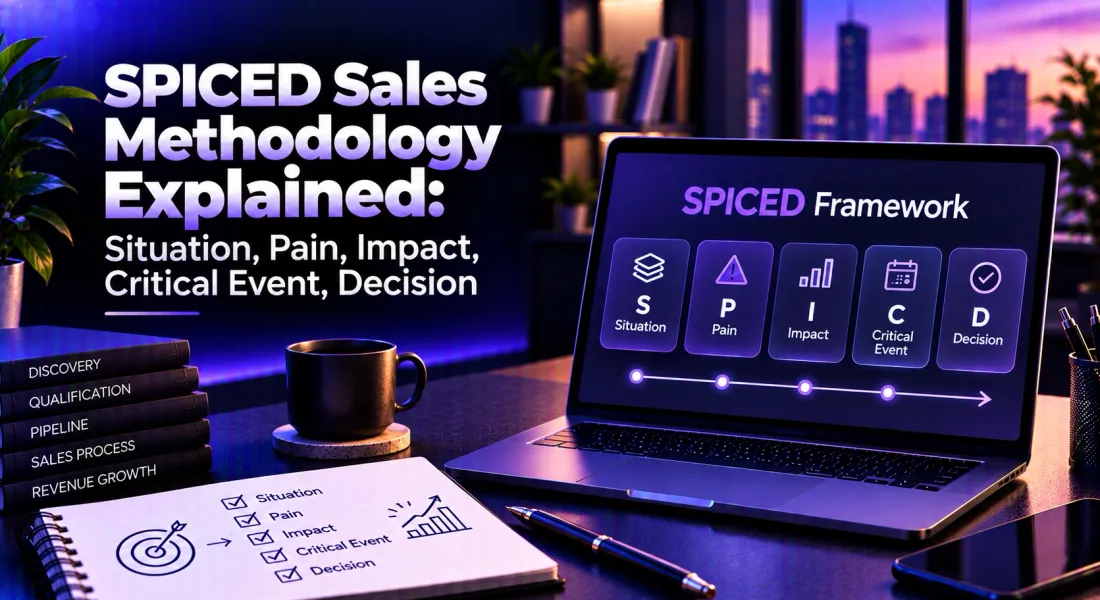
SPICED Sales Methodology Explained: Situation, Pain, Impact, Critical Event, Decision
The SPICED methodology is a sales discovery and qualification framework built around five things a seller needs to understand about a buyer: their Situation, their Pain, the Impact of solving it, the Critical Event that sets the deadline, and how the Decision will be made. It was created by Winning by Design for businesses where revenue depends on customers getting ongoing value.
You will sometimes see it searched as the spice sales methodology or simply spice sales, but the name is SPICED, with the final letters standing for Critical Event and Decision. The framework has become popular with SaaS and subscription businesses because it carries through the whole customer journey, not just the first sale.
Sellers who use it often describe it as more consultative than older checklists, but frameworks of every kind attract the same criticism in sales communities: done badly, they become forms to fill in rather than conversations to have. This guide explains each element of the SPICED methodology, gives example questions, walks through a real-style example and shows how to use it without sounding scripted.
What Is the SPICED Methodology?
The Winning by Design SPICED framework was developed by Winning by Design, the revenue consultancy founded by Jacco van der Kooij. Its core idea is that recurring revenue comes from recurring impact: customers keep paying when they keep getting the result they bought.
That idea shapes everything about SPICED. Instead of asking only “will this prospect buy?”, it asks “what impact does this customer need, and by when?”. The answers are useful to sales during the deal, to the team that onboards the customer after it, and to whoever manages the renewal.
SPICED is often grouped with qualification frameworks such as BANT and MEDDIC, but it leans more towards discovery. It tells a seller what to understand, and the qualification judgement follows from that understanding.
Turn your SPICED discovery notes into a branded proposal. Create your first proposal free.
The 5 Elements of SPICED
S: Situation
The facts about the buyer’s world: their company, team, current tools and processes, and the context they are working in. Much of this can be researched before the first call.
Situation questions are necessary, but they are the least valuable part of the conversation for the buyer. Experienced sellers keep them brief and research the basics in advance, so the call can focus on the elements that matter more.
Example questions: How does your team handle this today? Which tools are involved? How has the process changed over the last year?
P: Pain
The problem the buyer is experiencing, and why it matters to them. Pain is the reason a conversation exists at all.
Look for pain that is specific and felt, not general. “Our proposals are slow” is a start; “we lost two deals last quarter because competitors sent proposals days before us” is pain.
Example questions: What is not working the way you want it to? What made this a priority now? Who feels this problem most?
I: Impact
What changes for the buyer if the pain is solved. Winning by Design separates two kinds of impact: rational impact, which is measurable (revenue, cost, time), and emotional impact, which is personal (less stress, more confidence, recognition).
Both matter. Rational impact justifies the purchase to finance; emotional impact explains why your champion will fight for it internally.
Example questions: If this were solved, what would be different in six months? What would that be worth to the business? What would it mean for you and your team?
C/E: Critical Event
A specific, dated event that creates a deadline for the decision, with a consequence if it is missed: a contract renewal, a product launch, a regulatory date, a new financial year.
Many sellers consider this the most valuable element in SPICED, because it separates urgent deals from interesting ones. A wish (“we’d like this sorted by summer”) is not a critical event. A date with a consequence (“our current contract ends on 31 March and we lose data access”) is.
Example questions: Is there a date by which this needs to be in place? What happens if that date is missed? What is driving the timing?
D: Decision
How the buyer will decide: the criteria they will use, the people involved and the process they will follow, from evaluation to signature.
Understanding the decision early avoids the most painful surprise in sales: a deal everyone agrees on that stalls for weeks in a procurement or legal process nobody mentioned.
Example questions: How will you evaluate the options? Who else will be involved? What steps does a purchase like this go through before it is signed?
SPICED Example: A Discovery Call Mapped to the Framework
A seller of proposal software speaks to the head of sales at a 40-person consulting firm. Here is what they learn, organised by SPICED.
| Element | What the seller learned |
|---|---|
| Situation | Eight consultants write proposals in a word processor, copying from old documents; the firm wins most work through referrals |
| Pain | Proposals take three to four days; two deals were lost last quarter to faster competitors |
| Impact (rational) | Each lost deal was worth around $60,000; faster proposals can recover a significant share |
| Impact (emotional) | The head of sales is tired of weekend proposal work and wants the team to look more professional |
| Critical event | A major tender is due in seven weeks, and the firm wants the new process in place before it |
| Decision | Head of sales recommends; managing partner approves; IT reviews the tool; decision expected within three weeks |
With this information, the seller knows what the proposal must say, who it must persuade, what deadline to plan backwards from and why the buyer personally cares. That is far more useful than knowing only that the prospect “has budget”.
SPICED vs BANT vs MEDDIC
| SPICED | BANT | MEDDIC | |
|---|---|---|---|
| Main focus | Understanding impact and urgency | Fast early qualification | Rigorous qualification of complex deals |
| Elements | Situation, Pain, Impact, Critical Event, Decision | Budget, Authority, Need, Timeline | Metrics, Economic buyer, Decision criteria, Decision process, Identify pain, Champion |
| Best for | Consultative and recurring revenue sales | High lead volumes and early filtering | Large enterprise deals |
| Carries past the sale | Yes, designed to | Rarely | Sometimes |
The frameworks are not mutually exclusive. Some teams use BANT for a quick first filter, SPICED for discovery, and MEDDIC-style checks for their largest deals.
For large deals with long cycles and many stakeholders, our guide to the enterprise sales cycle covers how to keep them moving.
What Reps Say About SPICED Sales in Practice
Discussions of spiced sales in sales communities tend to share a few themes.
It Feels More Consultative
Reps who have used several frameworks often describe SPICED as the most conversational, because it starts with the buyer’s situation and pain rather than budget and authority. Buyers experience it as discovery rather than qualification.
That matters more as buyers do more research alone. A seller who opens by understanding the buyer’s situation earns more trust than one who opens by checking budget.
Any Framework Can Become a Form
A recurring complaint is that qualification frameworks turn into CRM fields reps fill in to satisfy managers. SPICED is not immune. If reps write “Pain: inefficiency” to complete a field, the framework adds nothing.
The test is specificity. Every SPICED field should contain something the buyer actually said, ideally in their words.
Buyers Notice Interrogation
Prospects describe sellers working through a methodology like a questionnaire. The fix is the same as for any framework: hold a natural conversation, then use SPICED afterwards to check what you learned and what you still need.
One practical habit is to ask one question per element at most on a first call, and let the buyer’s answers lead the conversation into the next element.
The Critical Event Changes Forecasting
Sellers often say that asking about the critical event is what changed their forecasts most. Deals without one slip; deals with a real event and a real consequence tend to close close to their date.
If a deal has no critical event, it is worth asking whether one exists or can be created, such as a pilot ending before a budget cycle. If not, forecast it cautiously.
How to Use SPICED Beyond the First Call
SPICED is designed to travel with the customer, which is what separates it from frameworks used only to qualify.
During the Deal
Revisit each element as the deal develops. Impact often grows as more stakeholders join; the critical event can move; the decision process usually becomes clearer and longer.
Update the SPICED notes after every significant meeting, and share the summary with your champion. Asking them to correct anything you have wrong builds trust and catches errors early.
In the Proposal
A SPICED-led proposal practically writes itself. The situation and pain become the problem statement, the impact becomes the business case, the critical event shapes the timeline, and the decision tells you which sections each stakeholder needs.
Open with an executive summary built on the buyer’s own pain and impact. This guide on how to write an executive summary shows how.
At Handover to the Delivery Team
Passing the SPICED notes to onboarding means the customer does not have to explain their situation and goals again. The team knows what impact was promised and by when.
The handover meeting can even be structured around the five elements, so the delivery team hears the customer’s pain and expected impact in the customer’s own words.
At Renewal
Renewal conversations go back to impact: did the customer get what they bought? If yes, the renewal is easy; if not, you know exactly what to fix.
These AI prompts for contract renewal proposals help you build that case.
Reviewing impact regularly during the contract, not just at renewal, gives you time to fix shortfalls before they become reasons to leave.
4 SPICED Mistakes to Avoid
Spending the Call on Situation
Asking questions that ten minutes of research would answer wastes the buyer’s time. Research the situation first and confirm it briefly.
A short line such as “I saw you opened a second office this year; how has that changed things?” shows you have done the research and moves straight to what matters.
Treating a Wish as a Critical Event
“We’d like to start next quarter” is a preference. A critical event has a date and a consequence. Without the consequence, expect the date to move.
Ask “what happens if this slips by three months?”. If the answer is “nothing much”, there is no critical event yet.
Capturing Only Rational Impact
A business case without a personal reason to act often stalls. Ask what solving the problem would mean for the people involved, not just for the company.
Emotional impact does not need to be dramatic. “I would stop spending my weekends on this” is often what turns an interested buyer into an active champion.
Assuming the Decision Process
Never assume who signs or how. Ask early and confirm again before you send the proposal.
Send proposals built around your buyer’s impact and critical event. Start free.
Ask specifically about steps that often surprise sellers late on, such as IT reviews, legal review of terms or approval thresholds that need a more senior sign-off.
Turning SPICED Notes Into a Proposal
Once discovery is done, speed matters, especially when there is a critical event. Proposal.biz uses AI-powered document generation to turn your call notes into a branded proposal draft, pulling your services, pricing and case studies from your content library.
Prompt it with the SPICED summary, for example: “Proposal for a 40-person consulting firm; pain is slow proposals and lost deals; impact is faster turnaround before a tender in seven weeks; decision by head of sales and managing partner.” Then refine the draft.
Share the proposal as a link and you can see when each stakeholder opens it and how far they read. That shows whether the people you identified under Decision are actually engaging.
You can create and send proposals this way and collect the signature in the same window.
Final Word on the SPICED Methodology
The SPICED methodology works because it focuses discovery on what matters most to the buyer: the pain, the impact of solving it, the event that makes it urgent and how they will decide. Keep situation questions short, insist on a real critical event, capture both rational and emotional impact, and carry the notes into the proposal, onboarding and renewal.
For sales teams adopting a consistent discovery framework, see how Proposal.biz supports sales teams.
FAQs About the SPICED Methodology
What Does SPICED Stand for?
SPICED stands for Situation, Pain, Impact, Critical Event and Decision. The C and E together represent Critical Event.
Who Created the SPICED Framework?
SPICED was created by Winning by Design, the revenue consultancy founded by Jacco van der Kooij, for businesses that rely on recurring revenue.
Is It Called SPICE or SPICED?
The correct name is SPICED. People sometimes search for SPICE, but the framework has five elements, with Critical Event represented by the letters C and E.
How Is SPICED Different From BANT?
BANT is a quick check of budget, authority, need and timeline. SPICED focuses more deeply on the buyer’s pain, its impact and the event that makes the decision urgent, and it is designed to carry through the whole customer journey.
What Is a Critical Event in SPICED?
A specific, dated event with a consequence if it is missed, such as a contract ending, a launch or a new financial year. It is what turns an interesting deal into an urgent one.

Prabir Chaudhary
 Prabir Chaudhary


 Ronak Surti


 Dimple Maru