
Table of Contents
Sales Funnel vs Sales Pipeline: What’s the Difference?
A sales funnel shows how potential buyers move from first awareness to purchase, and how many drop out at each stage. A sales pipeline shows the specific deals a sales team is actively working, what stage each is at and what needs to happen next. The funnel is about conversion rates across all prospects; the pipeline is about managing individual opportunities.
The two describe the same journey from different angles, which is why the terms get mixed up. You will hear people talk about a “pipeline funnel” as if it were one thing, and in sales communities, the simplest definitions often win: the pipeline is all the potential deals you are working, whether or not they close.
This guide explains sales funnel vs pipeline in practice: how each works, who uses it, how they fit together, a worked example, the metrics for each and the stages where deals most often leak.
Sales Funnel vs Pipeline at a Glance
| Sales funnel | Sales pipeline | |
|---|---|---|
| Perspective | The buyer’s journey | The seller’s work |
| Unit | Groups of prospects | Individual deals |
| Main question | How many prospects convert at each stage? | Which deals are where, and what happens next? |
| Measures | Conversion rates and drop-off | Deal value, stage, age and next steps |
| Typical owners | Marketing and sales leadership | Sales reps and sales managers |
| Used for | Improving conversion and planning volume | Managing deals and forecasting revenue |
Move deals through the proposal stage faster. Create your first proposal free
How a Sales Funnel Works
A sales funnel describes the stages a group of potential buyers passes through before purchase. It is shaped like a funnel because fewer people make it through each stage.
Typical Funnel Stages
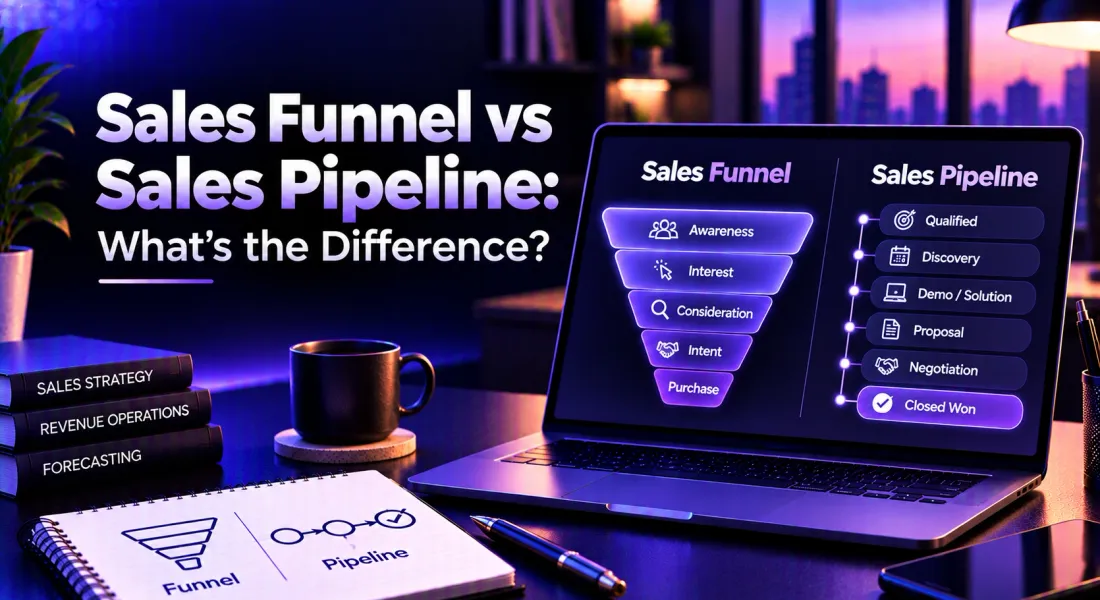
Stages vary by business, but a common version runs: awareness (they learn you exist), interest (they engage with your content or website), consideration (they evaluate you against alternatives), intent (they ask for a demo, quote or proposal) and purchase.
In B2B, the funnel often continues after purchase into onboarding, expansion and renewal, because the customer relationship is where much of the revenue comes from.
What the Funnel Measures
The funnel’s main measure is conversion: what share of people move from one stage to the next. If 2,000 people visit your pricing page and 100 request a demo, that stage converts at 5%.
Conversion rates show where interest is lost. A healthy top of the funnel with weak conversion further down points to a different problem from a funnel that is simply too empty.
Who Uses It
Marketing teams use the funnel to plan campaigns and measure their contribution. Sales and revenue leaders use it to understand how much activity is needed at the top to hit a revenue target at the bottom.
Leadership also uses the funnel to plan hiring and budgets. If the conversion rates are known, the funnel shows how much marketing and sales capacity a revenue target requires.
How a Sales Pipeline Works
A sales pipeline tracks the individual deals a sales team is working, from first qualified conversation to signature. Each deal sits in a stage, with a value, an expected close date and a next step.
Typical Pipeline Stages
A common B2B pipeline runs: qualified, discovery, demo or solution, proposal, negotiation, and closed won or closed lost. The exact stages should match how your customers actually buy.
Each stage needs clear entry and exit criteria. “Proposal” should mean a proposal has been sent, not that one is being considered; otherwise the pipeline reflects hope rather than progress.
What the Pipeline Measures
Pipeline value, the number of deals at each stage, how long deals have been in each stage, and the next action for each deal. Managers often weight pipeline value by stage to produce a more realistic forecast.
Age matters as much as value. A deal that has sat in the proposal stage for three times your normal cycle is far less likely to close than its stage suggests.
Who Uses It
Sales reps use the pipeline daily to decide what to work on next. Sales managers use it weekly to coach reps, spot stalled deals and forecast revenue.
For more on analysing what the pipeline tells you, see our steps to conducting a sales analysis.
Leadership also uses the funnel to plan hiring and budgets. If the conversion rates are known, the funnel shows how much marketing and sales capacity a revenue target requires.
Why People Use “Pipeline Funnel” Interchangeably
The confusion has a few sources, and understanding them helps teams talk to each other clearly.
They Cover the Same Journey
The later stages of the funnel (intent and purchase) are the same moments the pipeline tracks in detail. Where the funnel ends and the pipeline begins depends on how each company defines its stages.
Many companies draw the line at qualification: before it, prospects are tracked in the funnel; after it, they become deals in the pipeline.
Tools Show Them Differently
CRMs usually present a pipeline view of deals, while marketing platforms present funnel reports of conversion. Teams that live in different tools end up using different words for overlapping things.
Connecting the tools, or at least using the same stage names in both, removes a lot of the confusion.
Marketing and Sales Speak Different Languages
Marketing talks about the funnel because it measures groups of people. Sales talks about the pipeline because it manages individual deals. Without shared definitions, the two teams argue about numbers that describe different things.
Agreeing stage definitions together is a core part of sales and marketing alignment.
How the Funnel and Pipeline Work Together
The Funnel Feeds the Pipeline
Prospects who reach the intent stage of the funnel become qualified deals in the pipeline. If the funnel narrows, the pipeline empties a few weeks or months later, depending on your sales cycle.
That delay is why a quiet month at the top of the funnel often shows up as a weak quarter later. Watching funnel volume gives you early warning.
The Pipeline Explains Funnel Leaks
If funnel conversion from intent to purchase is weak, the pipeline shows why: deals stalling at proposal, lost to a competitor in negotiation, or disqualified late because they were never a fit.
Reviewing lost deals by stage and reason turns those leaks into specific fixes, such as better qualification questions or faster proposals.
Together They Make Forecasts Reliable
The funnel tells you whether enough new opportunities are coming in; the pipeline tells you how likely the current ones are to close and when. A forecast built on only one of them misses half the picture.
Teams that review both together catch problems earlier, because a dip in one usually shows up in the other weeks or months later.
Example: One Quarter Viewed Both Ways
Here is how the same quarter can look through each lens. Figures are illustrative.
| Funnel view (marketing and leadership) | Count | Conversion to next stage |
|---|---|---|
| Website visitors from target market | 20,000 | 2% |
| Leads (downloads, sign-ups) | 400 | 25% |
| Qualified opportunities | 100 | 40% |
| Proposals sent | 40 | 30% |
| Deals won | 12 | N/A |
| Pipeline view (sales team) | Deals | Value |
|---|---|---|
| Discovery | 30 | $450,000 |
| Proposal sent | 18 | $310,000 |
| Negotiation | 6 | $120,000 |
| Closed won this quarter | 12 | $195,000 |
The funnel shows leadership that proposals convert at 30% and that lifting it would add more revenue than doubling website traffic. The pipeline shows the sales manager that 18 deals worth $310,000 are sitting at the proposal stage, and which of them have gone quiet.
Metrics for Each
| Funnel metrics | Pipeline metrics |
|---|---|
| Conversion rate between stages | Total and stage-weighted pipeline value |
| Volume at each stage | Number of deals per stage |
| Cost per lead and per opportunity | Average deal size |
| Time from first touch to opportunity | Average time in each stage |
| Lead source performance | Close rate from qualified to won |
The single most useful combined metric is stage-to-stage conversion within the pipeline, because it connects the funnel’s view of drop-off with the pipeline’s view of specific deals.
Where Deals Leak Between Stages
Every funnel and pipeline leaks. Knowing the usual leak points tells you where to look first.
Weak Leads at the Top
If lead sources bring in people who were never likely to buy, every later stage suffers. Fixing lead quality often does more than adding volume.
Ask sales which lead sources produce the best conversations, and shift budget towards them, even if they produce fewer leads.
Late Disqualification
Deals that should have been disqualified in discovery linger until the proposal or negotiation stage, wasting time and inflating the pipeline. Better qualification early on keeps the pipeline honest.
It feels uncomfortable to disqualify a friendly prospect, but every weak deal removed frees time for the real ones.
Silence After the Proposal
The proposal stage is one of the most common places for deals to stall. Without visibility, a rep cannot tell whether the buyer is reviewing it, sharing it internally or ignoring it.
Document analytics and engagement tracking show when a proposal is opened and how far it is read, so stalled deals stand out from active ones.
Negotiation That Drags
Deals that reach negotiation and then stop moving usually have an unaddressed objection or a stakeholder nobody has engaged. Ask directly what stands between the buyer and a decision.
Set a target date for each negotiation and agree the remaining steps with the buyer. A shared timeline keeps both sides moving.
How to Manage Both Well
Define Stages Once, Together
Agree funnel and pipeline stage definitions across marketing and sales, with clear criteria for moving from one to the next. Write them down and use them in every report.
Review the definitions once a year, or when your sales process changes. Stages that no longer match how customers buy produce misleading reports.
Review the Pipeline Weekly and the Funnel Monthly
Pipeline reviews focus on specific deals and next steps, so they need to be frequent. Funnel reviews focus on trends in conversion, which are clearer over a month or a quarter.
Keep the two reviews connected. A short funnel summary at the start of the monthly pipeline meeting reminds everyone where the next quarter’s deals will come from.
Remove Stale Deals
Deals that have not moved for far longer than your normal cycle inflate the pipeline and distort forecasts. Close them out or move them back to nurture.
Many teams set an automatic flag when a deal exceeds a set number of days in one stage, which prompts a decision rather than a quiet accumulation of old deals.
Fix the Biggest Leak First
Find the stage with the weakest conversion and work on it before anything else. A small improvement at a weak stage usually beats a large increase in volume at the top.
For practical ideas on speeding up slow stages, see our strategies to shorten the B2B sales cycle.
Send proposals as trackable links and spot stalled deals early. Start free
4 Mistakes to Avoid
Counting Hope as Pipeline
Deals added because a conversation went well, without real qualification, make the pipeline look healthier than it is. Set clear entry criteria for each stage.
A simple test is whether the buyer has agreed a next step with a date. If not, the deal probably belongs earlier in the funnel.
Measuring Volume Instead of Conversion
More leads and more deals look good in a report but say nothing about efficiency. Conversion between stages is what drives revenue.
Report both side by side, so volume is always seen in the context of how much of it turns into revenue.
Running the Funnel and Pipeline in Separate Silos
When marketing reports the funnel and sales reports the pipeline with no shared definitions, the two teams spend meetings arguing about whose numbers are right.
A single shared report, owned jointly, ends most of those arguments and focuses both teams on the leaks that matter.
Ignoring the Proposal Stage
Many teams track carefully until the proposal goes out, then wait. Treat the proposal stage as active: track engagement, follow up with purpose and set a next step for every deal.
This guide on how to track proposal engagement covers what to watch.
Final Word on Sales Funnel vs Pipeline
Sales funnel vs pipeline is a question of perspective. The funnel shows how groups of buyers convert from awareness to purchase; the pipeline shows the individual deals your team is working and what happens next. Use the funnel to find where conversion is weak, use the pipeline to manage the deals in front of you, and agree the stage definitions so both views tell the same story.
When deals reach the proposal stage, Proposal.biz lets you create and send proposals as trackable links, so the pipeline shows real engagement rather than guesses.
FAQs About Sales Funnels and Pipelines
What Is the Difference Between a Sales Funnel and a Sales Pipeline?
A sales funnel shows how groups of prospects convert from awareness to purchase. A sales pipeline tracks the individual deals a sales team is working, their stage, value and next steps.
Is a Pipeline Part of the Funnel?
In practice, the pipeline covers the later stages of the funnel in detail, from qualified opportunity to closed deal. The funnel also includes earlier stages such as awareness and interest.
Who Manages the Sales Funnel and the Pipeline?
Marketing and leadership usually focus on the funnel. Sales reps and sales managers manage the pipeline day to day.
What Are Typical Sales Pipeline Stages?
A common B2B pipeline runs from qualified, to discovery, demo or solution, proposal, negotiation, and closed won or lost. Stages should match how your customers buy.
How Often Should You Review the Pipeline?
Weekly for the pipeline, because it is about specific deals and next steps. Funnel conversion trends are better reviewed monthly or quarterly.

Dimple Maru
 Prabir Chaudhary


 Ronak Surti