
Table of Contents
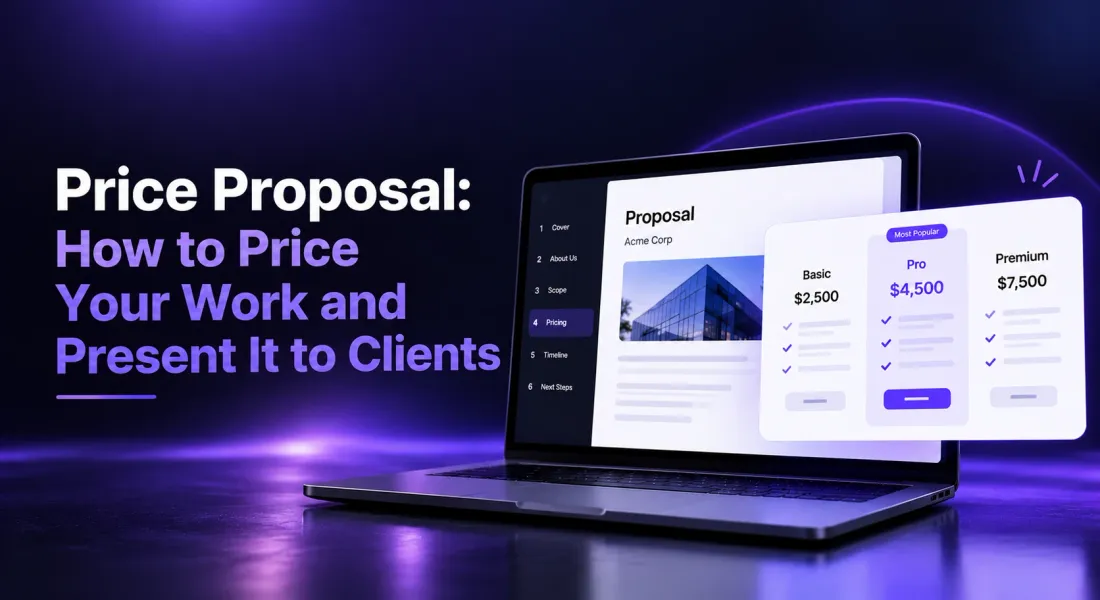
Price Proposal: How to Price Your Work and Present It to Clients
To price a proposal, choose a pricing model that fits the work, set a number that covers your costs and reflects the value to the client, then present two or three options that make the decision easy. A strong price proposal explains what the client pays, what they get and why it is worth it.
Pricing is where most proposals are won or lost. The work can be excellent, but if the price arrives as an unexplained total on the last page, the client compares it with the cheapest quote they have and the conversation becomes about cost instead of outcome.
Freelancers and agency owners talk about pricing more than almost anything else, and the same questions keep coming up: hourly or fixed? What do I say when a client asks my rate on the first call? What happens when the scope grows? This guide answers those questions with practical methods, not theory.
It covers how to charge customers for services, a method for answering “how much do I charge?”, how to present pricing to a client, how to explain flat rate pricing, how to handle negotiation, and a price proposal example you can adapt.
How to Charge Customers for Services: 5 Pricing Models
Before you work out a number, choose how you will charge. The model shapes how the client perceives the price as much as the number itself.
| Model | How it works | Best for | Watch out for |
|---|---|---|---|
| Hourly | Client pays for hours worked at an agreed rate | Unclear scope, ongoing support | Clients watching the clock; no reward for working faster |
| Day rate | Fixed price per day of work | Workshops, audits, on-site work | Days that run long without extra pay |
| Fixed or flat rate | One price for a defined scope | Projects with clear deliverables | Scope creep if the scope is vague |
| Retainer | Monthly fee for ongoing work or access | Ongoing marketing, advisory, support | Unused hours causing resentment on either side |
| Value-based | Price tied to the value of the outcome | High-impact work with measurable results | Needs solid data on the client’s numbers |
Build branded price proposals with clear pricing tables. Create your first proposal free.
Hourly and Day Rates
Simple to explain and fair when the scope is genuinely uncertain. Many freelancers argue hourly is the only safe option for poorly defined or custom work, because it guarantees your minimum rate however much the project grows.
The downside is that you are paid for effort, not results. Clients tend to focus on how many hours you log, and you earn less the faster and better you get.
Fixed or Flat Rate Pricing
One price for a clearly defined result. Clients like the certainty, and you benefit when you work efficiently.
It only works when the scope, revisions and exclusions are written down. The flat rate is a promise about a defined piece of work, not an open-ended commitment, and the proposal has to say so.
Retainers
A monthly fee for ongoing work, set out in a retainer agreement. Retainers smooth your income and give clients predictable costs.
Define what the fee covers each month and what happens to unused time. Unclear retainers are a common source of friction: the client feels they paid for hours they did not use, or you feel they are asking for more than the fee covers.
Value-Based Pricing
The price reflects what the outcome is worth to the client rather than what it costs you to deliver. It needs a good discovery conversation and real numbers from the client.
Consultants who use it often present it in tiers: one option that does exactly what was asked, and higher options that deliver more of the outcome. Our guide to value-based selling in proposals explains how to build the case.
How Much Do I Charge? A 4-Step Method
“How much do I charge?” is the question behind most price proposals. There is no universal answer, but this method gives you a defensible number every time, and it is close to how many experienced freelancers actually price.
1. Calculate Your Floor
Work out the minimum you must charge: the hours or days involved, multiplied by a rate that covers your salary or target income, overheads, tools, taxes and the time you cannot bill.
Below this number, the project loses money. Knowing it stops you discounting into a loss when a client pushes back.
2. Add a Buffer for the Unknown
Estimates are almost always optimistic. A common rule of thumb in freelance communities is to estimate the hours, multiply by your rate, then add around 20% to cover meetings, revisions and the surprises every project brings.
If the deadline is unusually tight, add a rush premium on top. Compressing the work has a real cost to your other clients and your evenings.
3. Check the Market Range
Look at what comparable providers charge for similar work in your market. You do not need to match them, but you should know whether you are at the bottom, middle or top, and be able to say why.
4. Estimate the Value to the Client
Ask what the result is worth: extra revenue, hours saved, costs avoided. If a project saves the client a meaningful amount every year, a price that is a fraction of that is easy to justify.
Then adjust for scope risk and relationship. Consider a lower first project only if it genuinely leads to more work, and say so in the proposal so the next price is not a surprise.
Worked example (illustrative figures): a website project is estimated at 10 days. At a day rate of $800, that is $8,000, and a 20% buffer brings it to $9,600, your floor. Comparable agencies charge $10,000 to $18,000. The client expects the new site to bring in several extra enquiries a month. A fixed price of $14,000 sits in the market range, clears your floor comfortably and is small next to the value. That becomes your recommended option.
What to Say When a Client Asks Your Rate Early
One of the most common pricing questions in freelance forums is what to do when a client asks “what’s your rate?” on the first call, before you understand the project.
Giving a single number too early anchors the conversation on cost before you have discussed value. Refusing to answer looks evasive. The middle path is a range tied to the type of work, followed by a question.
“Projects like this usually land between [low] and [high], depending on [the main variable, such as number of pages or integrations]. To give you an accurate figure, can I ask a few questions about what you need? And is there a budget range you are working within?”
This avoids price shock later, because the proposal confirms a number the client has already heard. It also tells you early if the budget is nowhere near what the work needs, which saves you writing a proposal that was never going to land.
How to Present Pricing to a Client
How you present a price changes how it is received. These six principles cover how to present pricing to client stakeholders in a way that keeps the conversation on value.
Lead With the Outcome, Then the Price
Put the price after the client’s goals and your approach, never before. By the time they see the number, they should already know what it buys.
A price read straight after the client’s goals feels like an investment. The same price read before any context feels like a cost.
Offer Two or Three Options
Options let the client choose how to say yes instead of whether to say yes. A common structure is a lean option, a recommended option and a premium option, each with a clear difference in scope or outcome.
Make the differences meaningful. Three options that differ only by a few hours feel like a sales trick.
Put Your Recommended Option in the Middle
Most buyers avoid the extremes. Place the option you believe is right for them in the middle and label it as your recommendation, with one sentence explaining why.
Be honest about why it is recommended. A one-line reason tied to the client’s goal makes the recommendation feel like advice, not upselling.
Break the Price Into Understandable Parts
Show what each phase or deliverable costs, or how the total is made up. A breakdown makes the price feel earned rather than arbitrary.
Keep it at phase level. A line-by-line breakdown of hours invites the client to negotiate each line individually.
State What Is Not Included
Exclusions prevent disputes and make the comparison with cheaper quotes fair. If another quote leaves out testing or revisions, your list shows it.
Exclusions also protect the relationship later. When a request comes in that was excluded, you can point to the proposal instead of having an awkward conversation.
Add Payment Terms and a Validity Date
Say when payments are due, in how many instalments, and how long the price is valid. A validity date also gives the client a natural reason to decide.
Be clear about whether your figure is fixed or can change. A quote is binding for its validity period, while an estimate can change as the work becomes clearer. This breakdown of the difference between an estimate and a quote explains when to use each.
Present pricing options in a branded proposal your client can sign and pay from. Start free.
How to Explain Flat Rate Pricing to a Customer
Clients used to hourly billing sometimes distrust a single number, and freelancers often report clients asking for an hourly breakdown of a fixed price. Knowing how to explain flat rate pricing to a customer comes down to three points: what the price covers, why it protects them, and what happens if the scope changes.
“This is a flat rate of [amount] for [defined result]. It covers [deliverables], [number] rounds of revisions and [support period]. You will not be billed for extra hours if the work takes us longer than planned; that risk sits with us. If you ask for something outside this scope, we will quote it separately before doing it, so there are never surprises on the invoice.”
The message reframes the flat rate as protection for the client: a fixed budget, no clock-watching, and a clear process for changes.
If a client insists on an hourly breakdown, you can share the estimated effort per phase without committing to hours. The price stays fixed; the breakdown simply shows it is grounded in real work.
What to Include in a Price Proposal
Use this checklist for the pricing section of any proposal. When the numbers are the whole document, see how to write a financial proposal instead.
• A short summary of the client’s goal and the outcome the price delivers
• The pricing model and why you chose it
• Two or three options with clear differences in scope
• A breakdown by phase or deliverable
• What is included and what is excluded
• Payment terms, schedule and accepted methods
• Validity date for the price
• How changes to scope will be priced
• A clear next step, such as signing to accept an option
Price Proposal Example
Here is how the pricing section of a website redesign proposal can look. Figures are illustrative.
| Essentials | Growth (recommended) | Complete | |
|---|---|---|---|
| Price | $9,500 fixed | $14,000 fixed | $21,000 fixed |
| Pages | Up to 8 | Up to 15 | Up to 25 |
| Design rounds | 1 | 2 | 3 |
| Copywriting | Client supplies | Key pages written | All pages written |
| Launch support | 2 weeks | 30 days | 90 days |
| Best for | A fast refresh | Growing enquiries from the site | A full rebrand and launch |
Below the table, the proposal would state payment terms (for example, 40% to start, 40% at design approval, 20% at launch), exclusions, the validity date and how extra pages are priced.
Notice that each option changes the outcome, not just the effort. The client is choosing how much of the result they want, which is a far easier conversation than haggling over hours.
Large projects sometimes work better split into phases, each priced and approved separately. This guide to a multi-phase proposal strategy explains when that helps.
How to Handle Price Objections and Negotiation
Price pushback is normal, and handling it well often wins the deal. The key principle, repeated across freelance and sales communities, is simple: never cut the price without cutting the scope.
”It Is More Than We Expected”
Ask what they expected and what that figure was based on. Then either show what the gap buys or offer a smaller option.
Often the gap comes from a different scope in their head. Clarifying it can resolve the objection without any change in price.
”Another Supplier Is Cheaper”
Compare scope, not totals. Walk through what is included in your price that the other quote leaves out, such as revisions, testing or support.
If the scopes really are the same, decide whether you want to compete on price. Many experienced freelancers would rather lose that deal than set a low anchor for the relationship.
”We Need to Think About It”
Ask what they need to think through and who else is involved. Often the real concern is internal approval, which you can help with by providing a short business case.
Agree a date to reconnect before the call ends. “Shall we speak again on Thursday once you have discussed it?” keeps the decision moving instead of leaving it open-ended.
When Hard Negotiation Is a Warning Sign
A view you will see often in freelance forums: clients who push hard to lower your rate before work starts tend to push hard on everything else too, from scope to payment terms. Not every negotiation is a red flag, but aggressive haggling at the start is worth noting before you commit.
How to Build and Send a Price Proposal Faster
Proposal.biz pulls your services and prices from your content library, so pricing is consistent across every proposal. The drag-and-drop proposal builder includes pricing blocks for options and breakdowns, and the client reads the proposal as a link on any device.
When the client chooses an option, they sign inside the same document. Signing records the signed status and date, and both parties receive a confirmation email. Payment collection through payment integration lets them pay the deposit at the point of signing.
For smaller jobs, you can create and send quotes from the same library instead of a full proposal.
Final Word on Writing a Price Proposal
A good price proposal is not about finding the lowest number the client will accept. Choose the model that fits the work, set a price that clears your floor with a buffer, share a range early so there is no shock, and present options tied to outcomes, with clear terms and exclusions. Review your prices every year, and raise them for new clients first.
Then watch how the client engages with it. With document analytics and engagement tracking, you can see whether they reached the pricing section and came back to it. If they did and went quiet, they probably have a question, and a quick call beats a discount.
FAQs About Price Proposals
What Should a Price Proposal Include?
The pricing model, two or three options, a breakdown by phase or deliverable, inclusions and exclusions, payment terms, a validity date, how scope changes are priced and a clear next step.
How Do I Decide How Much to Charge for a Service?
Calculate the minimum that covers your costs and target income, add a buffer of around 20% for the unexpected, check what comparable providers charge, and estimate what the outcome is worth to the client.
What Should I Say When a Client Asks for My Rate on the First Call?
Give a range for that type of work, explain what drives the price up or down, and ask about their budget. It avoids price shock later without committing to a number before you understand the project.
Is Flat Rate Pricing Better Than Hourly?
For projects with a clear scope, flat rate pricing often suits both sides: the client gets a fixed budget and you benefit from working efficiently. Hourly pricing suits work where the scope is genuinely unknown.
Should I Lower My Price if the Client Pushes Back?
Lower the scope, not the price. Offering a smaller option keeps your rate intact and lets the client choose what fits their budget.

Ronak Surti

 Ronak Surti