Table of contents13 RFP Response Mistakes that most businesses overlook
Key takeaways
- Answer the question that was asked, not the one you want to answer, even when it is tempting to steer toward your strengths.
- Address implicit concerns, because not every concern a client has is spelled out in black and white.
- Remove internal jargon and acronyms and use one term for each thing, since inconsistent terminology quietly undermines credibility.
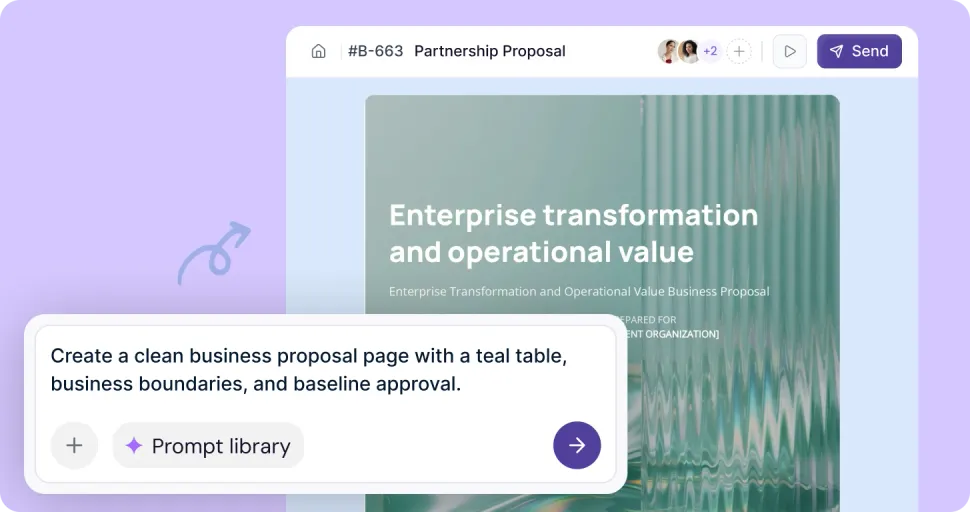
- Proposal.biz helps with consistency by drafting and designing the RFP response in your brand style, and Document Chat can adjust tone across sections.
- Use visual hierarchy, because a wall of text is exhausting to read without headings or bullets.
- Tailor the executive summary to the client, and map each requirement directly to your solution instead of staying vague.
- Respond directly to the evaluation criteria, remove metadata and tracked changes before you send, and state your pricing assumptions clearly.
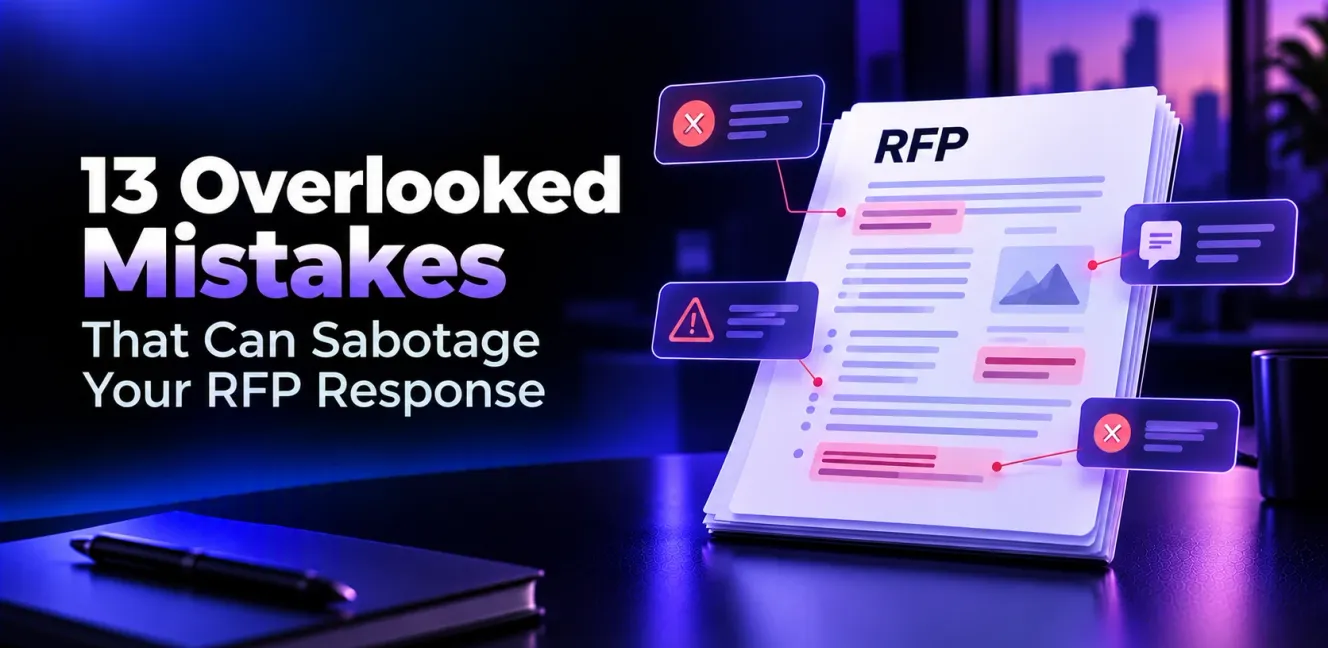
Responding to an RFP (Request for Proposal) takes serious time, energy, and coordination. Teams strategize, pull in experts, gather case studies… and still lose. Why? Because sometimes it’s not about what you say, but how you say it, or what you accidentally miss.
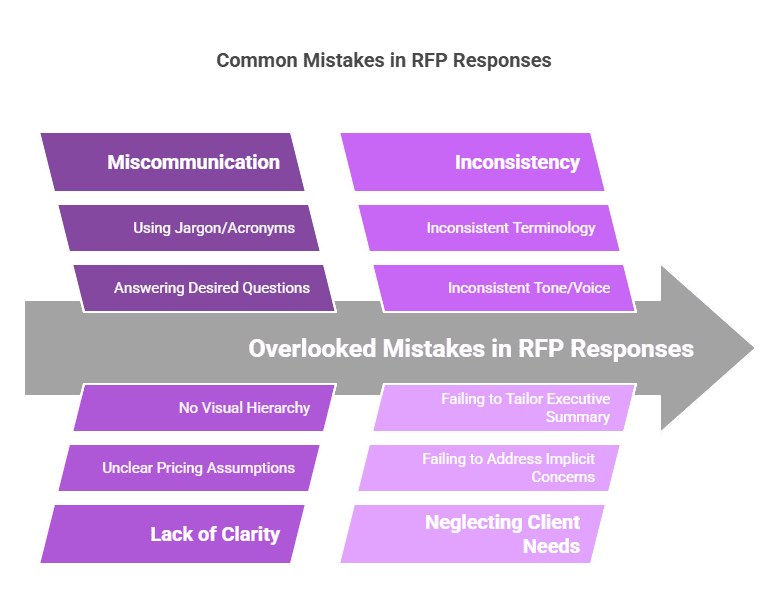
Here are 13 overlooked mistakes in RFP response that can quietly sabotage your chances of winning. These pitfalls in RFP response are more subtle but just as dangerous. Avoiding them could improve your RFP response proposal and strengthen your RFP proposal strategy.
13 RFP Response Mistakes that most businesses overlook
1. Answering the Question You Want to Answer
It’s easy to get excited about your strengths and steer your answer in that direction, even when it doesn’t quite match what was asked.
For instance, if the RFP asks how you handle post-launch support, and you end up talking about how your product uses the latest AI tech, that’s a mismatch.
Even if what you’re saying is impressive, it’s not answering the question. Evaluators are looking for specific, relevant information. Going off-topic makes them work harder, and that’s not what you want.
2. Failing to Address Implicit Concerns
Not every concern a client has will be spelled out in black and white. Sometimes an RFP is asking very detailed questions about onboarding, or change management, or training, and that’s a clue.
Maybe they’ve had a bad experience in the past. Maybe they’re nervous about adoption. Ignoring these underlying fears or avoiding reassurance can make your response feel tone-deaf.
Showing that you understand their deeper concerns, even if they’re only hinted at, can make a huge difference and help you avoid common RFP response mistakes.
3. Using Internal Jargon or Acronyms Without Clarification
Every company has its own internal shorthand, but your RFP audience might not speak your language.
Throwing in acronyms or terms that only your team uses can create confusion and even frustration. If a reviewer doesn’t understand what you’re saying, they’re not going to stop and decode it. They’ll just move on.
Always write like the reader has no context. Simple, clear language wins every time.
4. Inconsistent Terminology
Using three different words to describe the same thing can quietly undermine your credibility.
For example, if one part of your proposal says “platform,” another says “solution,” and a third says “tool,” the evaluator might wonder if you’re talking about different things, or if you just didn’t catch the inconsistency.
It’s a small detail, but it makes your proposal harder to follow and can make you seem less organized. This type of inconsistency is one of the pitfalls in RFP response that can impact your chances.
5. Inconsistent Tone or Voice Across Sections
This usually happens when multiple people contribute to a proposal and no one takes a final pass to unify everything.
One section might sound super formal, another might be casual and chatty, and another might read like a marketing brochure.
The result? A proposal that feels disjointed and uneven. Even if the content is strong, inconsistency in tone can make it feel like the team wasn’t aligned, or worse, rushed.
6. No Visual Hierarchy
A wall of text is exhausting to read. If your proposal is just paragraph after paragraph without headings, bullets, or any formatting to break things up, it becomes difficult to scan, and evaluators do scan.
They don’t read every word, at least not at first. If nothing stands out, you’re making their job harder, which can backfire.
Clear formatting helps them find what they’re looking for quickly, and keeps their attention on you.
7. Failing to Tailor the Executive Summary to the Client
The executive summary is one of the most important parts of the proposal.
And yet, a lot of teams treat it like a generic intro to their company. They talk about themselves (how long they’ve been in business, what they offer, how innovative they are), but never bring it back to the client.
This section should highlight the client’s goals, pain points, and how you can help. Neglecting this can lead to RFP response mistakes that make it harder to connect with the evaluator.
8. Not Clearly Mapping Requirements to Solutions
Being vague or overly general is a common trap. If a client asks, “How do you ensure data security?” and the answer is, “Our platform is built with top-tier security in mind,” that’s not enough.
It’s too broad, too abstract. Evaluators want to see clear connections between what they asked for, what you’re delivering, and what value it brings.
Make it obvious. Spell it out. The clearer you are, the easier it is for someone to give you points.
9. Assuming Evaluators Know Your Reputation or Market Position
Just because you’re a well-known name in your industry doesn’t mean the person reviewing your proposal knows who you are, or why they should care.
Even if they’ve heard of your company, they still want to see why you’re a fit for this particular project. Relying on reputation instead of showing real proof (metrics, examples, outcomes) is risky.
Every claim should be backed up. Don’t make them assume; show them.
10. Overuse of Marketing Fluff
We’ve all seen it: “We’re the world’s leading provider of cutting-edge solutions with unparalleled service.”
That kind of language might sound good in a brochure, but in an RFP response, it can work against you. Evaluators are looking for substance, not slogans.
They want clarity, honesty, and proof. Overusing buzzwords can lead to pitfalls in RFP response, making your proposal seem vague or insincere, and ultimately hurt your chances.
11. Failing to Address Evaluation Criteria Directly
When an RFP includes scoring criteria, it’s basically handing you a map to win. Ignoring it (or not matching your response clearly to the criteria) is a huge miss.
Evaluators are literally checking boxes. If they can’t easily find what they need to score you high, you probably won’t get the points.
Structuring your responses so they mirror the evaluation framework helps them find answers fast, and improves your score.
12. Submitting with Metadata or Tracked Changes
It’s the kind of thing that slips through the cracks. You export your final document, hit send, and then realize you left tracked changes on, or that the metadata shows internal comments, file versions, or author names.
It’s not just sloppy. It can actually make you look unprofessional or careless.
Always clean your file before submission. It’s a tiny step that says, “We pay attention.”
13. Unclear Pricing Assumptions
Your pricing might look good on paper, but if it’s not clear what’s included, or what’s not, it can raise red flags.
Ambiguity around pricing can create doubt or leave evaluators wondering about hidden costs, which an itemised price quote avoids. That uncertainty can hurt your proposal, even if your numbers are competitive.
Be transparent, break things down clearly, and list assumptions. This avoids mistakes in RFP submissions and builds trust, showing you’re not trying to hide anything.
Wrapping It Up
Winning an RFP isn’t just about being the best fit. It’s about showing that you’re the best fit. And that takes clarity, strategy, and attention to the details that most people overlook.
So next time you’re assembling a proposal, keep an eye out for these sneaky mistakes. A few simple tweaks can move your response from good… to the one that wins.