

Table of Contents
GTM Tech Stack 2027: 7 Layers and 13 Tools for an AI-First Go-to-Market Team
A GTM tech stack is the connected set of software a company uses to find buyers, manage customer data, act on buying signals, run sales and marketing, close deals and measure what worked. In 2027 the interesting part is no longer which tools exist. It is how well they hand context to each other.
AI changed both sides of the table. G2’s March 2026 buyer survey (1,076 respondents) found that 51% of B2B software buyers now start research with an AI chatbot more often than with Google, and 71% use chatbots somewhere in their software research. Sellers got the same speed-up: account research, enrichment, outreach drafts and call summaries all take minutes instead of hours.
That did not make go-to-market simple. It moved the bottleneck. Finding a prospect is cheap now. Earning a decision from a buying group still takes evaluation, internal alignment, finance scrutiny and sign-off.
So the best GTM stack is not the one with the most AI tools. It is the one where each layer gives the next layer better information.
This guide breaks the stack into seven layers, compares two tools in each (13 in total, because layer 6 is a single tool), and shows what a startup, a scaling team and an enterprise typically need. A note on bias: we make Proposal.biz, which appears in layer 6, so weigh that section accordingly. The other tools are examples, not a ranking, and we have no relationship with them.
What is a GTM tech stack?
A GTM tech stack, or go-to-market technology stack, covers every system between “we think this account might care” and “they signed and we can measure why.” It is broader than a sales tech stack. A sales stack supports what reps do: prospecting, outreach, calls, proposals, closing. A GTM stack adds marketing, customer data, RevOps and measurement around the same buyer.
A complete B2B stack can be read as seven layers:
- System of record
- Context and customer data
- Signals and enrichment
- AI agents and execution
- Deliverability infrastructure
- Buyer-facing deal execution
- Governance and measurement
The tools vary by company. The architecture matters more than the logos.
The GTM tech stack for 2027 at a glance
| Layer | What it solves | Tools covered |
|---|---|---|
| 1. System of record | Keeps accounts, contacts, deals and pipeline consistent | HubSpot, Salesforce |
| 2. Context and customer data | Gives people and AI richer customer context across systems | Hightouch, Twilio Segment |
| 3. Signals and enrichment | Shows which accounts matter and why now | Clay, Apollo |
| 4. AI agents and execution | Turns signals into research, outreach and follow-up | Regie.ai, Artisan |
| 5. Deliverability infrastructure | Protects sending infrastructure and sender reputation | Instantly, Smartlead |
| 6. Buyer-facing deal execution | Turns deal context into proposals, evaluation and signature | Proposal.biz |
| 7. Governance and measurement | Explains conversations, buyer journeys, pipeline and revenue | Gong, HockeyStack |
You do not need all 13. The goal is to make the handoffs between layers reliable.
What changed in GTM after AI?
The old motion was fairly linear. Marketing generated demand, SDRs built lists and researched prospects, reps ran outreach, qualified deals landed in the CRM, someone eventually wrote a proposal, and RevOps tried to attribute the revenue afterward.
AI compressed several of those steps at once. Account research that took a person 20 minutes can run automatically. Enrichment pulls from many sources. Drafts, call summaries and suggested next steps appear on their own. Buyers gained the same advantage: they can use AI to learn a category, build a shortlist and compare vendors before a rep is involved.
So the question changed. It is no longer “which AI tool should we add?” It is “how should data, people and agents work together from the first buying signal to the signed deal?”
Layer 1: System of record (HubSpot vs Salesforce)
What does the system of record do?
It stores the commercial truth: accounts, contacts, opportunities and pipeline. An AI agent can write a great email, but if it does not know that another rep contacted the account yesterday, or that procurement asked for revised pricing, the email is worse than useless. AI makes a reliable CRM more important, not less.
HubSpot
HubSpot suits teams that want records, sales activity, marketing and workflows close together. The appeal is accessibility: a growing B2B company can run contacts, deals, pipelines and automations without a big CRM administration function.
The trade-off shows up with complexity. Heavily customized objects, elaborate territories or unusual enterprise processes can outgrow it.
Salesforce
Salesforce is the more configurable option for sophisticated sales operations. Its strength is extensibility: custom objects, permissions, forecasting and processes built around your own structure. Its Agentforce products also bring AI agents closer to the data already in the CRM.
The cost is operational weight. Larger Salesforce setups usually need more administration, implementation work and RevOps support than a small team can spare.
HubSpot vs Salesforce: HubSpot generally fits teams that want speed and simpler setup. Salesforce becomes more compelling as customization, permissions and enterprise complexity grow.
Whichever you pick, check what happens downstream. Once a deal reaches the proposal stage, company and contact details should flow forward instead of being retyped. Our guide to integrating proposal software with CRM systems covers what to look for.
Layer 2: Context and customer data (Hightouch vs Twilio Segment)
Why does an AI GTM stack need a context layer?
A CRM tells you a lot about an account, but rarely everything. Product usage may live in a warehouse, website behavior in analytics, billing in Stripe and support conversations somewhere else. Reps and AI agents both make better decisions with the fuller picture.
Hightouch
Hightouch is built around the data warehouse. It syncs warehouse data into marketing and sales tools, so the warehouse stays the source of truth instead of another application owning your customer data. Its site now also pitches an AI-assisted marketing platform on top of that composable CDP, but the warehouse-first idea is the core.
The catch is maturity. An early-stage SaaS company whose data mostly sits in HubSpot, Stripe and its product database may be solving an infrastructure problem it does not have yet. It pays off once there is a warehouse worth building around.
Twilio Segment
Segment, now part of Twilio, comes at the problem from the collection side. It gathers first-party events from websites and apps, unifies them into customer profiles and routes them to the tools that need them.
Its strength is consistency. Instead of each tool interpreting “trial started” or “pricing page viewed” differently, you define events once. The limit is that infrastructure does not fix bad definitions. If product, marketing and sales disagree about what “activated” means, Segment will distribute the wrong answer very efficiently.
Hightouch vs Segment: Hightouch makes sense when warehouse data already sits at the center. Segment helps most when collecting and standardizing behavioral data is the harder problem.
Layer 3: Signals and enrichment (Clay vs Apollo)
What does this layer do?
It answers two questions: who deserves attention, and why now. Static filters like industry, size and job title still matter, but teams now layer on funding, hiring, technology changes, website activity, job moves and custom research.
Clay
Clay is the clearest example of GTM becoming programmable. It positions itself as GTM infrastructure: a marketplace of data providers, waterfall enrichment that tries several sources in turn, AI research agents and a visual workflow canvas. A team can find companies matching its ICP, check hiring activity, find decision-makers and use AI to judge whether an account deserves outreach.
That flexibility is also the cost. Someone has to build the workflows, choose providers, watch usage and decide which signals matter. For a growth team or a GTM engineer that is a feature. For a small sales team that just wants a contact list, it can be more system than needed.
Apollo
Apollo is the more packaged route. Its site describes a large contact and account database plus AI agents, buying signals and outreach in one place, and it also includes sending features such as domain warming and inbox rotation. That makes it quick to go from “this looks like our buyer” to “we contacted the right person.”
The trade-off is customization. You work mostly within Apollo’s model. Clay becomes more attractive when your ICP needs unusual research or data from several sources.
Clay vs Apollo: Choose Clay when you want to customize the research itself. Apollo is usually simpler when you want data, signals and outreach in one predefined environment.
Layer 4: AI agents and execution (Regie.ai vs Artisan)
Where do AI agents fit in a GTM stack?
Signals tell you something happened. The execution layer decides what to do about it: research the company, find the right person, draft outreach, follow up, and hand the conversation to a human at the right moment.
Regie.ai
Regie.ai sells RegieGO, which it calls an agentic sales workspace. It combines prompt-driven sourcing, ranking, messaging, call prep and a power dialer across email, LinkedIn and phone. It is aimed at reps and founders who want to run their own pipeline faster, with calls queued up for the person to make.
Its limit is scope. It handles execution, not your CRM, customer data, deliverability or buyer-facing documents. Its public pages also say little about review steps, so ask in a demo how much of the output a person checks before it goes out.
Artisan
Artisan goes further toward delegation. Its AI BDR, Ava, is pitched as finding leads, enriching them, sending personalized messages and booking meetings, with a built-in contact database and Salesforce and HubSpot integrations.
The efficiency potential is obvious, and so is the risk. An autonomous agent amplifies whatever sits underneath it. Weak targeting, bad account data or thin messaging get executed at scale just as easily as good processes. Delegation works best once your ICP, exclusions, messaging and handoff rules are written down.
Regie.ai vs Artisan: Regie.ai is built around a rep who works alongside AI. Artisan is closer to handing a larger share of outbound to an AI BDR. Both are moving toward more autonomy, so compare current demos rather than last year’s reviews.
Layer 5: Deliverability infrastructure (Instantly vs Smartlead)
Why does deliverability need its own layer?
AI can produce thousands of personalized emails far faster than a team can write them. Mailbox providers still decide whether anyone sees them.
Google’s sender rules are specific. A bulk sender, meaning roughly 5,000 or more messages a day to personal Gmail accounts, must authenticate with SPF, DKIM and DMARC, support one-click unsubscribe on marketing mail, and keep its user-reported spam rate below 0.1%. A rate of 0.3% or higher makes a sender ineligible for mitigation. Smaller senders should still authenticate their domains. In short, AI raises how much you can send much faster than it raises your sender reputation.
Instantly
Instantly focuses on cold-email campaigns and the infrastructure around them: sending accounts, warmup, inbox placement checks and deliverability tools. It has grown into a broader sales engagement platform, with a lead database, AI reply and outreach agents and a lightweight CRM.
Its limit is that none of this fixes targeting. No deliverability tool can offset irrelevant outreach for long.
Smartlead
Smartlead covers similar ground with heavy emphasis on infrastructure. It supports unlimited sending accounts, a warmup engine, sender rotation and dedicated infrastructure options, and it is popular with agencies that manage many client domains from one account.
The trade-off is complexity. A team running small, highly targeted outbound may not need that much machinery.
Instantly vs Smartlead: Both belong in this layer. The useful question is which fits your sending operation, such as one company versus many client domains, not which promises more email volume.
Layer 6: Buyer-facing deal execution (Proposal.biz)
Where does proposal software fit in a GTM stack?
A lot of GTM technology is optimized for getting a meeting. A meeting is not revenue. Once an opportunity turns serious, the buyer needs to understand the solution, check the business case, review pricing, involve other stakeholders and get a yes inside their own company.
That is why proposal software belongs in the stack. It is where what the GTM system learned becomes something a buying group can actually evaluate. (We make Proposal.biz, so treat this section as one vendor’s view.)
Proposal.biz
Proposal.biz is an AI proposal, SOW and document builder. You can draft from a prompt or a website URL, start from 100+ templates, keep your brand and reusable company content in one library, and send documents that buyers can e-sign. E-signatures are on every plan, and there is a free plan to try it.
Where it connects to the rest of the stack:
- CRM: the HubSpot integration is live. It syncs contacts and deals, fills documents with that data and pushes signed contracts back. CRM sync is part of paid plans, and Salesforce is listed as upcoming, so check the integrations page and the pricing page for your setup. Our guide to proposal software with CRM integration explains why depth matters more than a logo on a page.
- Drafting: AI gets you a first draft, but a proposal is more than text. The difference between generating copy and running a proposal workflow is covered in why ChatGPT, Gemini and Claude cannot replace a proposal tool and in our comparison of ChatGPT vs Claude for proposal writing.
- Engagement: once a proposal is sent, it produces signals of its own. Did the buyer open it? Did someone new view it? On the Professional plan, per-section heatmaps show which parts got attention. Our guide to tracking proposal engagement shows how to use that in follow-up.
- Signature: the buyer signs in the same document, and the signed status and date show up for the seller. See e-signatures.
Other tools can fill this layer too: a general proposal platform, a document tool, even a well-managed set of templates in your CRM. The point is that the layer exists and is owned by someone.
What should actually go into the proposal?
Software does not rescue a weak business case. A useful proposal explains the buyer’s situation, desired outcomes, recommended solution, scope, timeline, pricing, proof and next step. Our sales proposal writing guide walks through the process, and The Anatomy of a Winning Proposal goes deeper on problem framing, proof and pricing. If you want AI to write the first draft, follow the step-by-step guide to writing a proposal using AI, or start from the professional business proposal template or the wider template library.
The job of this layer is simple: turn everything the GTM system knows into something the buying group can evaluate and act on.
Layer 7: Governance and measurement (Gong vs HockeyStack)
How do you know whether the stack works?
AI increases activity. Activity is not revenue. More emails, more meetings and more proposals are not automatically success. The last layer explains what happened to the buyer and whether GTM work influenced pipeline and revenue.
Gong
Gong works from customer interactions. It now describes itself as a revenue AI platform: it analyzes conversations and deal activity, supports forecasting and engagement, and runs agents for follow-ups and pipeline updates. A CRM can show that a deal changed stage. Conversation intelligence can show why: a new stakeholder, an objection, a pricing challenge, procurement joining the call.
Its perspective is the sales conversation and the active deal. It is not a full marketing attribution tool.
HockeyStack
HockeyStack looks at the wider journey. It unifies marketing, product and sales data, and offers buyer-journey views and multi-touch attribution from the first anonymous visit through closed-won. That helps answer which channels appear before qualified pipeline and which content reaches target accounts.
Like every attribution product, the output is only as good as the inputs: tracking coverage, identity resolution, CRM hygiene and the model’s assumptions.
Gong vs HockeyStack: Gong gives deeper context on sales conversations and live deals. HockeyStack gives a broader view of the marketing and sales journey around pipeline and revenue.
What does an AI-first GTM workflow look like?
Take one example: Clay, then HubSpot, then Regie.ai, then Instantly, then Proposal.biz, then HockeyStack.
Clay finds and researches the account. HubSpot keeps the long-term customer and deal record. Regie.ai helps run prospecting. Instantly handles sending infrastructure. When the account becomes a qualified opportunity, Proposal.biz turns the deal details and your discovery notes into the proposal. HockeyStack connects the journey back to the marketing and sales activity that came before.
The vendors can change. What matters is that context does not reset at every handoff. If discovery shows that implementation risk is the buyer’s biggest worry, the proposal should address it. If the buyer rereads the implementation section after you send it, the next call should start there. If accounts with a certain signal convert better, targeting upstream should shift. That is what turns a pile of software into a system. Our post on sales and marketing alignment covers the people side of the same handoffs.
What is a good GTM tech stack for a startup?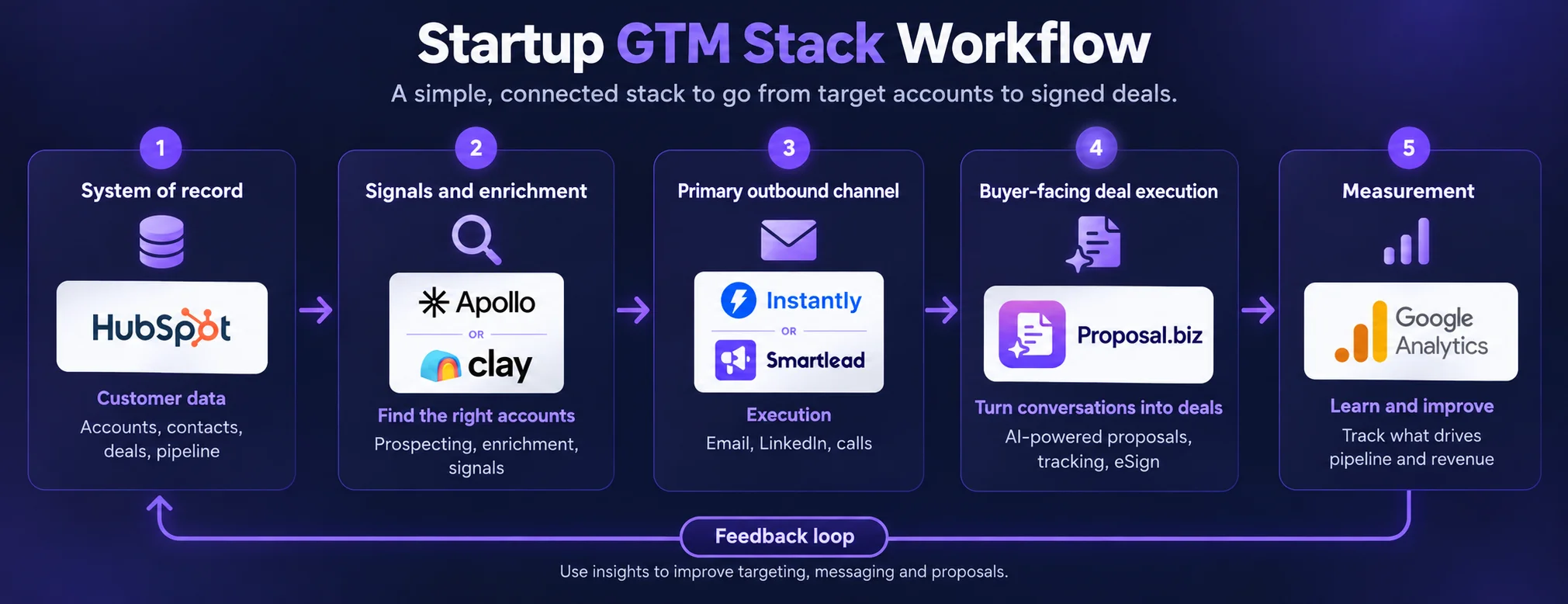 Early-stage companies rarely need seven platforms. A practical starting point is a CRM like HubSpot, a prospecting tool like Apollo or Clay, one main outbound channel, a way to send proposals, and basic analytics.
The priorities are plain: keep customer records clean, find the right accounts, build a repeatable prospecting motion, give qualified buyers a professional proposal and learn which activities lead to real opportunities. Adding warehouse infrastructure, enterprise conversation intelligence or several autonomous agents before those basics work adds complexity faster than revenue. For the proposal step, a template library beats rebuilding every document from scratch.
What does a scaling GTM stack look like?
As pipeline and headcount grow, specialization starts to pay: HubSpot, Hightouch, Clay, Regie.ai, Instantly, a proposal tool, and Gong or HockeyStack.
The challenge shifts from running the motion to keeping customer context consistent while marketing, SDRs, AEs, RevOps and AI systems all touch the same account. The buyer-facing layer becomes a repeatability problem too. Winning proposal structures, proof, pricing approaches and messaging should not be reinvented by every seller.
What does an enterprise GTM stack look like?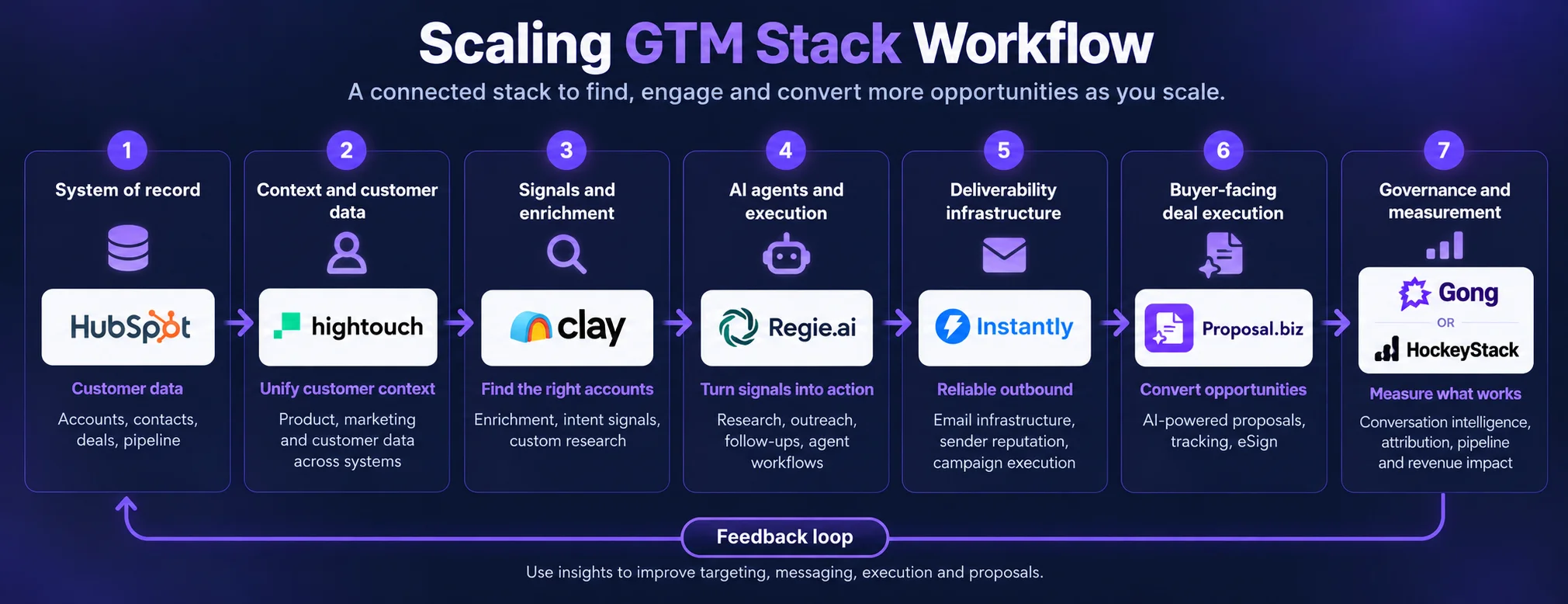 Enterprise stacks are more customized. Salesforce may be the system of record, a warehouse may feed Hightouch, several data providers may feed enrichment, agents may run inside strict permissions, and sending infrastructure may be split by region or business unit.
The number of products grows, but the seven jobs stay the same. That is useful, because it keeps architecture talks from turning into vendor talks too early. Decide what each layer must accomplish, then decide which product is necessary.
How should you choose GTM tools in 2027?
Start with the workflow, not the category. Map what happens from the first account signal to the signed deal, then look for the points where:
- customer context disappears
- people copy data between systems by hand
- the same manual work repeats every time
- AI agents lack reliable information
- buyers hit friction
- nobody knows whether an activity influenced revenue
Then fix the layer that actually hurts. A company with clean CRM data but weak prioritization needs better signals before another agent. A company that books plenty of meetings but loses deals during evaluation may gain more from fixing its proposal workflow than from doubling outbound volume. A company with many tools and inconsistent data needs a context layer, not another app.
Order matters because AI amplifies whatever sits underneath it. Automating a good workflow creates leverage. Automating a bad one creates noise.
The GTM stack is becoming a context architecture
The defining change is not that every product has an AI feature. It is that both sides of the transaction have AI. Buyers research faster, sellers research faster, agents find prospects and send outreach, calls become structured data, and proposals can be drafted from deal context.
When activity is abundant, context becomes the scarce thing. The strongest stack is not the one that produces the most activity. It is the one that preserves the right information as the buyer moves from discovery to evaluation to decision.
That is also why the buyer-facing deal layer deserves more attention than it used to get. AI can help you pick the right account and book the meeting. But if the proposal is generic, disconnected from discovery, hard for your champion to share internally or vague about pricing and outcomes, sophistication earlier in the funnel will not save the deal.
Frequently asked questions
What is a GTM tech stack?
It is the connected set of software a company uses to identify buyers, manage customer data, run sales and marketing, support buyer evaluation, close deals and measure revenue outcomes.
What should a GTM stack include in 2027?
Seven layers cover it: system of record, context and customer data, signals and enrichment, AI agents and execution, deliverability infrastructure, buyer-facing deal execution, and governance and measurement.
Where do AI agents fit in a GTM stack?
In the execution layer. They turn customer context and account signals into research, prioritization, outreach and follow-up. Their output is only as good as the layers beneath them.
Is Clay a CRM?
No. Clay handles enrichment, account research, signals and workflows. A CRM such as HubSpot or Salesforce normally remains the long-term system of record, because enrichment data changes often while the CRM keeps the commercial history.
Where does proposal software fit in the GTM stack?
In the buyer-facing deal-execution layer, after qualification. Everything before it helps the seller understand and reach the buyer. The proposal turns that into something the wider buying group can read, share, track and sign.
How many tools should a GTM stack have?
There is no ideal number. Ask of each tool: does it create information or action that clearly improves the next stage? If not, it may just be another subscription. A small stack with solid integrations beats a large one with broken handoffs.
How do you know your GTM stack has too many tools?
Customer data is duplicated across systems, reps keep switching apps, several tools solve the same problem, AI agents work from inconsistent data, or nobody can say which systems contribute to pipeline and revenue.

Ronak Surti

 Dimple Maru

 Prabir Chaudhary

 Ronak Surti